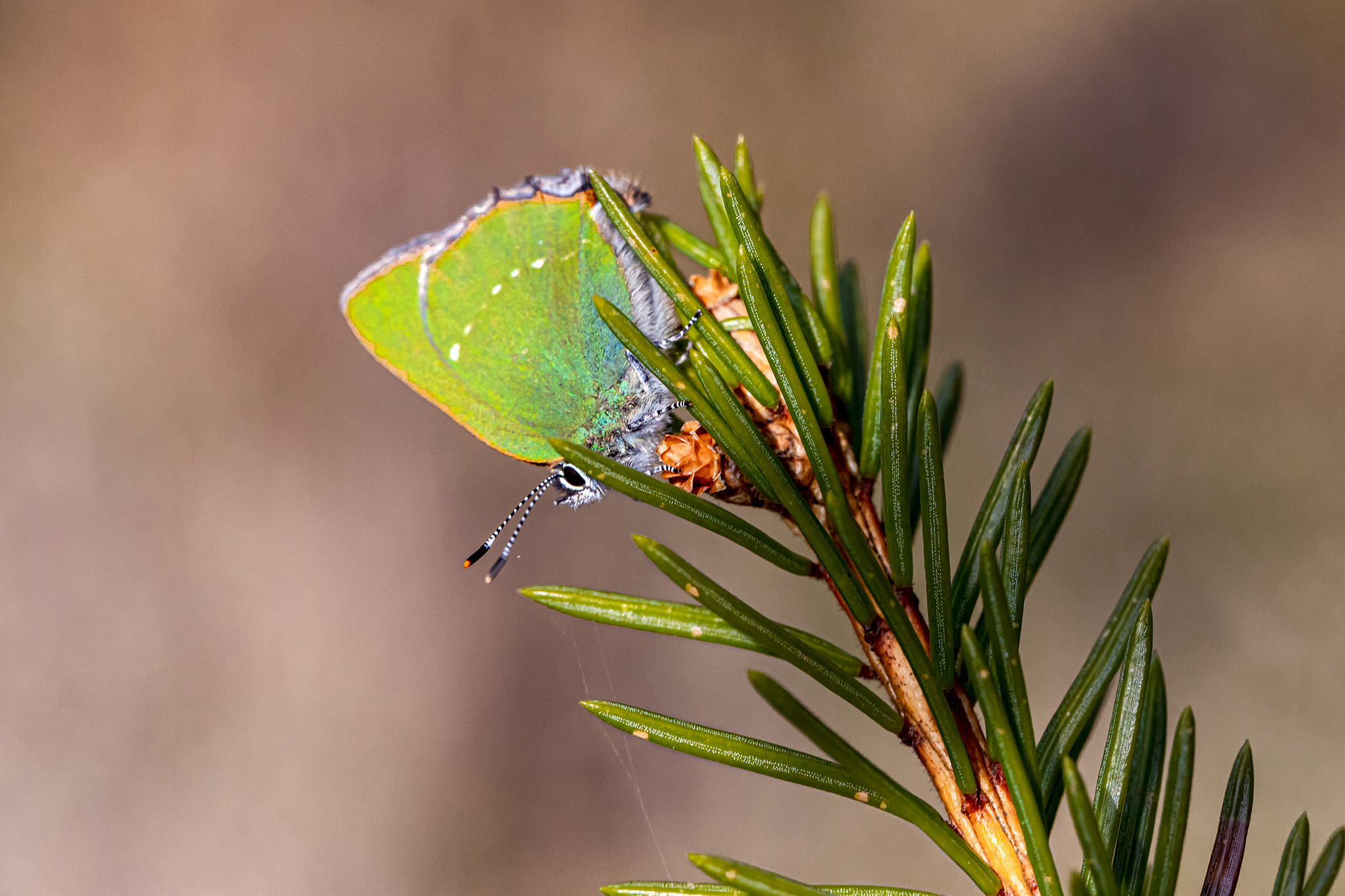

The Emerald of Spring: Discovering the Green Hairstreak (Callophrys rubi)
In the world of butterflies, true green is a rare and precious color. The Green Hairstreak (Callophrys rubi) is a master of disguise and a stunning “emerald jewel” that brings a splash of vibrancy to the early spring landscape across Europe, North Africa, and Asia.
Nature’s Master of Camouflage
The most enchanting feature of this butterfly is its brilliant green underside. Interestingly, this isn’t just a flat color; it is a subtle iridescence created by microscopic structures on its scales.
When it lands, the Green Hairstreak always sits with its wings tightly closed. This allows it to blend perfectly with the shimmering leaves of the spring foliage, making it nearly invisible to predators—and a rewarding challenge for wildlife photographers!
A Small but Mighty Presence
Don’t let its size fool you. Spanning only 2 to 3 centimeters, this tiny butterfly is a powerhouse of the meadows.
- The Upper Side: While the underside is a vivid green, the upper side of the wings (which you rarely see) is actually a somber brown.
- The Markings: Look closely for the delicate “hairstreak”—a thin, broken line of white spots on the hindwing that gives the species its name.
Habitat and Life Cycle
The Green Hairstreak is a specialist of the wild. It is most at home in open habitats such as:
- Heathlands and moors
- Gorse-covered hillsides
- Woodland edges and limestone grasslands
Its life cycle is intimately tied to host plants like Genista (Gorse) and Cytisus (Broom). As adults, they are vital pollinators, flitting from flower to flower to fuel their active lives with nectar.
A Note on Conservation
While the Green Hairstreak is currently widespread, it serves as a “bio-indicator.” Their presence often signals a healthy, biodiverse ecosystem. Protecting their varied habitats from fragmentation is key to ensuring that this emerald flash continues to brighten our springs.
Photographer’s Pro-Tip: Capturing the Green Flash
Because the Green Hairstreak is so small and well-camouflaged, it can be difficult to track.
- Look for “Perching” Behavior: Males are territorial and will often return to the same sunny leaf after chasing off a rival. If you see one fly away, wait a few minutes—it will likely come back to the same spot.
- Angle of Light: To capture the true iridescence of the green scales, try to position yourself so the sun is behind you or hitting the wings at a slight angle.
- Macro Focus: Use a shallow depth of field (low f-stop) to make that vibrant green pop against a soft, out-of-focus background.
Views: 157
Subscribe to the newsletter: