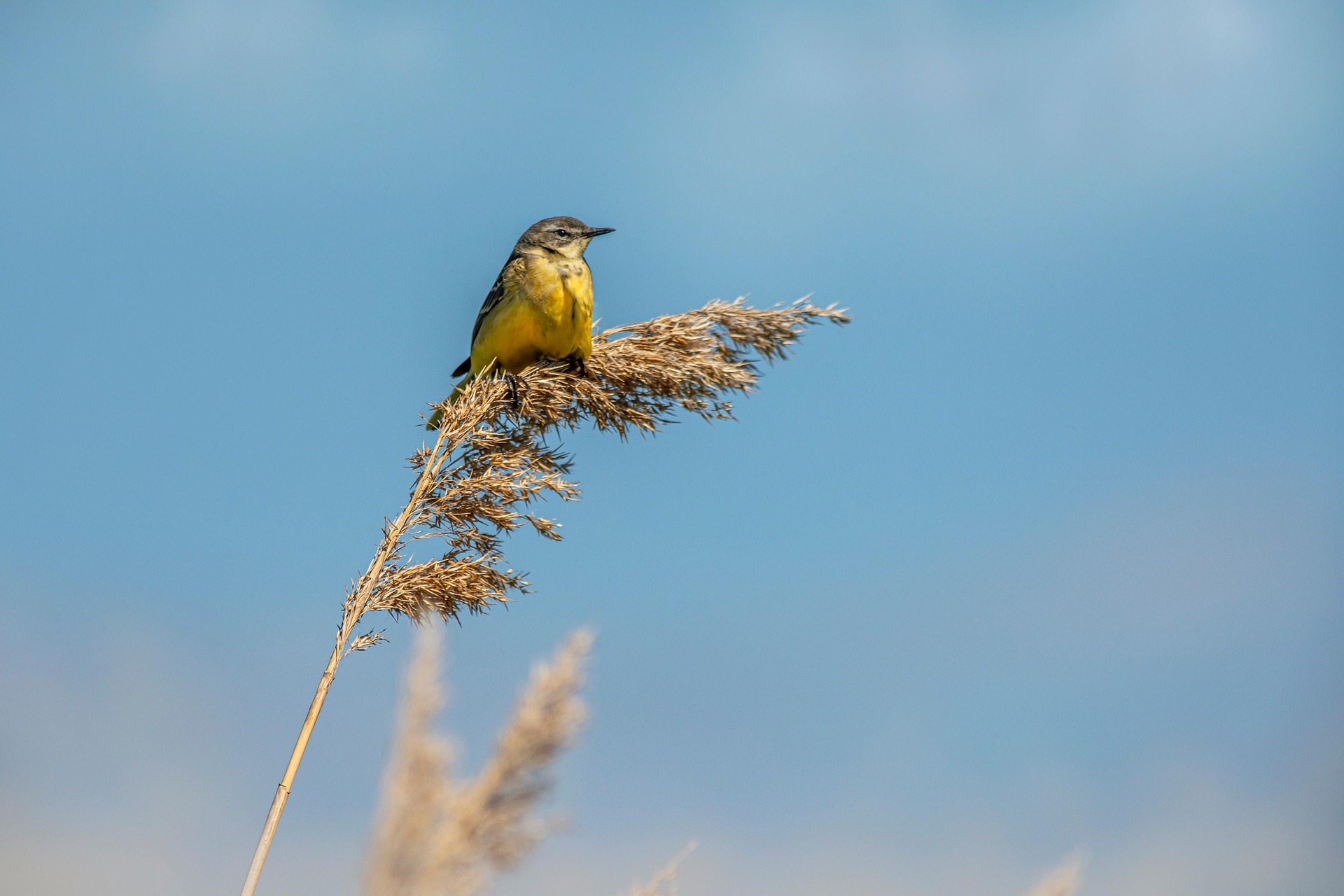
The Western Yellow Wagtail (Motacilla flava)—known in Estonian as the Hänilane—is a vibrant, ground-dwelling traveler that signals the true arrival of spring in European meadows. Unlike its cousin, the White Wagtail, which is often found near houses and stone walls, the Yellow Wagtail is a bird of the open fields, frequently seen dancing among the legs of grazing cattle.
1. A Taxonomic Puzzle: The Subspecies Complex
The Western Yellow Wagtail is famous (and sometimes frustrating) for its polymorphism. There are roughly 10–12 recognized subspecies, categorized primarily by the striking variations in the male’s head pattern during the breeding season.
- Blue-headed Wagtail (M. f. flava): The most common subspecies in Central and Northern Europe. The male has a slate-blue crown and a distinct white “eyebrow” (supercilium).
- Grey-headed Wagtail (M. f. thunbergi): A frequent visitor to Estonia and Scandinavia. The male lacks the white eyebrow and has a much darker, almost charcoal-grey head.
- Yellow-headed Wagtail (M. f. flavissima): Common in Britain, this subspecies looks almost entirely golden, with a yellow-green head.
2. The “Cattle-Follower” Strategy
Yellow Wagtails have a fascinating relationship with large herbivores like cows and horses.
- The Commensal Relationship: As cattle walk through long grass, they disturb a variety of insects (flies, beetles, and grasshoppers). The wagtails follow closely behind—sometimes just inches from a cow’s hooves—to snatch up the panicked prey.
- Ground Nesting: Despite their bright colors, they are remarkably secretive when nesting. They build their nests in a simple scrape on the ground, tucked deep inside a grass tussock or under a large leaf, making them vulnerable to early mowing or intensive grazing.
3. The Migration Marathon
These birds are long-distance migrants. Most European populations spend their winters in Sub-Saharan Africa.
- The Reed-Bed Roost: Before crossing the Mediterranean and the Sahara, they gather in massive numbers (sometimes thousands) to roost overnight in coastal reed beds.
- Spring Arrival: They usually return to Northern Europe and the Baltics in late April or early May, coinciding perfectly with the emergence of the first large hatches of field insects.
📸 Photographer’s Perspective: Capturing the Golden Glow
Photographing a Yellow Wagtail is a test of your ability to manage high-contrast colors and low-angle action.
- The Ground-Level View: Since they spend 90% of their time on the ground, you must get low. A “ground pod” or simply lying in the grass with a long lens (400mm+) is the only way to get that intimate perspective and smooth background blur.
- Managing the Yellows: Bright yellow feathers can easily “blow out” (lose detail) in direct midday sun. To keep the texture of the breast feathers visible, shoot in the soft light of early morning or underexpose by -0.3 to -0.7 EV.
- Freezing the “Wag”: The tail is constantly in motion. If you want to freeze the tail perfectly at the top or bottom of a “wag,” you’ll need a shutter speed of at least 1/1600s.
- Agricultural Patience: The best way to get close to them is often from a vehicle on a farm track or by sitting quietly near a muddy patch in a pasture where they come to drink or forage.
Quick Facts Table
| Feature | Detail |
| Scientific Name | Motacilla flava |
| Estonian Name | Hänilane |
| Length | 15–16 cm (Shortest tail of the European wagtails) |
| Diet | Primarily insects and small invertebrates |
| Migration | Long-distance (Europe to Sub-Saharan Africa) |
| Conservation | Species of Least Concern, but declining due to agricultural intensity |
Views: 233
Subscribe to the newsletter: