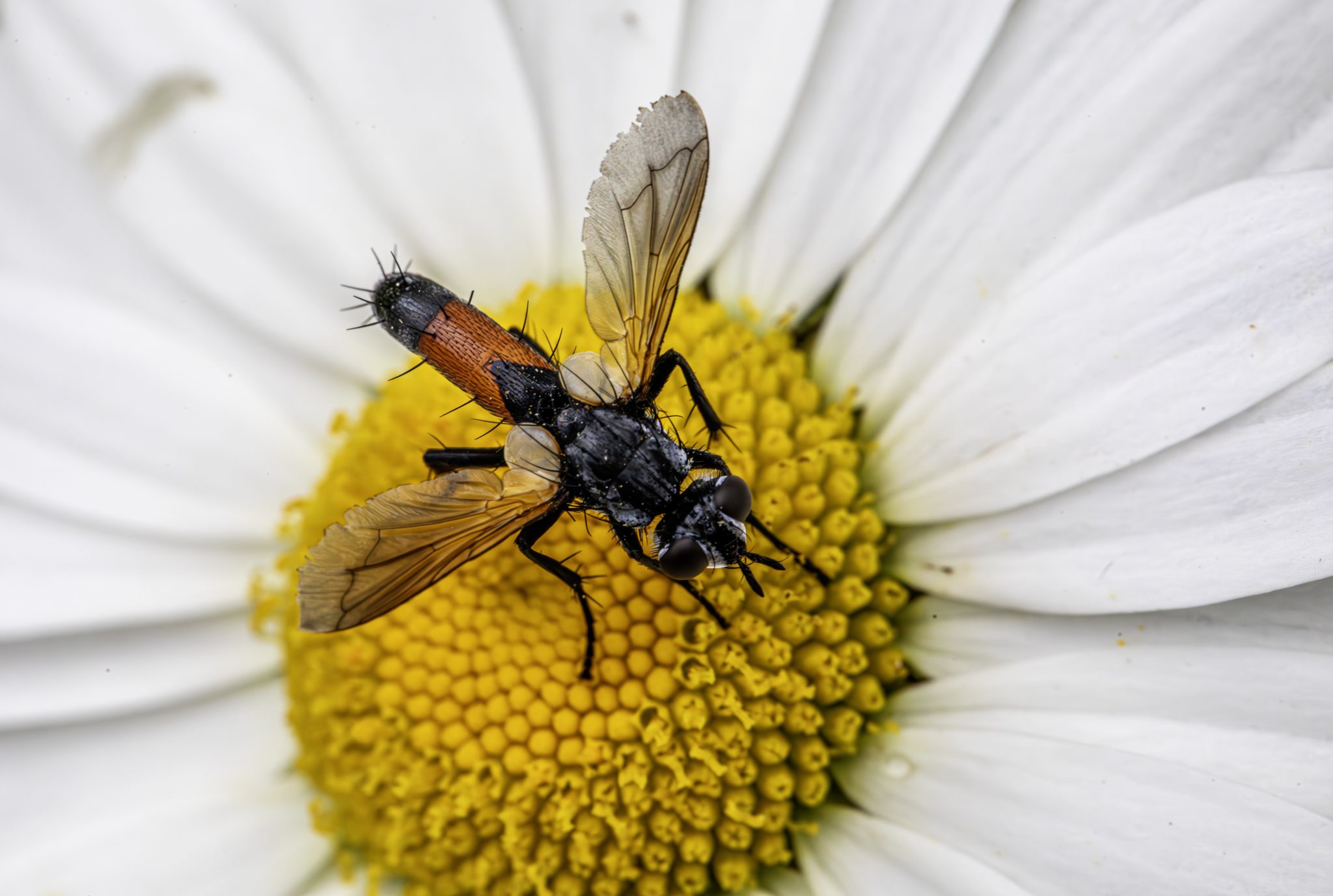
The Red-sided Tachinid (Eriothrix rufomaculata)—known in Estonia as Punatäpp-süsikärbes—is one of the more “stylish” members of the Tachinidae family. While many tachinids are drab and grey, this species is easily recognized by the vibrant, rusty-orange patches on the sides of its abdomen, making it a favorite for macro photographers.
Based on the detailed nature of the karits.eu galleries, here is a profile of this spiky, colorful garden ally.
1. The “Painted” Abdomen
The most striking feature of Eriothrix rufomaculata is its color scheme.
- The Contrast: It has a sleek, silver-grey thorax with dark longitudinal stripes, but the middle of the abdomen is splashed with bright orange or red on the sides.
- The “Racing Stripe”: A thick, black line runs down the center of its back, separating the orange patches.
- The Bristles: Like its cousins, it is covered in long, stiff, black bristles (macrosetae) that are particularly dense at the tip of the abdomen, giving it a “punk-rock” aesthetic.
2. The Long-Legged Wanderer
Compared to the bulky, rounder tachinids like Tachina fera, Eriothrix is relatively slender and long-legged.
- Agility: Its long legs allow it to navigate through the complex “forests” of flower heads (like Yarrow or Wild Carrot) with ease.
- Feeding Habits: As adults, they are purely nectar and pollen feeders. You will almost always find them on white, flat-topped flowers (umbellifers), where their orange sides stand out brilliantly against the white blossoms.
3. The Silent Hunter of Meadows
While the adults are peaceful flower-visitors, their larvae are specialized killers.
- Targeting Moths: Eriothrix rufomaculata primarily targets the caterpillars of Snout Moths (Crambidae) that live in the soil or in silken webs at the base of grass stems.
- Laying the Trap: The female fly lays her eggs in the grass near where the host caterpillars are feeding. Once the larvae hatch, they seek out the caterpillar and burrow inside to begin their development.
📸 Photographer’s Perspective: Capturing the “Red Sides”
This fly is an excellent subject for those looking to practice high-magnification macro photography.
- Profile Shots are Essential: To see the “red” in the Red-sided Tachinid, you must capture it from the side or a 3/4 angle. A top-down shot often hides the orange patches under the wings.
- Highlighting the Bristles: The black bristles can be very reflective. Using a diffuser on your flash is critical to avoid harsh white “hotspots” on the shiny black hairs.
- Shallow Depth of Field: Because the fly is quite long, if you shoot head-on at a wide aperture ($f/2.8$), only the eyes will be in focus. To get the eyes AND the abdominal bristles sharp, stop down to $f/11$ or higher, or use focus stacking.
- Patience on the Umbellifer: Because they love flat-topped flowers, you can often predict where they will move. They tend to walk across the “landing pad” of the flower rather than flying immediately, giving you time to compose the shot.
Quick Facts Table
| Feature | Detail |
| Scientific Name | Eriothrix rufomaculata |
| Common Name | Red-sided Tachinid / Punatäpp-süsikärbes |
| Size | 7–10 mm |
| Flight Period | July to September (Peak in late summer) |
| Primary Habitat | Meadows, grasslands, and hedge rows |
| Adult Diet | Nectar (especially from Apiaceae/Umbellifers) |
Explore more “spiky” macro wonders and high-resolution fly portraits at karits.eu.
Views: 393
Subscribe to the newsletter: