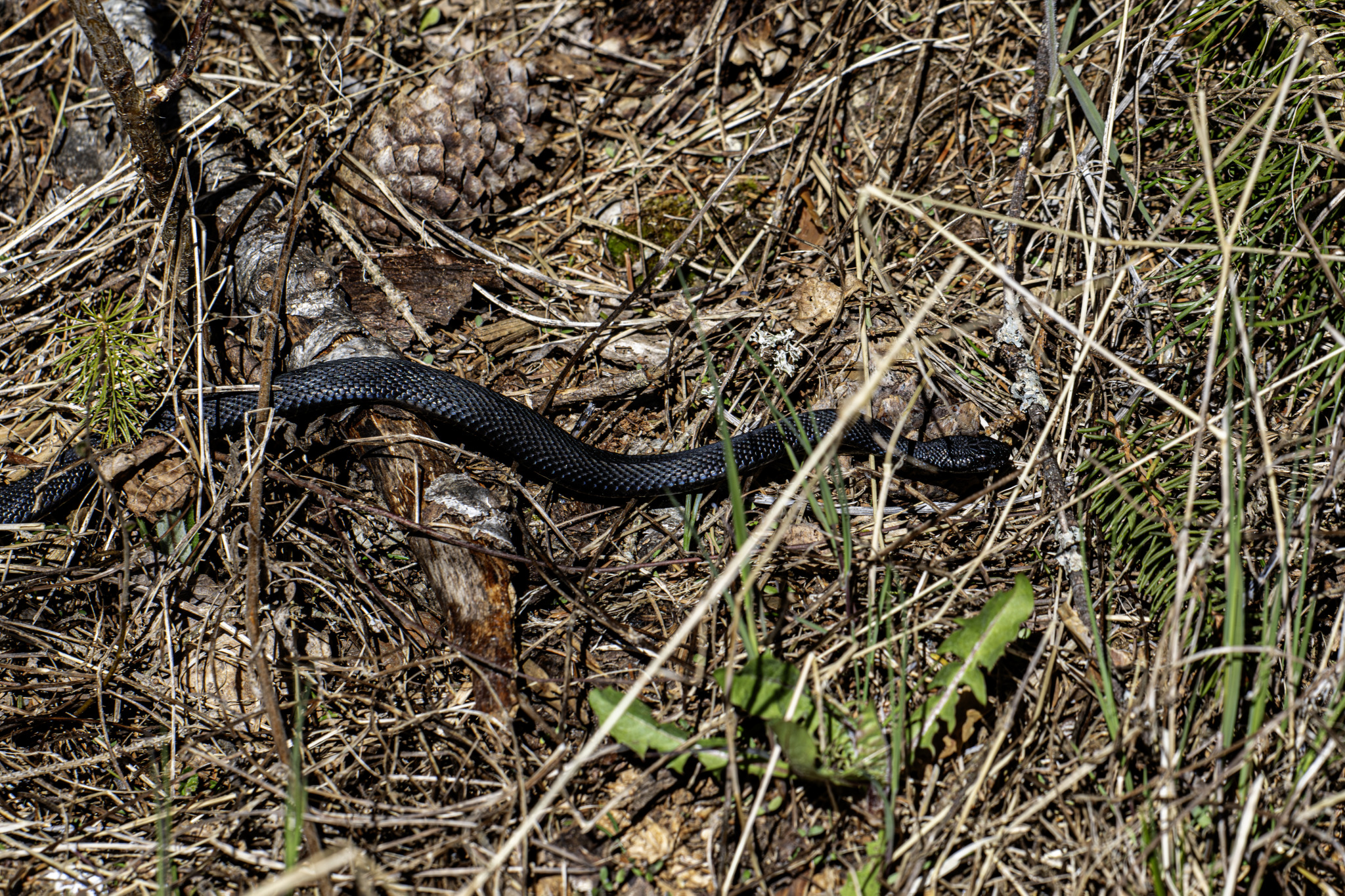
🌑 Melanism in the Grass Snake (Natrix natrix)
While the typical Grass Snake is easily recognized by its olive-green scales and iconic yellow “collar,” nature occasionally produces a version that looks like it was forged in a bed of charcoal. Melanism—a genetic mutation resulting in an excess of black pigment—creates a striking, jet-black variant that is both a biological marvel and a survival gamble.
🧬 What is Melanism?
Melanism is the opposite of albinism. It occurs when a genetic mutation causes the over-deposition of melanin in the skin or scales. In Natrix natrix, this transformation is often “total,” meaning the snake loses its characteristic yellow or white collar and its pale belly, becoming a uniform, velvety black.
- The “Carbonaria” Form: In older biological texts, these black individuals were often referred to as Natrix natrix var. carbonaria.
- Juvenile vs. Adult: Most melanistic grass snakes are born dark, but in some cases, the melanism intensifies as the snake matures and sheds its skin.
🌡️ The “Thermal Advantage” (The Upside)
In the cold-blooded world of reptiles, being black has one massive perk: thermoregulation.
- Faster Heating: According to the laws of physics, darker surfaces absorb thermal radiation more efficiently. A black snake can reach its optimal hunting temperature much faster than an olive-green one.
- Extended Activity: This allows melanistic snakes to emerge earlier in the morning, stay out later in the evening, and potentially remain active later into the autumn. This is why melanism is often more common in high-altitude or northern coastal populations.
🦅 The “Predation Penalty” (The Downside)
If being black makes you a “solar powered” super-hunter, why aren’t all grass snakes black? The answer lies in camouflage.
- Visual Standout: The Grass Snake’s usual olive-grey mottling is perfect for disappearing into reeds and dappled forest light. A solid black snake stands out starkly against green grass, making it an easy target for birds of prey like buzzards and herons.
- Loss of the “Collar”: The yellow collar of a normal grass snake may act as “disruptive coloration,” breaking up the snake’s outline. Without it, the snake’s shape is very easy for a predator to recognize.
🌍 Where is it Found?
Melanism in Natrix natrix is generally rare (often cited at less than 1% of the general population), but “hotspots” exist:
| Region Type | Prevalence | Why? |
| Mainland Europe | Very Rare | High predation pressure keeps the mutation suppressed. |
| Alpine Regions | Occasional | The thermal benefit of absorbing sun in cold air outweighs the risk of being seen. |
| Island Populations | Higher | The “Founder Effect” (limited gene pool) can make the trait more common if few predators are present. |
🐍 Behavior and Ecology
Interestingly, research suggests that melanistic individuals might behave differently than their green counterparts to compensate for their visibility:
- Shyness: Some studies indicate that black grass snakes are more “skittish” and quicker to retreat to water or thick cover, likely an evolutionary response to being more visible to predators.
- Size Advantage: Because they can spend more time at optimal temperatures, they often grow faster and reach larger adult sizes than their non-melanistic peers, which can lead to better reproductive success (more eggs).
⚠️ A Note on Identification
It is easy to mistake a melanistic Grass Snake for other species. If you spot a black snake in Europe, here is how to tell:
- The Eyes: Grass snakes have round pupils. The venomous European Adder (Vipera berus), which also has a melanistic form, has vertical, slit-like pupils.
- The Scales: Grass snakes have “keeled” scales (they have a ridge down the middle, making them feel rough).
- The Head: The Grass Snake has large, plate-like scales on its head, whereas the Adder has many small, fragmented scales.
Peer Observation: Finding a melanistic grass snake in the wild is like finding a shiny Pokémon. It’s a rare glimpse into how genetics can trade-off between the need for energy (heat) and the need for safety (camouflage). If you find one in 2026, consider yourself incredibly lucky!
Deep Overview: Grass Snake (Natrix natrix)
The grass snake (Natrix natrix), also known as the ringed snake or water snake, is a non-venomous, semi-aquatic reptile found across Europe and parts of Asia. It is known for its distinctive yellow collar, docile nature, and excellent swimming ability. Despite being harmless to humans, it often mimics venomous snakes as a defense mechanism.
Taxonomy & Classification
- Kingdom: Animalia
- Phylum: Chordata
- Class: Reptilia
- Order: Squamata
- Family: Colubridae
- Genus: Natrix
- Species: Natrix natrix
- Common Names:
- Grass snake
- Ringed snake
- Water snake
Physical Description
- Size:
- Length: 70–120 cm (27–47 in) (some reach 2 meters)
- Females are typically larger than males
- Coloration & Markings:
- Olive-green, brown, or grayish body with dark spots along the sides
- Distinctive yellow, white, or orange collar around the neck (often bordered by black)
- Dark round pupils and a slender head
- Scales keeled, giving a slightly rough texture
- Body Shape:
- Slender and elongated body
- Round snout, adapted for grabbing slippery prey
Distribution & Habitat
- Geographic Range:
- Widespread across Europe, western Asia, and parts of North Africa
- Found in countries like UK, Germany, France, Russia, Turkey, and Iran
- Preferred Habitat:
- Near freshwater sources like ponds, lakes, rivers, and marshes
- Also found in meadows, forests, grasslands, and gardens
- Prefers humid environments but can venture into dry areas
Behavior & Adaptations
- Diurnal (active during the day):
- Hunts and basks in the sun during daylight hours
- Excellent Swimmer:
- Can dive and stay submerged for several minutes
- Hibernation:
- Hibernates in burrows, tree roots, and compost heaps during winter (October–April)
- Defense Mechanisms:
- Plays dead (thanatosis): Rolls onto its back, hangs its tongue out, and secretes a foul-smelling liquid
- Hisses and flattens its body to appear larger
- Can release a musky odor from anal glands
- Rarely bites, prefers to escape rather than attack
Diet & Hunting Techniques
- Carnivorous (primarily amphibians):
- Main diet: Frogs, toads, newts
- Also eats fish, small mammals, birds, and invertebrates
- Hunting Strategy:
- Uses speed and stealth to catch prey
- Swallows prey whole, as it has no venom or constriction ability
Reproduction & Life Cycle
- Breeding Season:
- Mating occurs in spring (April–June) after hibernation
- Egg-Laying:
- Oviparous (lays eggs)—unlike many other European snakes
- Females lay 10–40 eggs in warm, decaying vegetation (compost heaps, manure piles)
- Eggs hatch in August–September after 8–10 weeks
- Lifespan:
- Typically 10–15 years in the wild
- Can live longer in captivity
Predators & Threats
- Natural Predators:
- Birds of prey (hawks, buzzards, herons)
- Foxes, badgers, wild boars
- Larger snakes and mammals
- Human-Related Threats:
- Habitat destruction (wetland drainage, urbanization)
- Road mortality (frequently killed by vehicles)
- Misidentification as venomous snakes leads to unnecessary killing
- Conservation Status:
- Listed as “Least Concern” (LC) by the IUCN, but populations are declining in some regions
- Protected by law in many European countries (e.g., UK, Germany)
Ecological Importance
- Controls amphibian populations:
- Helps regulate frogs and toads, maintaining ecological balance
- Prey for larger predators:
- Part of the food web in freshwater and woodland ecosystems
- Indicator species:
- A healthy grass snake population indicates good water quality and habitat health
Relationship with Humans
- Harmless to Humans:
- Non-venomous and rarely bites
- Common in Gardens & Farms:
- Helps control pests like frogs and rodents
- Superstitions & Myths:
- Some cultures wrongly associate it with venomous snakes
- In folklore, it is sometimes seen as a guardian of water sources
Fun Facts
- Can swim across large lakes and slow-moving rivers
- Fakes death in the most dramatic way, even emitting a rotting smell to fool predators
- Unlike vipers, it has round pupils, helping to distinguish it from venomous species
- Females are significantly larger than males, an uncommon trait in many snake species
Conclusion
The Natrix natrix is a fascinating, adaptable snake that thrives in wetlands, woodlands, and grasslands. Its non-aggressive nature, unique defense mechanisms, and ecological role make it an essential part of European wildlife. Though harmless to humans, it faces threats from habitat destruction and human persecution.
Views: 790
Subscribe to the newsletter: