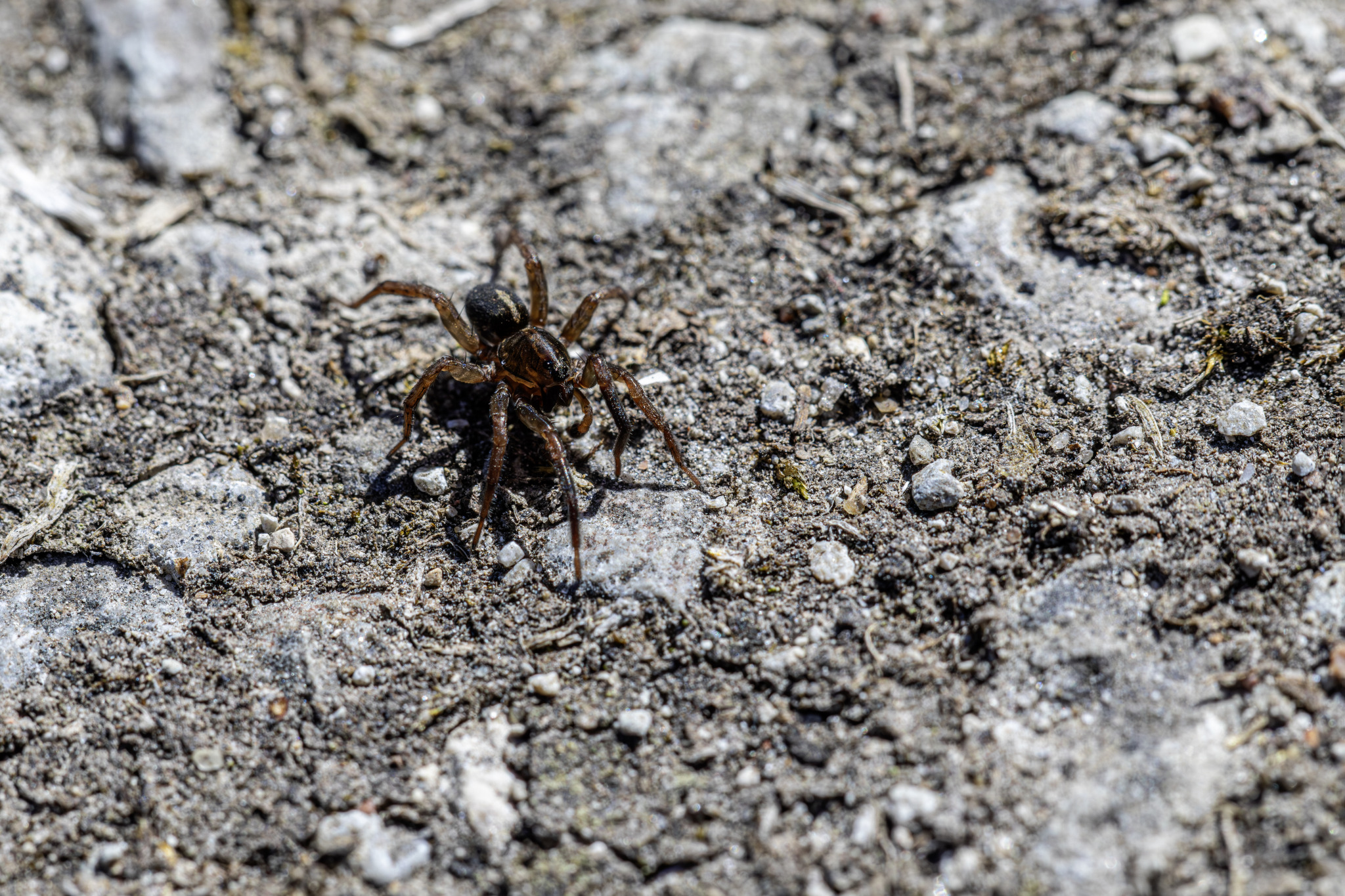
🕷️ Deep Review:
If the Garden Spider is the master architect of the air, the Ground Wolf Spider is the undisputed heavy-weight sprinter of the leaf litter. Part of the Lycosidae (Wolf Spider) family, Trochosa terricola is a robust, terrestrial hunter that relies on speed, camouflage, and brute strength rather than sticky silk to secure its next meal.
📏 Physical Characteristics: The “Double-Stripe” Hunter
The Ground Wolf Spider is a stout, powerful arachnid designed for life on the forest floor.
- The Signature Marking: Look closely at the “head” (cephalothorax). It features two thick, dark longitudinal bands. In the center of the pale stripe between these bands, there are two small dark dots or lines (forming a shape often compared to a “U” or a “||”).
- Coloration: Generally a mix of rich reddish-brown and earthy tans. Unlike many other wolf spiders, T. terricola often has a distinct reddish-orange tint to its legs, which helps distinguish it from its cousins.
- Eyesight: Like all wolf spiders, it has eight eyes arranged in three rows. The middle row features two large, forward-facing eyes that provide excellent binocular vision and depth perception for pouncing.
| Feature | Female | Male |
| Body Length | 10–14 mm | 7–9 mm |
| Leg Span | ~25–35 mm | ~20–30 mm |
| Key ID | Large, bulky abdomen. | Darker, “hairy” front legs (pedipalps). |
🏠 Habitat and Lifestyle: The “Earth Dweller”
As the Latin name terricola (“earth dweller”) suggests, this spider is almost exclusively found on the ground.
- Environment: They thrive in damp, shaded areas. You’ll find them in deciduous woodlands, mossy grasslands, and under the cool shadows of garden log piles or large stones.
- The Day Shift: During the day, they are rarely seen. They hide in silk-lined retreats or shallow burrows they excavate in the soil or under leaf litter.
- The Night Shift: They are primarily nocturnal. When the sun goes down in May (which, in 2026, is currently prime activity time), they emerge to prowl their territory for prey.
🏹 Hunting: The “No-Web” Strategy
Unlike the “sit-and-wait” orb weavers, the Ground Wolf Spider is an active predator. It does not spin a web to catch insects.
- Stalking: It uses its sensitive leg hairs to detect the tiniest vibrations of a passing insect.
- The Sprint: Once prey is detected, the spider uses its powerful legs to close the distance in a fraction of a second.
- The Takedown: It pounces and pins the prey down with its strong front legs before delivering a paralyzing bite.
- The Menu: They are the “lions” of the undergrowth, eating anything they can overpower, including beetles, ants, crickets, and even other spiders.
🐣 Breeding: “Mom of the Year”
Wolf spiders are famous for their surprisingly dedicated parental care, and T. terricola is no exception.
- The Egg Sac: After mating, the female spins a white or greyish silk egg sac. Instead of leaving it in a nest, she attaches it to her spinnerets and carries it with her everywhere.
- The “Bus” Phase: When the spiderlings hatch, they don’t leave immediately. They climb onto the mother’s back, huddling together in several layers. The mother carries her hundreds of “passengers” for several days until they are strong enough to disperse and fend for themselves.
⚠️ Identification: Terricola vs. Ruricola
It is very easy to confuse T. terricola with its close relative, Trochosa ruricola (the Rustic Wolf Spider).
- The “Claw” Test: To be 100% certain, experts look at the claws on the front legs. T. terricola lacks a specific large claw on the tip of the male’s pedipalp that T. ruricola possesses.
- Color Hint: T. terricola is generally more “warm” and reddish, whereas T. ruricola tends to be more “cold” and olive-brown.
💡 Safety and Interaction
Despite their somewhat intimidating, “hairy” appearance, Ground Wolf Spiders are completely harmless to humans.
- Temperament: They are incredibly shy and will almost always choose to bolt into the shadows rather than confront a human.
- Venom: While they do have venom (to paralyze their insect prey), it is very weak. On the incredibly rare occasion a human is bitten (usually only if the spider is being squeezed), the effect is less than a mosquito bite.
Fun Fact: If you go into your garden at night with a bright flashlight held at eye level, you can see the eyes of wolf spiders reflecting back at you like tiny green diamonds in the grass. This is due to a reflective layer behind their retinas called the tapetum lucidum, similar to what you see in the eyes of cats.
Views: 277
Subscribe to the newsletter: