The Springtime Scout: Exploring the Orange Tip Butterfly (Anthocharis cardamines)
For many naturalists, the first sighting of a male Orange Tip (Anthocharis cardamines) is the true beginning of spring. While species like the Brimstone or Peacock overwinter as adults, the Orange Tip emerges fresh from its chrysalis in April, flickering through hedgerows like a wandering scrap of paper—until the sun catches those brilliant, fiery wingtips.
A Tale of Two Sexes
The Orange Tip is a classic example of sexual dimorphism, where males and females look strikingly different.
- The Male: Unmistakable. The outer half of the forewings is a saturated, glowing orange. This is thought to be an aposematic (warning) signal, telling predators that the butterfly is distasteful due to mustard oils accumulated during its caterpillar stage.
- The Female: Lacks the orange entirely. She is often mistaken for a “Small White” or “Green-veined White,” though her rounded wing shape and distinct black central spot set her apart.
The “Mossy” Illusion
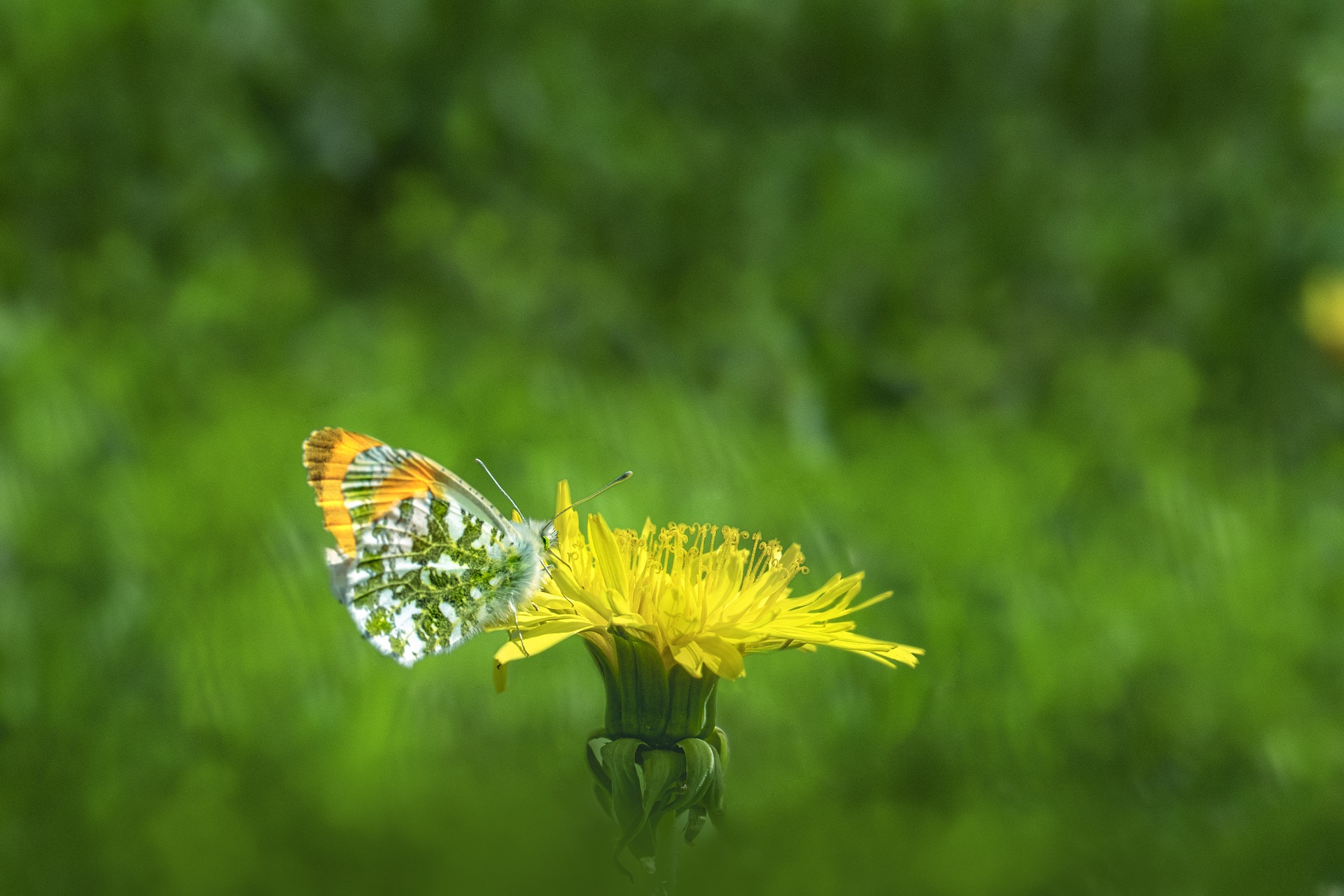
While the uppersides are bold, the underside of the hindwings is a masterpiece of deception. Both sexes possess a complex, mottled pattern of grey, black, and yellow scales that, when viewed together, create a perfect “mossy green” camouflage. When the butterfly rests on the white flowers of Garlic Mustard or Cuckooflower, it practically vanishes against the dappled light of the vegetation.
A Brutal Beginning: The Cannibalistic Larva
The life of an Orange Tip begins with a solitary egg, usually laid on the flower stalk of Cuckooflower or Garlic Mustard.
- The Pheromone Deterrent: When a female lays an egg, she leaves behind a pheromone that tells other females, “This plant is occupied.”
- A High-Stakes Race: If two eggs are laid on the same plant, the first caterpillar to hatch will typically eat the second egg. Because the larvae feed primarily on the developing seed pods—a limited resource—this cannibalistic behavior ensures the survivor has enough food to reach maturity.
The Thorn-Like Chrysalis
By July, the caterpillar seeks out a sturdy stem or woody twig to pupate. The chrysalis is uniquely shaped—long, thin, and curved, looking exactly like a plant thorn or a leaf bud. It will remain in this state for nearly 11 months, enduring the wind and ice of winter before the cycle begins again the following spring.
📸 Photographer’s Perspective: Chasing the White Flash
The Orange Tip is a challenging subject because it is a “patrolling” butterfly; males rarely stop for long as they search for mates along woodland edges.
- Identify the “Patrol Route”: Males often fly a regular circuit. Instead of chasing them, find a patch of Garlic Mustard or Bluebells along their path and wait. They will eventually return to the same spot to nectar.
- Mind the “Green” Scales: Macro photography reveals a secret: there is no green pigment on an Orange Tip. The “green” is an optical illusion created by a mix of black and yellow scales. To capture this detail, use a high-quality macro lens and ensure your focus is sharp enough to resolve individual scales.
- Low-Light Stalking: These butterflies are very sensitive to heat. On overcast days or in the early morning, they are much more stationary. Look for them resting “closed-wing” on flower heads; this is the best time to showcase the mossy underside.
- Expose for the White: Like the Snowy Owl, the white wings of the Orange Tip can easily “clip” and lose detail in bright sun. Check your histogram and use a slight negative exposure compensation (-0.3 EV) if the sun is harsh.
Quick Facts Table
| Feature | Detail |
| Wingspan | 40–52 mm |
| Flight Period | April – June (One generation per year) |
| Primary Host Plants | Cuckooflower (Cardamine pratensis) and Garlic Mustard |
| Overwintering | As a pupa (for approx. 11 months) |
| Scientific Name | Anthocharis cardamines |
| Fun Fact | The “green” underside is actually an illusion of black and yellow scales. |
Views: 1804
Subscribe to the newsletter: