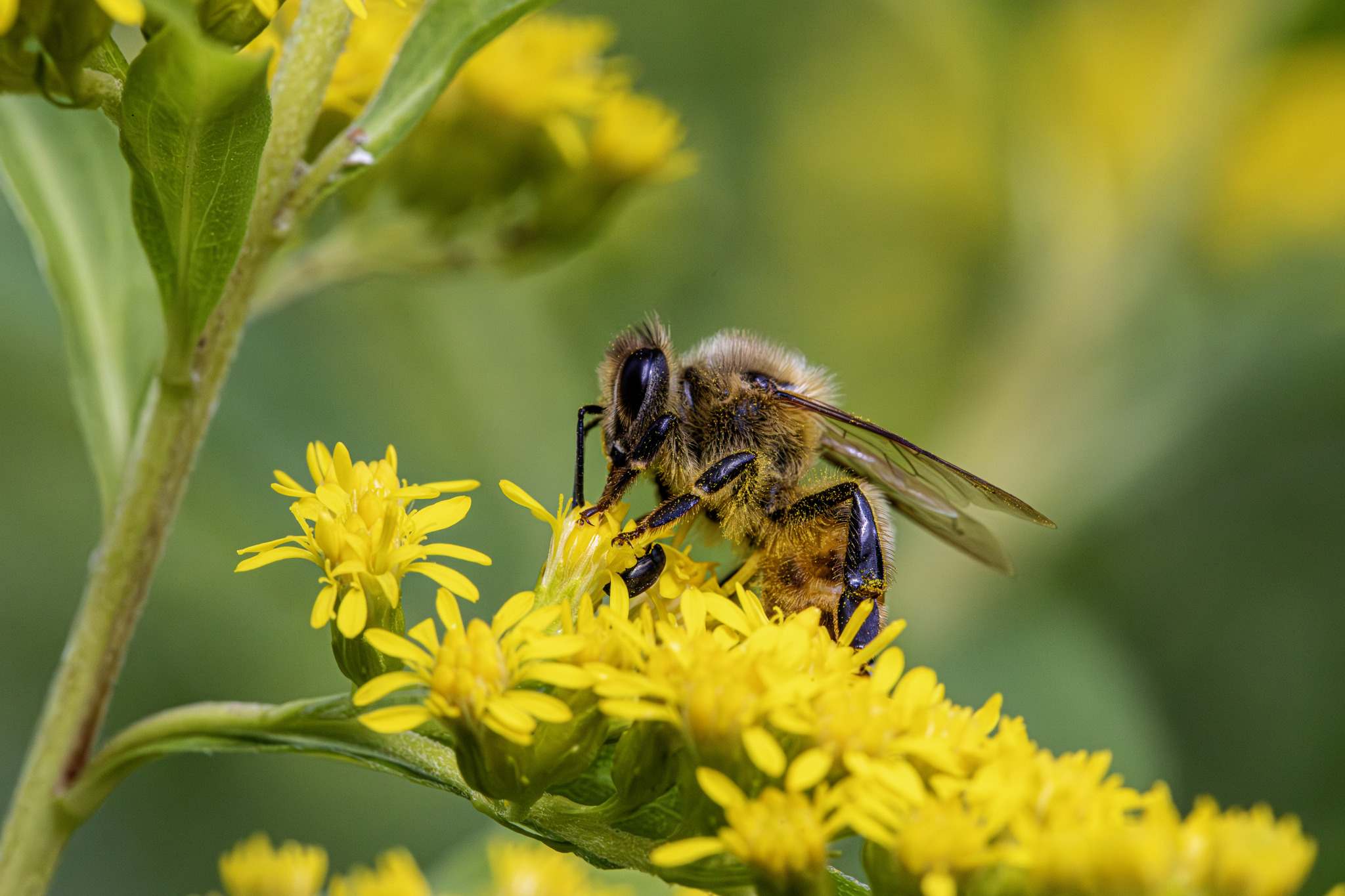
The Western honey bee (Apis mellifera)—known in Estonian as the Kodumesilane—is arguably the most studied and vital insect on the planet. While we often think of them in terms of honey and agriculture, through a macro lens, they reveal themselves as complex, fur-covered pilots equipped with an array of specialized tools for survival.
As a staple of Estonian gardens and wildflower meadows, here is a deeper look at the world’s most famous “workaholic.”
1. The Toolbelt: The Pollen Basket
One of the most rewarding details to capture in macro photography is the corbicula, or “pollen basket.”
- The Structure: On the tibia of their hind legs, honey bees have a smooth, slightly concave region surrounded by stiff hairs.
- The Packing: As the bee forages, it brushes pollen from its body and mixes it with a little nectar, packing it into these baskets. Seeing a bee with bright orange or yellow “saddlebags” is a sign of a successful mission.
- Propolis: These baskets aren’t just for food; bees also use them to carry propolis (tree resin), which they use as “bee glue” to seal cracks and disinfect the hive.
2. Sensory Sophistication
The “face” of a honey bee is a marvel of biological engineering:
- Compound Eyes: Thousands of tiny lenses (ommatidia) allow the bee to see into the ultraviolet spectrum, helping them spot “nectar guides” on flowers that are invisible to the human eye.
- The Hairy Thorax: The dense “fur” on a bee isn’t just for cuteness; it generates an electrostatic charge as the bee flies. When it lands on a flower, pollen literally jumps onto the bee’s hairs because of the difference in electrical potential.
3. The “Waggle Dance” and Social Intelligence
Beyond their physical traits, the Western honey bee is defined by its social structure.
- Communication: They are one of the few invertebrates capable of symbolic language. The “waggle dance” tells hive-mates the distance, direction, and quality of a food source relative to the sun.
- Overwintering: In the cold Baltic climate, honey bees don’t hibernate. They form a tight “winter cluster” around the queen, vibrating their wing muscles to generate heat and keep the center of the hive at a steady 35°C, even when it’s -20°C outside.
📸 Photographer’s Perspective: Mastering the “Bumble”
Honey bees are fast and unpredictable, making them a high-level challenge for macro enthusiasts.
- Freezing the Wings: To stop the blur of wings in mid-flight, you need an exceptionally fast shutter speed—at least 1/4000s. If you are using a flash, the high-speed sync (HSS) is your best friend.
- Focus on the Ocelli: While the large compound eyes are the main draw, try to capture the ocelli—the three tiny, simple eyes located in a triangle on the top of the head. They are used for light sensing and navigation.
- The “Nectar Sip”: The best time to photograph them is when they are deep inside a flower. They become momentarily still as they extend their proboscis (tongue) to drink, giving you a 1–2 second window to nail the focus.
- Diffuse the Sun: Honey bees have many reflective surfaces. Using a small diffuser or shooting during a “bright-overcast” day prevents harsh white highlights on their wings and thorax.
Quick Facts Table
| Feature | Detail |
| Scientific Name | Apis mellifera |
| Estonian Name | Kodumesilane / Meemesilane |
| Max Flight Speed | ~24 km/h |
| Life Span | Workers: 6 weeks (summer) to 6 months (winter) |
| Flower Visits | Up to 2,000 flowers in a single day |
| Honey Production | 1/12th of a teaspoon in a lifetime per bee |
Explore high-resolution macro studies of the Western honey bee and other pollinators at karits.eu.
Views: 1626
Subscribe to the newsletter: