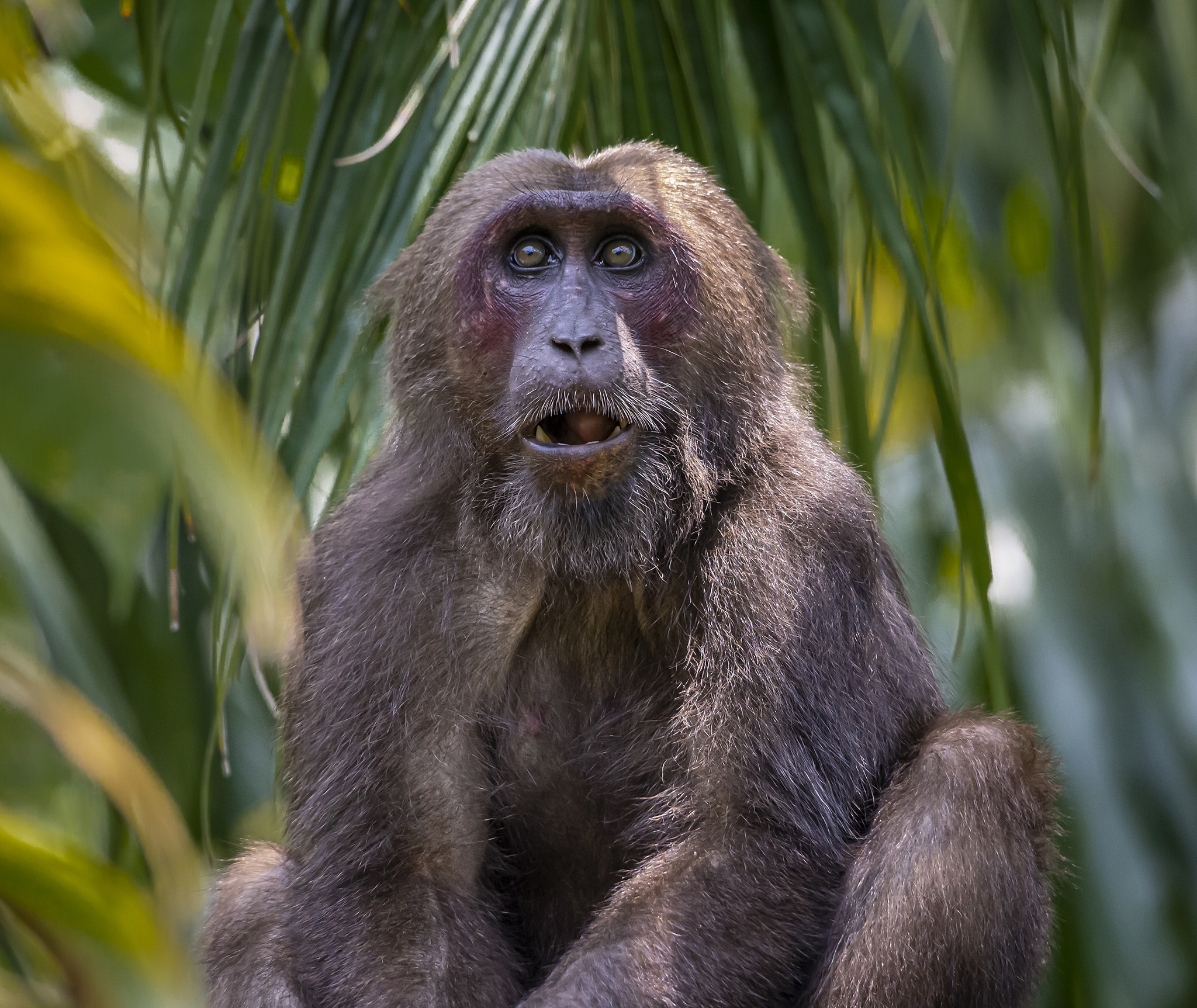

Here’s a comprehensive overview and description of the Stump-tailed Macaque (Macaca arctoides) — a fascinating and distinctive Old World monkey native to Southeast Asia.
🐒 Stump-tailed Macaque (Macaca arctoides)
Taxonomy
- Kingdom: Animalia
- Phylum: Chordata
- Class: Mammalia
- Order: Primates
- Family: Cercopithecidae
- Genus: Macaca
- Species: Macaca arctoides
- Common names: Stump-tailed macaque, Bear macaque, Red-faced macaque
General Description
The Stump-tailed macaque is a stocky, powerful primate recognized for its bare red or pinkish face, short tail, and dense fur. It has a somewhat bear-like appearance, which explains its nickname “bear macaque.”
- Body length: 45–65 cm (males larger than females)
- Tail length: 3–9 cm — short and “stump-like”
- Weight:
- Males: 10–15 kg
- Females: 7–12 kg
- Fur color: Dark brown to black, often shaggy or woolly in texture
- Face: Hairless and typically reddish or dark pink, becoming more vivid with age or emotion
- Distinctive features:
- Short, almost invisible tail
- Deep-set eyes and broad muzzle
- Strong limbs for climbing and ground movement
Distribution and Range
The stump-tailed macaque is native to Southeast and South Asia, with a wide but fragmented range.
Geographic range:
- India (Assam, Arunachal Pradesh, Meghalaya)
- Bangladesh
- Myanmar
- Thailand
- Laos
- Vietnam
- Cambodia
- Southern China (Yunnan)
- Malaysia (Peninsular regions)
They inhabit evergreen and semi-evergreen forests, from lowland rainforests to mountain forests up to 2000 m altitude.
Habitat
- Preferred environments:
- Tropical and subtropical broadleaf evergreen forests
- Montane and hill forests
- Occasionally in secondary growth and bamboo forests
- They are semi-terrestrial, spending much time on the ground but also climbing trees for food and safety.
Behavior and Ecology
Stump-tailed macaques are social, intelligent, and robust primates, living in large, cohesive groups of 20–60 individuals, led by a dominant male.
Daily Activity
- Diurnal: Active during the day
- Spend most of their time foraging on the ground, but sleep in trees at night.
- Move in groups with coordinated social hierarchy.
Social Structure
- Female-bonded groups: Females remain in natal groups, while males disperse at maturity.
- Hierarchy: Both males and females have clear dominance ranks.
- Grooming: An essential behavior that strengthens social bonds and reduces stress.
Communication
- Communicate via facial expressions, vocal calls, and body language.
- The red face and expressive eyes are key components of visual signaling.
Diet
Omnivorous, with a diet that varies by season and habitat.
Primary foods:
- Fruits and seeds
- Leaves and buds
- Roots and tubers
- Insects, frogs, and small vertebrates
- Bird eggs and agricultural crops (where habitat overlaps with farms)
They are opportunistic feeders, playing an important ecological role in seed dispersal.
Reproduction
- Mating system: Promiscuous (both sexes mate with multiple partners)
- Breeding season: Year-round, with peaks in cooler months
- Gestation period: ~175 days (5.5–6 months)
- Offspring: Usually one infant per birth
- Weaning: Around 8–12 months
- Sexual maturity:
- Females: ~4 years
- Males: ~6 years
- Lifespan: Up to 25 years in the wild, 30+ years in captivity
Females display sexual swellings when fertile, and infants are cared for by the mother, sometimes aided by other females.
Predators and Threats
Natural predators:
- Leopards, pythons, and large birds of prey
Main threats:
- Deforestation and habitat loss
- Hunting and poaching (for meat and traditional medicine)
- Capture for pet trade or biomedical research
- Conflict with farmers (crop raiding)
Conservation Status
- IUCN Red List: 🟥 Vulnerable
- Population trend: Decreasing
Major conservation concerns:
- Rapid habitat destruction due to agriculture and logging
- Fragmented populations reducing genetic diversity
Protection measures:
- Listed on CITES Appendix II (trade controlled)
- Occurs in many protected areas across its range (e.g., Kaeng Krachan NP in Thailand, Nam Et–Phou Louey NP in Laos)
- Some rehabilitation and breeding programs exist in Southeast Asia
Ecological Role
- Acts as an important seed disperser for many tropical tree species.
- Helps maintain forest regeneration and ecological balance.
Identification Summary
| Feature | Description |
|---|---|
| Scientific Name | Macaca arctoides |
| Common Names | Stump-tailed macaque, Bear macaque |
| Size | 45–65 cm body, 3–9 cm tail |
| Weight | 7–15 kg |
| Color | Dark brown fur, red face |
| Behavior | Ground-dwelling, social, intelligent |
| Diet | Omnivorous (fruits, leaves, insects) |
| Habitat | Tropical/subtropical forests |
| Range | South and Southeast Asia |
| Conservation Status | Vulnerable |
Interesting Facts
- The bare red face becomes darker and more vivid with age.
- Their short tail helps identify them instantly among macaques.
- They are excellent swimmers and sometimes bathe in forest pools.
- Despite their fierce appearance, they are shy and non-aggressive toward humans when unprovoked.
- Their thick fur allows survival in cooler, montane forests compared to other tropical macaques.
Summary
The Stump-tailed macaque (Macaca arctoides) is a strong, red-faced primate adapted to both forest floor and canopy life. Its intelligence, complex social behavior, and ecological importance make it a vital part of Asian tropical ecosystems. Sadly, habitat loss and hunting threaten this species, underscoring the importance of protecting Southeast Asia’s forests and wildlife.
Views: 1629
Subscribe to the newsletter: