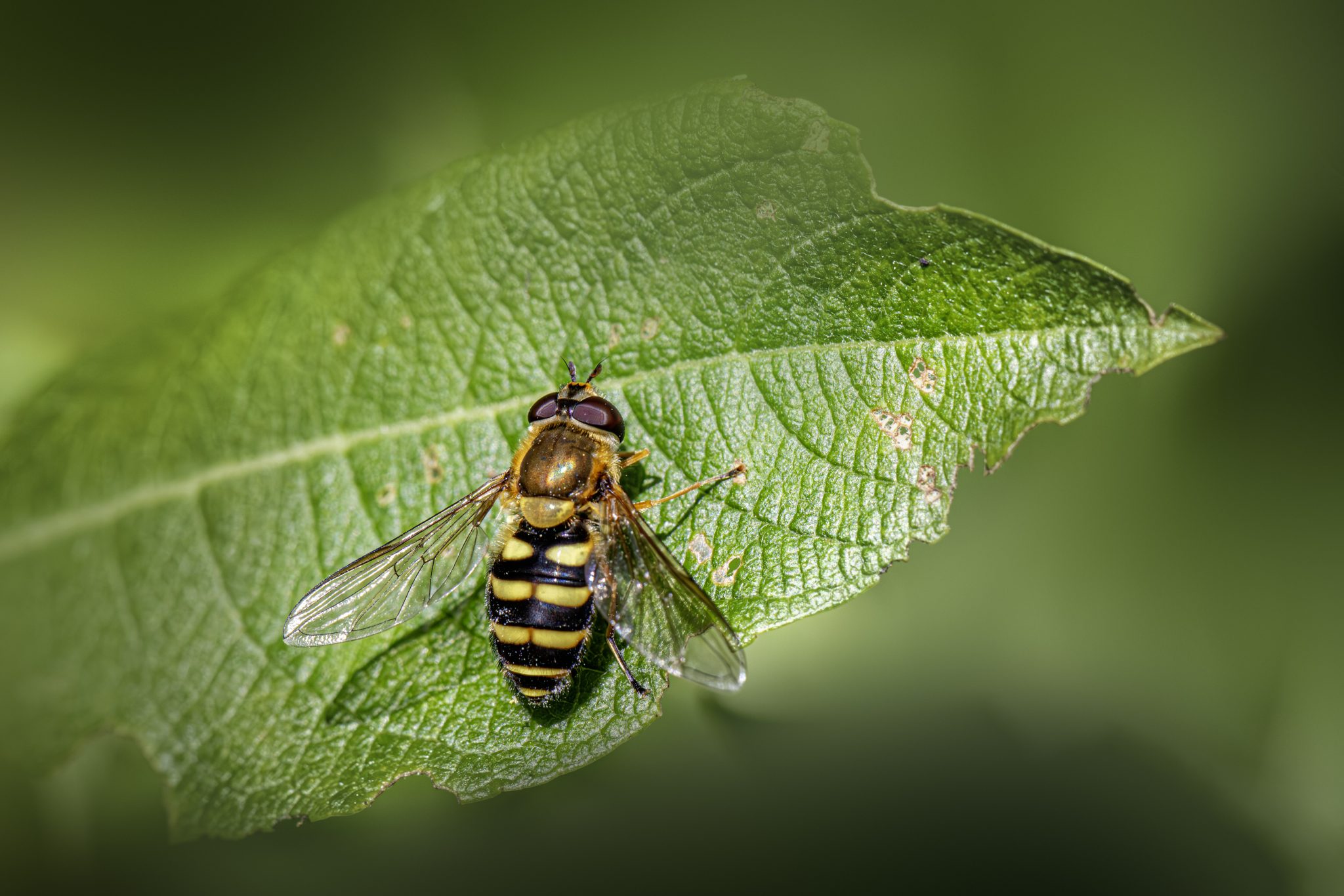
🪰 Common Banded Hoverfly (Syrphus ribesii)
🔹 Taxonomy
- Order: Diptera
- Family: Syrphidae (Hoverflies)
- Subfamily: Syrphinae
- Genus: Syrphus
- Species: S. ribesii
🌍 Distribution
- Widely distributed throughout Europe
- Also found across Asia, North Africa, and North America
- Very common in northern and temperate climates
A familiar and abundant garden hoverfly.
🏞️ Habitat
Highly adaptable. Common in:
- Gardens and urban parks
- Forest edges, hedgerows, scrubland
- Meadows and flower‐rich grasslands
- Farmland and orchards
Thrives wherever flowers and aphid colonies are present.
🧬 Identification (Key Field Features)
Medium‐sized hoverfly: 9–12 mm length.
Notable traits:
- Thorax metallic dark with slight bronze‐green reflection
- Abdomen with bright yellow transverse bands
- Legs: yellow with entirely yellow hind femur → crucial ID feature
- Wing venation typical of syrphines (false vein, spurious vein)
🟡 Sexual dimorphism:
- Females: eyes clearly separated
- Males: eyes meet on top of the head
✅ Distinguishing From Lookalikes
Especially from Syrphus vitripennis and S. torvus:
| Feature | S. ribesii | Similar Species |
|---|---|---|
| Hind femur | Completely yellow | Usually partly dark |
| Male eye hairs | Sparse | Denser in S. torvus |
| Larval host | Very broad aphid range | Slightly more selective |
Identification is easiest in hand or macro photos.
🌸 Adult Feeding
Feeds on nectar and pollen, particularly attracted to:
- Asteraceae (daisies, dandelions)
- Umbellifers (hogweed, cow parsley)
- Brambles, willows, wild roses
Important pollinator of both native and crop plants.
🐛 Larval Diet & Behavior
One of the most important aphid predators in gardens and agriculture.
- Larvae are blind, hunting by touch and chemical cues
- Feed on:
- Aphids (primary)
- Also small caterpillars and leafhoppers
One larva may consume hundreds of aphids before pupating.
🔄 Life Cycle
- 2–3 generations per year (may vary by latitude)
- Eggs laid singly near aphid colonies on plant leaves
- Larvae develop quickly in summer warmth
- Pupate on foliage or in leaf litter
Overwintering: generally as pupae
Adults appear early spring through late autumn.
🧠 Behavior
- Excellent hoverer; can remain suspended in air
- Batesian mimicry: yellow-and-black pattern deters predators
- Males often defend small flower territories
🌱 Ecological Importance
| Role | Contribution |
|---|---|
| Pollinator | High value for wild plants & crops |
| Predator (larvae) | Major natural aphid control |
| Bioindicator | Healthy, flower-rich habitats |
Frequently encouraged in sustainable farming and home gardens.
⚖️ Conservation Status
- Widespread, abundant, not threatened
- Benefited by:
- Organic farming
- Wildflower planting
- Reduced pesticide use
Population declines can occur where insecticide use is heavy.
✅ Summary Table
| Trait | Detail |
|---|---|
| Size | 9–12 mm |
| Generations | 2–3 per year |
| Larval diet | Aphids |
| Adult habitat | Flower-rich environments |
| ID key | Entirely yellow hind femur |
| Status | Common & ecologically valuable |
Views: 611
Subscribe to the newsletter: