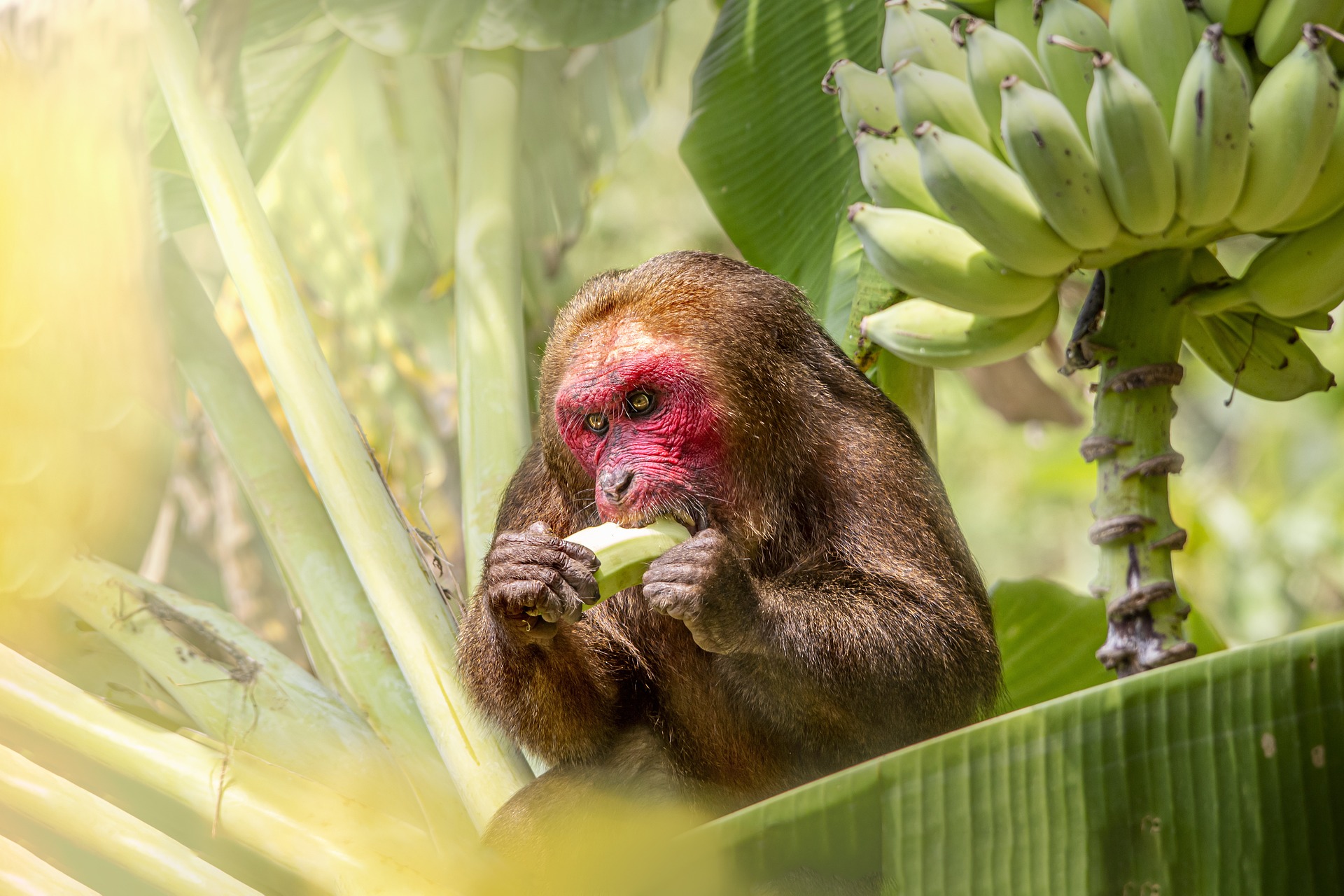
🐒 Deep Review: Stump-tailed Macaque (Macaca arctoides)
The Stump-tailed Macaque, also known as the Bear Macaque or Red-faced Macaque, is a robust and highly social Old World monkey native to South and Southeast Asia. Its unusual appearance and complex social life make it a fascinating subject for study, though its existence is increasingly threatened in the wild.
📏 Physical Characteristics
- Appearance: This macaque is characterized by its long, thick, dark brown, shaggy fur that gives it the “bear macaque” nickname. Its face and extremely short, almost hairless tail are the most distinctive features.
- Face: The face is hairless and typically bright red or pink in young and healthy adults, but it darkens to brown or nearly black with age and sun exposure.
- Tail: As the name suggests, it has a very short, stubby, almost hairless tail, ranging from 3.2 to 69 mm in length.
- Size and Sexual Dimorphism: The species exhibits clear sexual dimorphism. Males are significantly larger, heavier, and have much longer canine teeth, which are used to assert dominance.
- Males: ~9.9–10.2 kg (21–22 lbs) and 51.7–65 cm long.
- Females: ~7.5–9.1 kg (17–20 lbs) and 48.5–58.5 cm long.
- Other Features: Like all macaques, they possess cheek pouches to store food while foraging. Infants are born with white hair that darkens as they mature, and adults often show balding on the top of the head.
🌏 Habitat and Distribution
- Geographic Range: They are found across a wide, though fragmented, range in South and Southeast Asia, including parts of India (south of the Brahmaputra River), southern China, Myanmar, Thailand, Laos, Cambodia, and Vietnam. They are possibly extinct in Bangladesh.
- Habitat: They prefer tropical and subtropical broadleaf evergreen forests and semi-evergreen forests, ranging from lowlands up to high montane forests (up to 2,800-4,000 meters in some areas). Their thick fur allows them to tolerate cooler, higher-altitude climates.
- Locomotion: They are semi-terrestrial, spending much of their time foraging on the forest floor, though they retreat to trees for safety and to sleep at night. They move quadrupedally on the ground, a contrast to their relatively ungainly movement in the trees.
🍎 Diet and Ecology
- Diet Type: The Stump-tailed Macaque is an omnivore, but it is primarily frugivorous (fruit-eating).
- Food Sources: Their diet includes a wide variety of foods:
- Plant Matter: Fruits (primary component), seeds, leaves, roots, flowers, and buds.
- Animal Matter: Insects, insect larvae, frogs, freshwater crabs, bird eggs, and small vertebrates. Their robust build suggests they consume a larger quantity of meat compared to many other macaque species.
- Ecological Role: As significant fruit-eaters, they play a crucial role as seed dispersers, aiding in forest regeneration and maintaining the ecological balance of their environment. They are also known to raid agricultural crops like corn, leading to human-wildlife conflict.
👨👩👧👦 Behavior and Social Structure
- Group Dynamics: They are highly social and live in large, cohesive, multi-male, multi-female groups, typically consisting of up to 60 individuals.
- Hierarchy: They are hierarchical, with dominance established through physical contact and large canine teeth in males.
- Female Philopatry: Females are philopatric, meaning they typically remain in their natal group for life, forming the core of the social structure. Males leave their natal group after reaching sexual maturity to join a new troop.
- Temperament: Compared to some other macaque species (like Rhesus or Long-tailed macaques), Stump-tails are often described as having a more peaceful and egalitarian social structure, with a rich repertoire of reconciliation tactics used to defuse confrontations.
- Communication: They communicate using a mix of vocalizations (e.g., “coo” to stay in contact, grunts) and visual cues, including expressive red faces, “teeth chattering,” and presenting the rump (a social gesture).
⚠️ Conservation Status and Threats
- IUCN Status: The Stump-tailed Macaque (Macaca arctoides) is currently classified as Vulnerable on the IUCN Red List of Threatened Species.
- Threats: Their population is in decline due to several human-induced factors:
- Habitat Loss and Fragmentation: This is the most significant threat, driven by agricultural expansion (especially shifting agriculture), commercial logging, and other human encroachment.
- Hunting and Poaching: They are heavily hunted for use as a protein source for bushmeat and for ingredients in traditional medicine. The availability of modern weapons has made hunting more efficient.
- Illegal Pet Trade and Biomedical Research Capture: Capture for these purposes also contributes to population decline.
- Conservation Efforts: They are legally protected in many range countries and are listed on CITES Appendix II, which regulates their international trade. They occur in several protected areas across their range, though enforcement remains a challenge.
Would you like to know more about their specific communication methods or perhaps the conservation efforts in a particular country within their range?
Visited 1,764 times, 77 visit(s) today
Views: 1394
Subscribe to the newsletter: