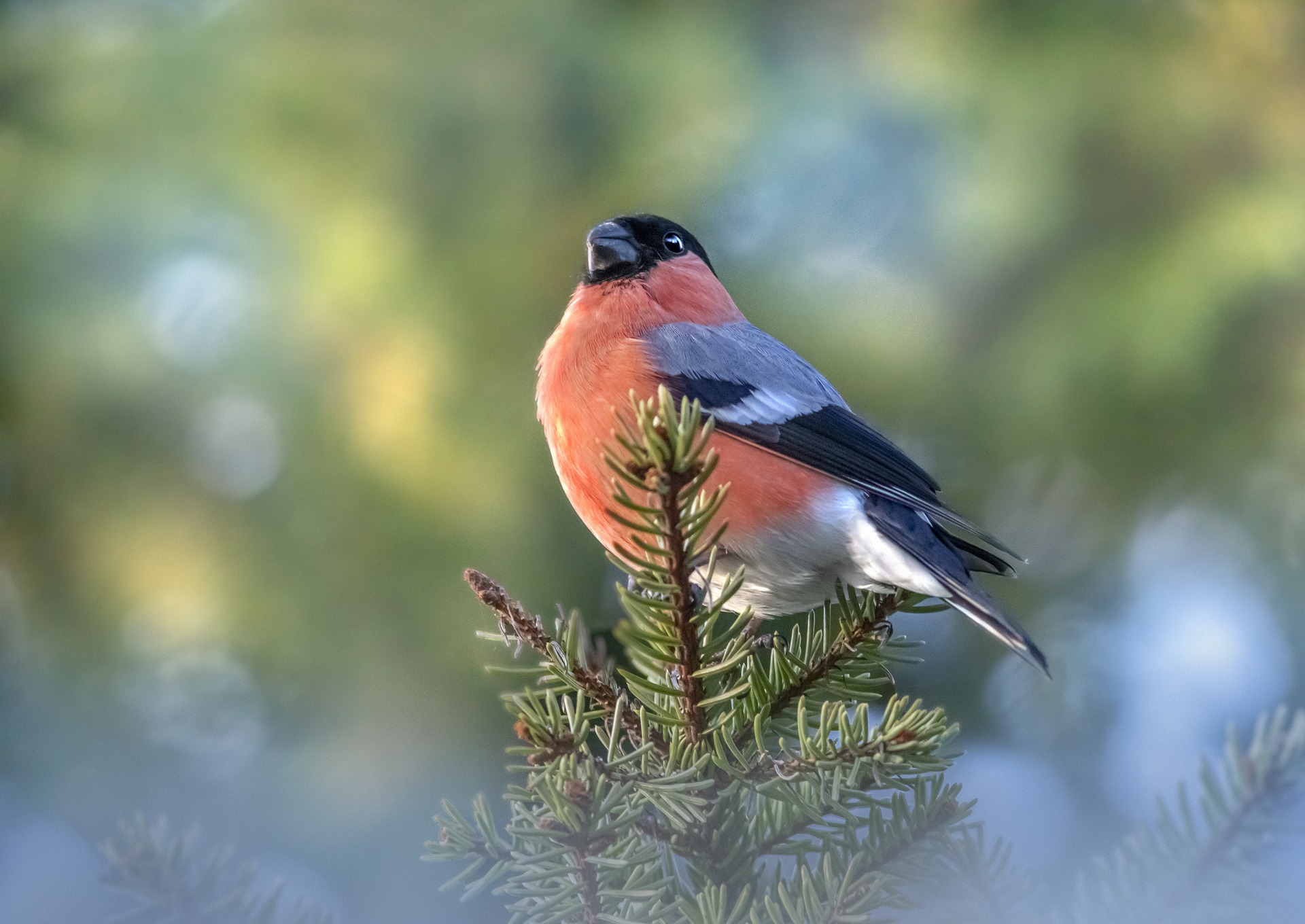
The Eurasian bullfinch (Pyrrhula pyrrhula) is one of the most distinctive and beloved songbirds in the Palearctic. Known for its quiet, shy nature and the male’s stunning rose-red breast, it is a bird of contrasts—vibrant in appearance but exceptionally understated in behavior.
1. Physical Profile
The bullfinch is a “bull-headed” bird, appearing neckless and chunky compared to more slender finches like the Chaffinch.
- Sexual Dimorphism: * Males: Flashy bright pink-to-red underparts, a blue-grey back, and a jet-black “cap” that extends around the eyes.
- Females: Much more subdued, with buff-brown underparts, though they retain the striking black cap and grey-brown back.
- Common Features: Both sexes share a thick, stubby black bill (perfect for crushing seeds and buds) and a brilliant white rump patch, which is often the only thing you see as the bird flies away into cover.
- Dimensions: Roughly 15–17 cm in length, weighing about 21–27g.
2. Behavior & Habitat
Unlike many finches that form massive, noisy winter flocks, the bullfinch is a creature of habit and solitude.
- Shy Nature: They are notoriously “skulking.” They rarely venture more than 10 meters from dense cover, preferring thick hedgerows, coniferous forests, and overgrown gardens.
- Dietary Specialist: They are famous for their love of tree buds (especially fruit trees like cherry and plum). In the spring, a small group can quickly strip an orchard, which historically led to them being labeled as agricultural pests. In winter, they shift to seeds, with a particular fondness for ash keys and nettle seeds.
- Social Life: Usually seen in pairs or small family groups. They are monogamous and often stay with their partner year-round.
3. Vocalization: The “Quiet” Song
The bullfinch doesn’t “blast” its song like a Blackbird. Its vocalizations are:
- Call: A soft, melancholy, whistling “phu” or “peu”. It is one of the most easily overlooked sounds in the woods.
- Song: A complex but very quiet warble, often including “creaky” notes and mimicry. Because they are so quiet, they were popular cage birds in the 19th century, specifically trained to whistle human folk tunes.
4. Conservation & Status
While globally listed as Least Concern, the Eurasian bullfinch has faced significant local challenges.
| Region | Status | Key Threats |
| UK | Amber Listed | Massive 40% decline since the 1970s due to the removal of hedgerows and “over-tidying” of woodland. |
| Europe | Stable/Declining | Vulnerable to agricultural intensification and the loss of fruit-bearing scrub. |
| Azores | Vulnerable | The “Azores Bullfinch” (P. murina) was once a subspecies but is now its own species; it is one of Europe’s rarest birds. |
Quick Identification Table
| Feature | Male | Female | Juvenile |
| Breast | Rose-Red | Grey-Brown | Buff-Brown |
| Cap | Glossy Black | Glossy Black | No Cap (Brown) |
| Rump | White | White | White |
| Back | Blue-Grey | Grey-Brown | Ginger-Brown |
Pro Tip for Birdwatchers: If you want to see one, don’t look for the red breast first. Look for the white rump flashing against the dark green of a hedge as they flee. They are often detected by their soft, “sad” whistle before they are ever seen.
Views: 1840
Subscribe to the newsletter: