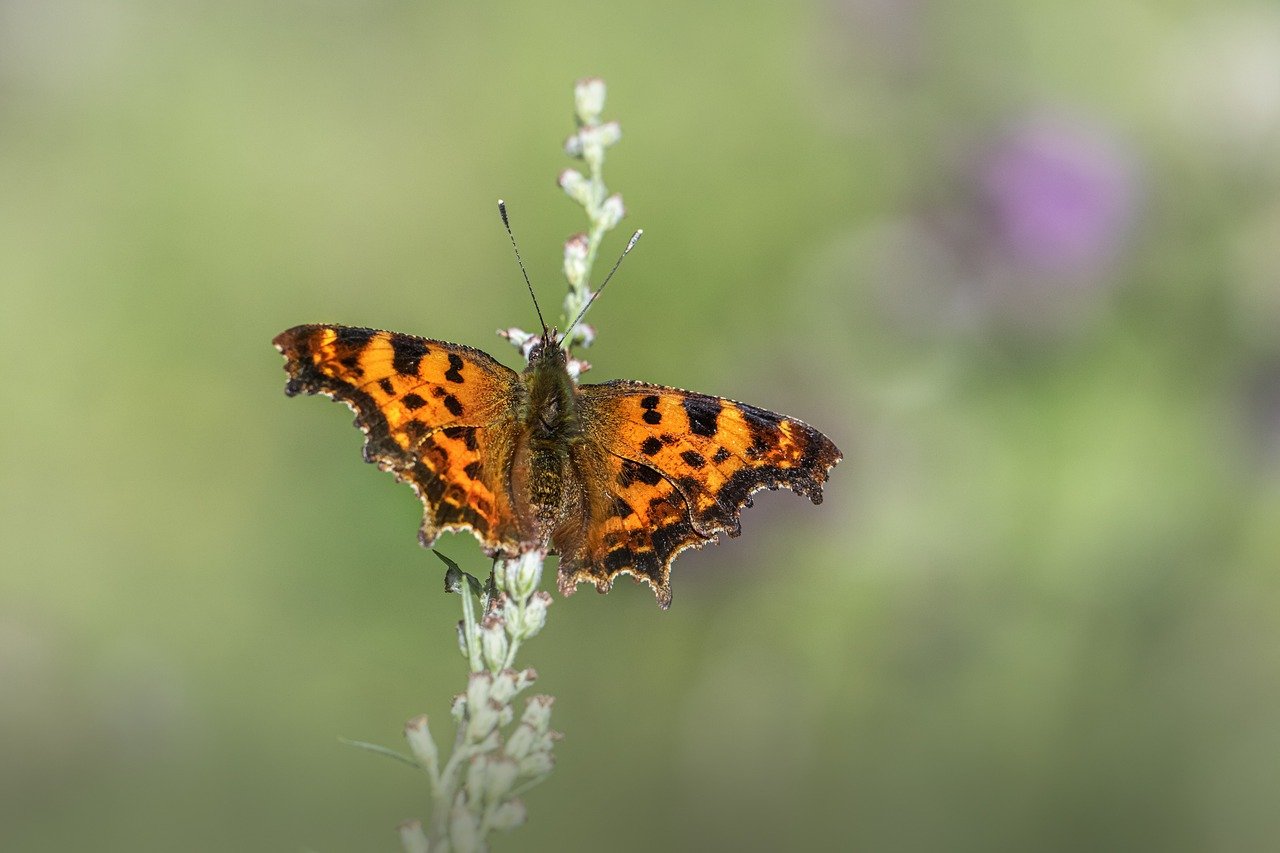
The Comma (Polygonia c-album) is a master of camouflage and a biological marvel of adaptability. Historically, it is famous for its dramatic population “yo-yo”—collapsing to near-extinction in parts of its range in the early 20th century before staging one of the most spectacular recoveries in the insect world.
1. Physical Profile: The “Withered Leaf”
The Comma’s name and scientific epithet (c-album meaning “white C”) come from a tiny, silver-white mark on its hindwing underside.
- The Wings: Its most striking feature is its deeply scalloped, “ragged” wing edges. This is an advanced form of disruptive coloration; when the butterfly closes its wings, the irregular outline breaks up its silhouette, making it look exactly like a jagged, dead leaf.
- Upperside: A vibrant tawny-orange with bold black and dark-brown spots. From a distance, it can be mistaken for a Small Tortoiseshell, but the jagged edges are a dead giveaway.
- Underside: Intricately marbled in shades of dark brown, grey, and mossy green.
- The “C” Mark: Centered on the hindwing underside is a small, bright white “comma” or “C” shape. It is thought that this mark may mimic a small crack or a glimmer of light reflecting off a dewdrop on a leaf, further enhancing its camouflage.
2. The hutchinsoni Mystery: Dual Life Strategies
One of the most fascinating aspects of Comma biology is its seasonal polyphenism—the ability to produce two distinct physical forms depending on environmental cues.
| Feature | Typical Form (Dark) | Form hutchinsoni (Pale) |
| Appearance | Darker orange upperside; dark brown underside. | Brighter, golden-orange; paler, buff underside. |
| Strategy | The Hibernator: Emerges in late summer, feeds up, and overwinters as an adult. | The Sprinter: Emerges in mid-summer and breeds immediately. |
| Lifespan | Long (9–10 months). | Short (a few weeks). |
| Causal Factor | Shorter day length during larval stage. | Increasing day length (spring/early summer). |
Biological Insight: Form hutchinsoni (named after the 19th-century entomologist Emma Hutchinson) allows the species to “squeeze in” an extra generation during warm years, accelerating its population growth.
3. Behavior & Evolution
- The “Aggressive Basking” Male: Males are highly territorial. They perch on sun-drenched leaves along woodland edges and launch high-speed “intersections” against anything that flies past—including other butterflies, birds, and even humans—before returning to the exact same leaf.
- Bird Dropping Mimicry: While the adult mimics a leaf, the caterpillar mimics bird droppings. In its middle growth stages, it is black and white, sitting exposed on the top of leaves. Predators usually ignore it, assuming it is unpalatable waste.
- The “Hops” Connection: Historically, the Comma was a major pest in hop gardens. Its 20th-century decline in the UK was linked to the collapse of the hop-growing industry, though it has since successfully switched its primary allegiance to the Stinging Nettle (Urtica dioica).
4. Conservation & The “Great Northward March”
As of late 2024, the Comma remains a poster child for the effects of climate change on biodiversity.
- Status: Least Concern (IUCN).
- Expansion: In the 1920s, the Comma was nearly extinct in England, restricted only to the Welsh borders. Today, it has spread hundreds of miles north, reaching deep into Scotland and even parts of Scandinavia.
- Why the comeback? Warmer summers have favored the hutchinsoni form, allowing for more successful second broods. Additionally, its high “polyphagy” (ability to eat many different plants like elms, willows, and currants) has allowed it to find homes in modern, fragmented landscapes where specialists might fail.
Quick ID: Comma vs. Southern Comma
If you are in Southern Europe, you might encounter its close cousin, the Southern Comma (Polygonia egea).
- The Mark: P. c-album has a “C” mark; P. egea has a thinner, “V-shaped” or “L-shaped” mark.
- Wing Edges: P. egea is slightly less “jagged” and more delicately marked.
- Habitat: P. egea prefers rocky walls and ruins, whereas P. c-album is firmly a woodland and garden species.
Would you like me to create a guide on how to attract Commas to your garden, or perhaps explore the “Question Mark” butterfly, its North American relative?
Views: 1553
Subscribe to the newsletter: