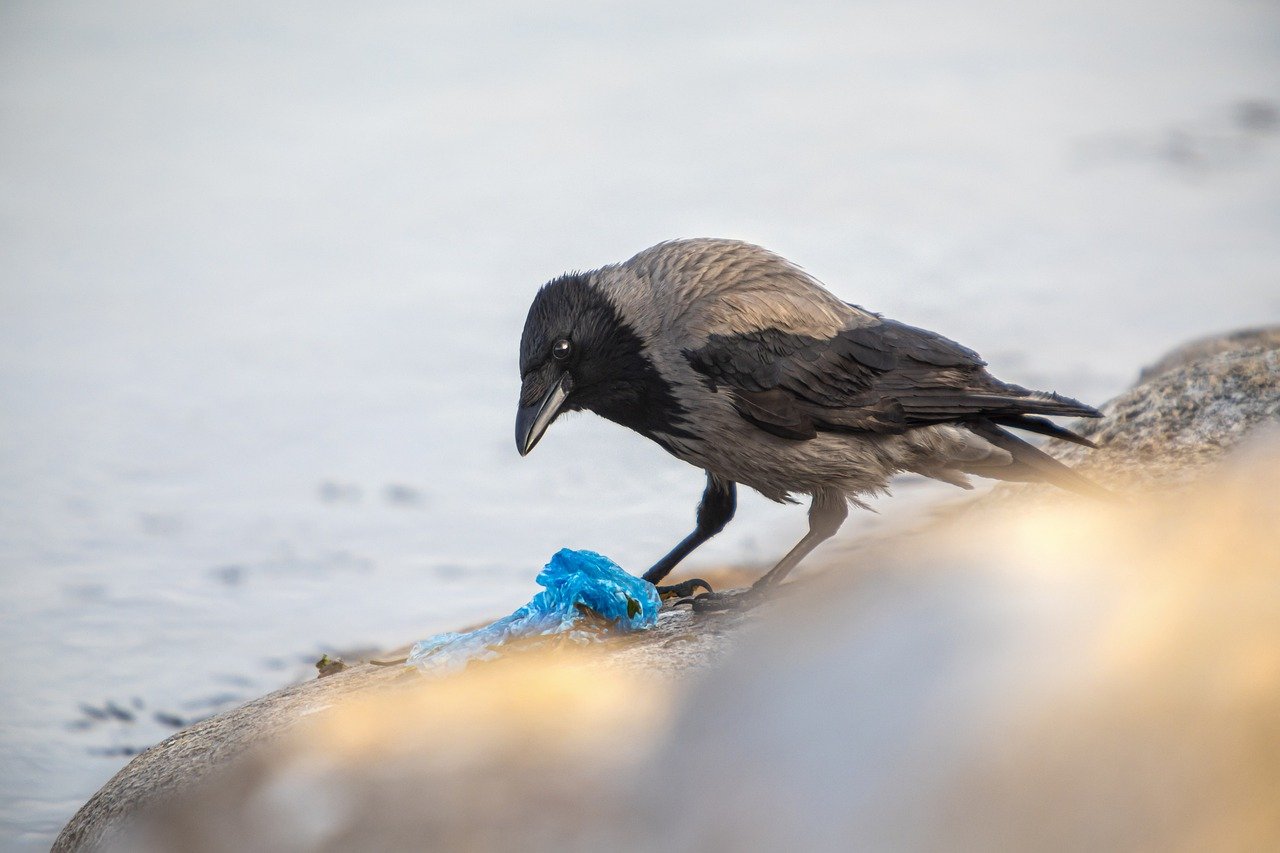
The Hooded Crow (Corvus cornix) is one of the most distinctive and intelligent members of the corvid family. Once considered a mere subspecies of the all-black Carrion Crow, it has become a central figure in evolutionary biology as a textbook example of “speciation in progress.” Known as the “Hoodie” in Scotland and Ireland, its striking two-tone plumage and complex social behaviors make it a staple of both the European landscape and regional folklore.
1. Physical Profile
The Hooded Crow is easily identified by its “mantle”—a contrasting ashy-grey body paired with a jet-black head, throat, wings, and tail.
- Size & Build: It measures between 48–52 cm in length with a wingspan of roughly 100 cm. It is virtually identical in size and shape to the Carrion Crow.
- The “Hood”: The black plumage on the head descends like a bib onto the breast, creating the “hooded” appearance.
- Subspecies Variations: There are four widely recognized subspecies:
- C. c. cornix (Nominate): Found in the UK, Ireland, and Northern Europe.
- C. c. sharpii: Paler grey, found from Siberia to the Caucasus.
- C. c. pallescens: A small, very pale form found in Turkey and Egypt.
- C. c. capellanus (Mesopotamian Crow): So pale it appears almost white; some authorities suggest it may be a separate species entirely.
2. The Evolutionary “Conundrum”
The Hooded Crow is famous in science for its relationship with the Carrion Crow (Corvus corone).
- The Species Split: For decades, they were treated as one species. In 2002, many ornithological unions (like the BOU) elevated the Hooded Crow to a full species. However, the debate continues because they are 99.72% genetically identical.
- Speciation Islands: Genomic research (notably a 2014 study) revealed that the differences between the two are concentrated in tiny “islands” of the genome—specifically on Chromosome 18. These genes control feather pigmentation and visual perception, meaning they look and perceive each other as different, despite being nearly identical under the hood.
- The Hybrid Zone: A narrow, stable “contact zone” runs across Europe (from Scotland through Germany to Italy). Here, the two species interbreed, producing fertile hybrids with “muddy” grey-and-black plumage.
3. Intelligence & Behavior
Like their raven cousins, Hooded Crows exhibit high-level problem-solving and social complexity.
- Tool Use & Innovation: In Finland, they have been observed reeling in fishing lines left by ice fishermen to steal the fish. They are also famous for dropping mollusks and nuts onto hard roads or rocks from specific heights to shatter the shells—a behavior known as “gravity-dropping.”
- Memory: They can recognize individual human faces and are known to hold “grudges” against people who have threatened them, warning other crows in the area.
- Social Structure: While Carrion Crows are often solitary or in pairs, “Hoodies” are notably more sociable, frequently foraging and roosting in large, communicative groups.
4. Habitat & Distribution
The Hooded Crow replaces the Carrion Crow in the north and east of the Palearctic.
- Range: It is the dominant crow across Ireland, Scotland, Scandinavia, Eastern Europe, and the Middle East.
- Adaptability: They are highly successful “generalists,” thriving in coastal cliffs, mountain moorlands, urban parks, and farmland.
- Migration: While mostly sedentary in the UK and Ireland, populations in Scandinavia are migratory, often flying to eastern England for the winter, where they were historically called “Royston Crows” or “Danish Crows.”
5. Culture & Folklore
The “Hoodie” holds a darker, more magical place in Celtic and Slavic tradition than the all-black crow.
- The Morrígan: In Irish mythology, the war goddess Morrígan often takes the form of a crow (specifically interpreted as a Hooded Crow) to hover over battlefields as an omen of doom or victory.
- The Cailleach: In Scottish lore, the Hooded Crow is associated with the Cailleach (the Queen of Winter), representing the transition between life and death.
- The “Hoodie Crow” Tale: A famous West Highland fairy tale tells of a youngest daughter who marries a Hooded Crow, only to find he is a cursed prince who is a man by day and a bird by night.
6. Conservation Status
- IUCN Status: Least Concern. * Status in UK: Green Listed. While they were heavily persecuted by gamekeepers in the 19th and 20th centuries for raiding nests, their populations are currently stable. In fact, in some areas of Northern Ireland, they have seen a significant increase in recent decades.
Views: 1945
Subscribe to the newsletter: