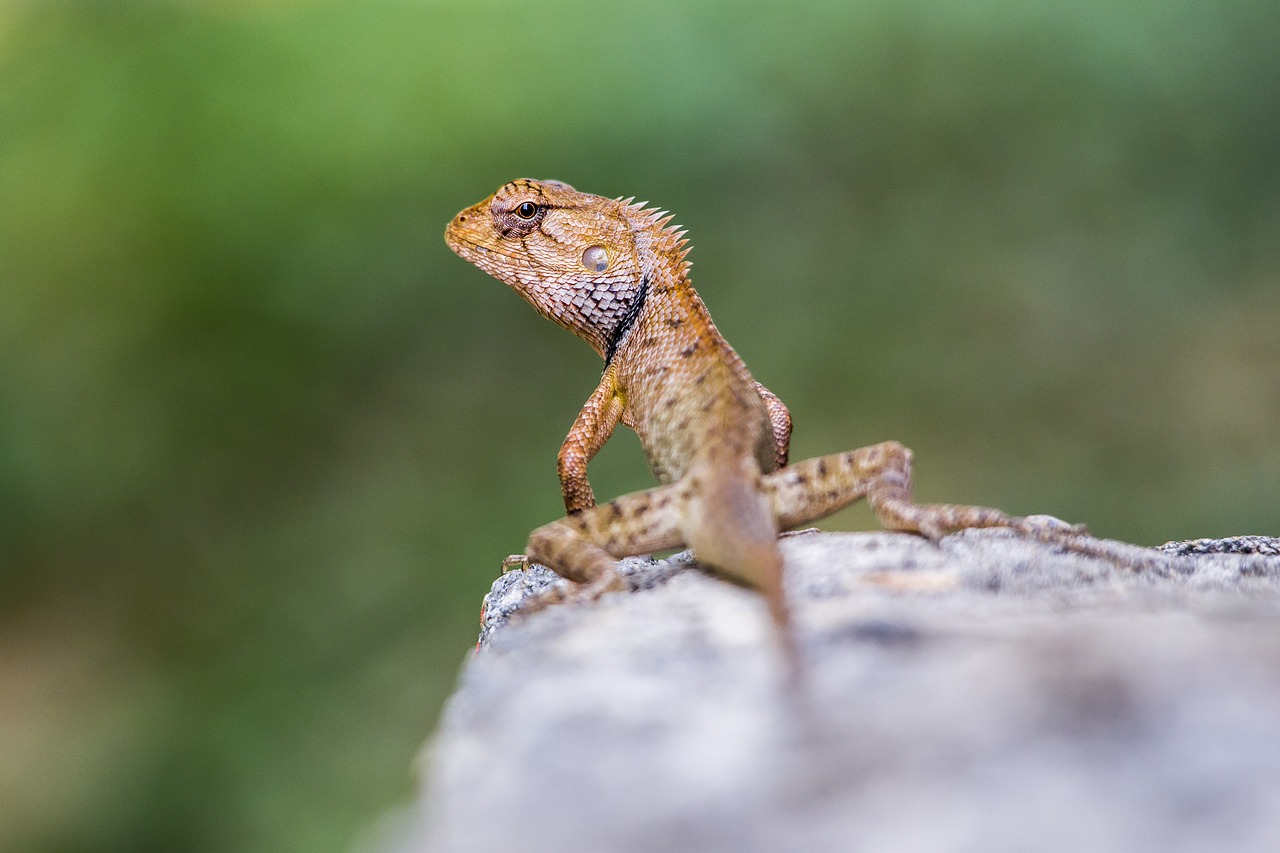
The Oriental Garden Lizard (Calotes versicolor), popularly known as the Changeable Lizard or the “Bloodsucker,” is one of the most successful and widespread lizards in the world. While it appears to be a common garden resident, recent genetic research has revealed that it is actually a “species complex” of several distinct, cryptic species.
🦎 Physical & Behavioral Profile
The Oriental Garden Lizard is a medium-sized agamid, typically reaching about 30–40 cm in length (including the tail).
- The “Bloodsucker” Myth: Its ominous nickname comes from the male’s striking transformation during the breeding season. His head and shoulders turn a vivid scarlet or orange-red, leading to a folk myth that the lizard has sucked blood from its prey.
- Color Change: Like a chameleon, it can adjust its hue based on temperature, mood, and surroundings. When stressed or during a fight, they can turn almost black or exhibit dark transverse stripes.
- No Tail-Dropping: Unlike many common lizards (like geckos or anoles), Calotes versicolor cannot drop its tail (caudal autotomy). If it loses its tail to a predator, it does not grow back.
- Territorial “Push-ups”: To defend territory or attract mates, males perform rhythmic “push-up” displays and vigorous head-bobbing while perched on high vantage points.
🧬 The “Species Complex” Revelation
For over 200 years, scientists thought Calotes versicolor was a single species ranging from Iran to China. However, major studies in 2021 (Gowande et al.) used DNA analysis to prove it is actually a group of distinct species that look almost identical.
| Lineage Name | Geographic Range | Status |
| C. versicolor (Sensu stricto) | Southern and Eastern India | The “true” original species. |
| C. irawadi | NE India to Southeast Asia | Most common in Thailand/Myanmar. |
| C. vultuosus | Indo-Gangetic Plains | Resurrected from an old synonym. |
| C. farooqi | Pakistan & adjacent regions | Formerly a subspecies, now elevated. |
Insight: This means the “Oriental Garden Lizards” you see in Singapore or Florida might technically be different species than the ones found in South India!
🌍 An Efficient Invader
The species has become a textbook example of a successful invasive lizard. They are generalists that thrive in “man-made” habitats like gardens, parks, and agricultural fields.
Major Invasions & Impacts:
- Singapore: Arrived in the 1980s (likely via trains from Malaysia). They have almost entirely displaced the native Green Crested Lizard (Bronchocela cristatella) through competition and aggression.
- Florida, USA: Established in St. Lucie County since 1978 after escaping from a reptile dealer. They are currently expanding through citrus groves and urban areas.
- Mauritius & Reunion: Linked to the decline and potential extinction of several native island skinks and geckos.
- Dietary Impact: While primarily insectivorous (ants, beetles, spiders), they are opportunistic hunters. Large adults have been documented eating small frogs, young snakes, and even fledgling birds.
🍽️ Quick Facts
- Hunting Style: “Sit-and-wait” predator. They stay motionless on a trunk and lunge at passing insects.
- Lifespan: Approximately 3 to 5 years in the wild.
- Reproduction: They lay 6–20 leathery eggs in moist soil. The sex of the hatchlings is determined by the temperature of the nest.
Views: 1068
Subscribe to the newsletter: