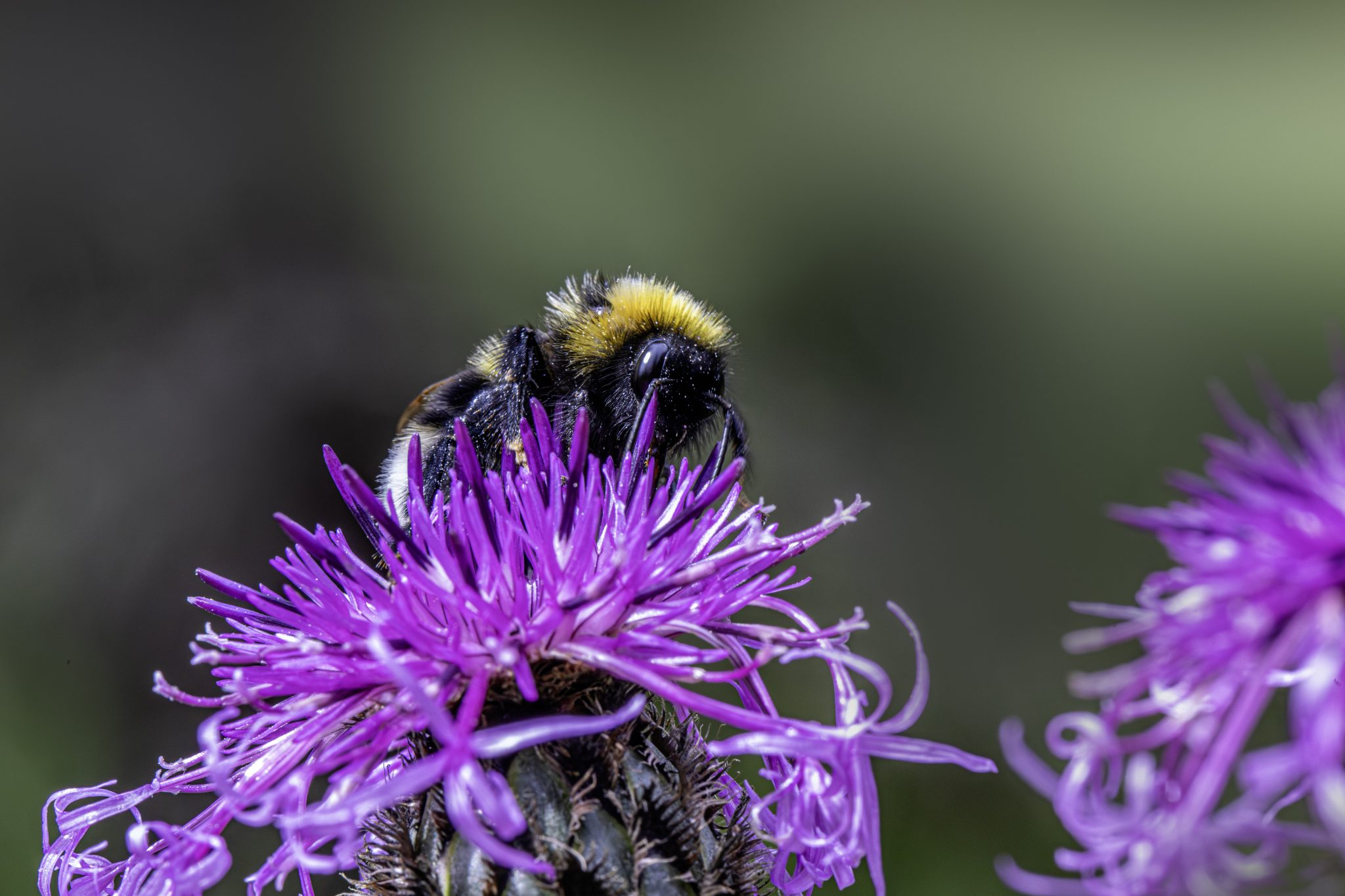
The Common carder bee (Bombus pascuorum) is the most ubiquitous of the “brown” bumblebees. While many bumblebee species are struggling, the Common carder remains a resilient generalist, found everywhere from high-altitude alpine meadows to the center of industrial cities. It is best known for its “shaggy” appearance and its unique architectural habit of “carding” its nest.
1. Physical Profile: The “Ginger” Identity
Unlike the neat, banded patterns of the Buff-tailed or White-tailed bumblebees, the Common carder is a messy, “fluffy” bee.
- Appearance: The thorax is covered in dense, reddish-brown (ginger) hairs. The abdomen is variable—usually a mix of ginger, cream, and black hairs—giving it a “grizzled” or faded look.
- The “Black Hair” Rule: This is the key to identification. Unlike its rarer cousins (the Moss and Brown-banded carder bees), the Common carder always has some black hairs mixed in on the sides of its abdomen.
- Long-Tongued Specialist: It possesses a notably long tongue (up to 15mm in queens). This allows it to feed on deep, tubular flowers that other bees cannot reach, such as honeysuckle, foxgloves, and red clover.
- Size: Queens are 15–18 mm; workers are much smaller (10–15 mm).
2. The “Carding” Master (Behavior & Nesting)
The name “carder” comes from the textile industry term for combing wool. This bee does exactly that with its nesting materials.
- Nest Construction: Unlike most bumblebees that hide in deep underground holes, carder bees often nest on the surface or just below it, in thick grass tussocks or moss mats.
- The Technique: The workers use their legs and mandibles to “comb” or “card” moss, dried grass, and hair together into a compact, felt-like ball. They then waterproof this structure with a thin layer of wax to protect the brood inside.
- Colony Size: Their colonies are relatively small, typically housing between 60 and 150 individuals at their peak in summer.
3. Lifecycle: The Marathon Runner
The Common carder bee has one of the longest active seasons of any wild bee in the Palearctic.
- Early Starters, Late Finishers: Queens emerge from hibernation as early as March and can still be seen foraging as late as November. This 8-to-9-month window is significantly longer than species like the Early bumblebee (B. pratorum), which completes its cycle by mid-summer.
- Succession: Because they are active so late into the autumn, they are vital pollinators for late-season plants like Ivy and Devil’s-bit Scabious.
- The Male “Patrol”: In late summer, you will see males (drones) flying low, repetitive circuits around bushes and hedges, depositing pheromones to attract new queens.
4. Identification: The “Brown” Bee Dilemma
Distinguishing the three main “carder” species in the field is a notorious challenge for entomologists.
| Feature | Common Carder (B. pascuorum) | Moss Carder (B. muscorum) | Brown-banded (B. humilis) |
| Abdomen Hairs | Black hairs always present | No black hairs (all ginger/blonde) | No black hairs on abdomen |
| Thorax Sides | Often has black/grey patches | Entirely ginger/yellow | White/pale sides (contrasting) |
| Appearance | Shaggy, untidy | Neat, “velvety” or “clipped” | Shaggy |
| Habitat | Gardens, Woods, Everywhere | Coastal, Damp grasslands | Dry, flower-rich meadows |
5. Conservation & 2024/2025 Status
While generally stable, the Common carder bee has faced a “moderate decline” over the last decade due to habitat fragmentation.
- The 2024 Impact: Across the UK and Northern Europe, 2024 was recorded as a historically bad year for bumblebees due to an exceptionally wet spring and cold start to summer. However, B. pascuorum fared better than most due to its late-season peak, allowing it to “rescue” its colony numbers when the weather improved in August.
- Resilience: Its ability to nest in “untidy” garden corners and its wide dietary range makes it a “winner” in the face of urban sprawl, provided chemical pesticide use is kept low.
Garden Tip: If you want to help them, stop “tidying” your garden early. Common carders rely on the dried grass and moss found in lawn “thatch” and hedge bases for their nests. A “messy” corner is a palace to a carder bee.
Views: 335
Subscribe to the newsletter: