The Elusive Sentinel: Mastering the Mystery of the Long-eared Owl (Asio otus)
Among the nocturnal hunters of the forest, few are as enigmatic or as masterfully camouflaged as the Long-eared Owl (Asio otus). Often described as the “ghost of the woods,” this slender owl is a master of the vertical line, stretching its body to mimic a broken branch and vanishing into the bark of a pine tree.
The “False Ears” and Hidden Geometry
The most striking feature of this species is, of course, the long “ear tufts” that give it its name. However, these are not ears at all—they are simply feathers used for communication and camouflage.
- The Real Ears: Hidden behind the facial disk are asymmetrical ear openings. One is higher than the other, allowing the owl to “triangulate” the tiny rustle of a vole in complete darkness.
- The Facial Disk: This orange, heart-shaped disk acts like a satellite dish, funnelling even the faintest sounds directly into those hidden ears.
The Secret Society of Winter Roosts
While many owls are strictly solitary, Long-eared Owls have a fascinating social side. During the winter months, they form communal roosts. You might find a dozen or more individuals huddled together in a single dense thicket of conifers or ivy. This “strength in numbers” strategy likely helps them stay warm and provides more eyes to watch for predators like Goshawks.
A Voice of the Night
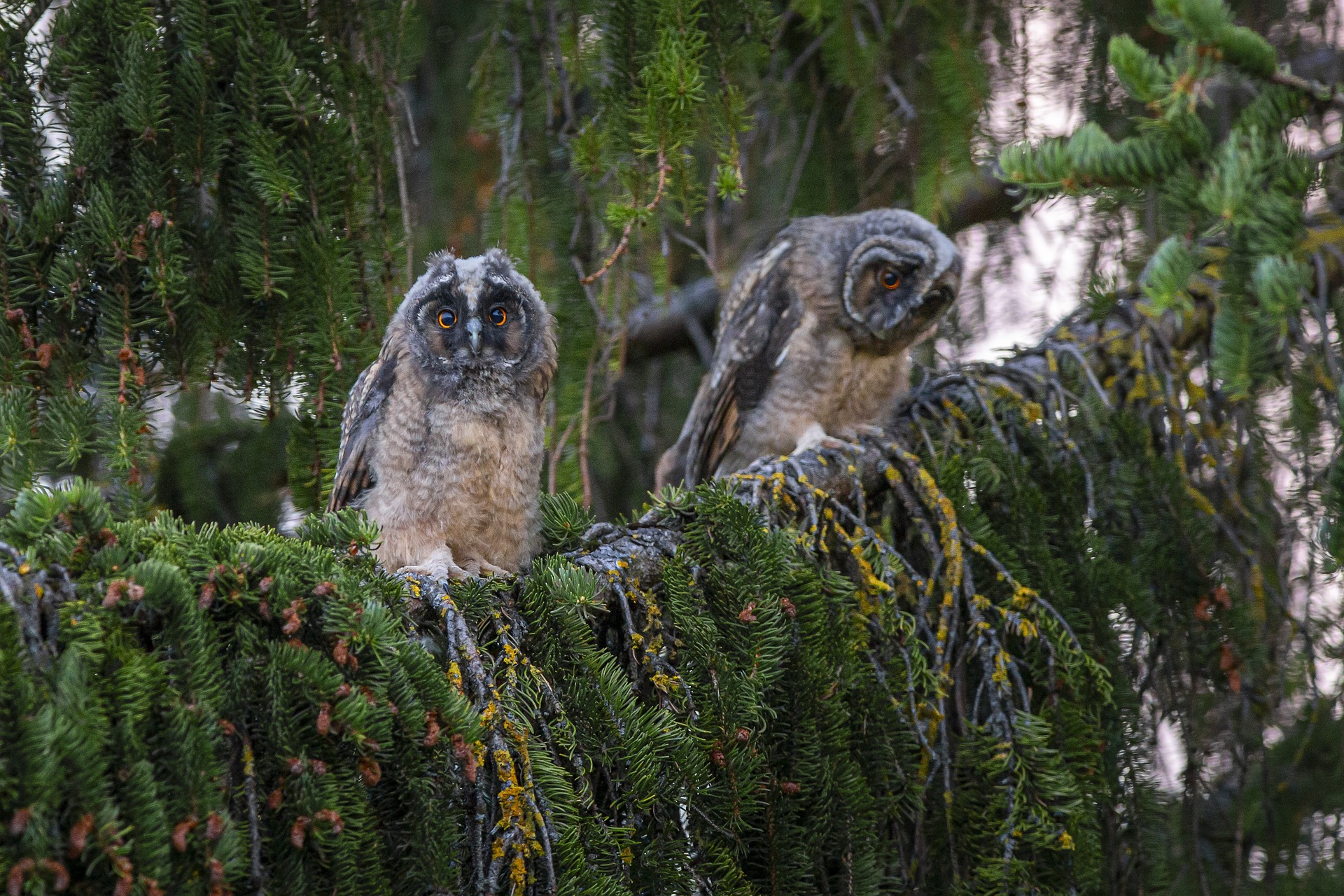
If you are wandering near a woodland edge in the spring, listen for the male’s song: a deep, mournful “hoo” repeated every few seconds. But the truly eerie sound comes from the fledglings; their “squeaky gate” hunger call is a high-pitched, metallic whine that can be heard from hundreds of meters away, guiding parents (and lucky birdwatchers) to their location.
📸 Photographer’s Perspective: Capturing the Invisible
Photographing a Long-eared Owl is a test of patience and ethics. Because they are so well-camouflaged and sensitive to disturbance, your approach is everything.
- Look for the “Sign”: Don’t just look for feathers. Search the ground under dense pine stands for pellets (regurgitated fur and bone) and “whitewash” (droppings). If you find a concentration of these, look directly up into the darkest part of the tree.
- Read the Body Language: If the owl “stretches” its body, flattens its feathers, and stares intently at you, it is stressed and trying to look like a branch. Back away immediately. A relaxed owl will look “puffy” or may even close its eyes.
- The “V” Between the Eyes: Focus your camera on the bridge of the beak. The Long-eared Owl has two vertical white lines between its yellow-orange eyes that form a striking “V” shape, which serves as a perfect focal point for sharp portraits.
Quick Facts Table
| Feature | Detail |
| Scientific Name | Asio otus |
| Wingspan | 90–100 cm |
| Favorite Prey | Voles (over 95% of their diet) |
| Nesting Habit | Reuses old nests of Crows, Magpies, or Hawks |
| Lifespan | Can live over 25 years in the wild |
| Status | Secretive and under-recorded in many regions |
Views: 1133
Subscribe to the newsletter: