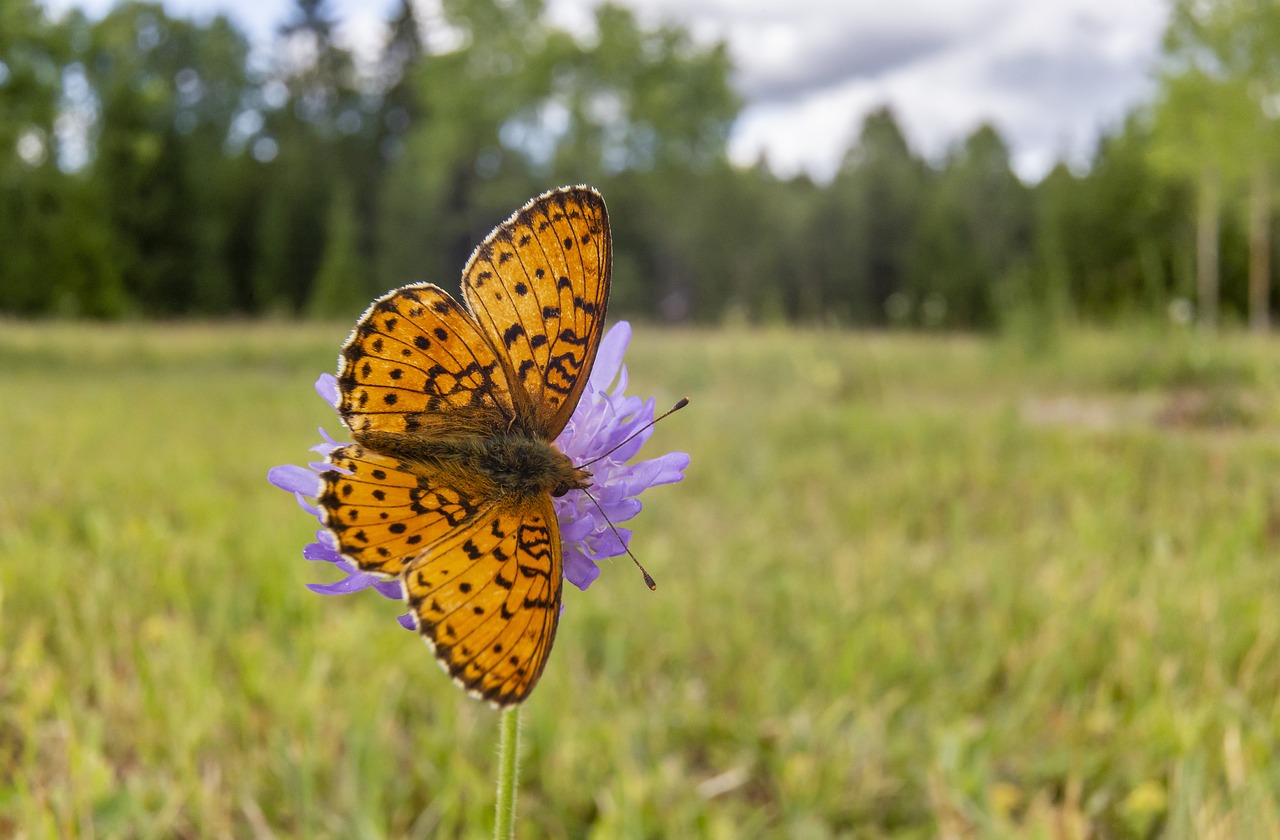
The Lesser marbled fritillary (Brenthis ino)—known in Estonian as the Luhatäpik—is a medium-sized butterfly that serves as a vibrant ambassador for Europe’s damp grasslands.1 While many of its fritillary relatives prefer dry, chalky downs, the Lesser marbled fritillary is a specialist of the wetlands, often found fluttering where the air is heavy with the scent of Meadowsweet.
Based on the macro photography and observations from karits.eu, here is a closer look at this “marbled” beauty.
1. The Underside: A Violet Marble Masterpiece
The “marbled” in its name comes from the exquisite pattern on the underside of its hindwings. Unlike many other fritillaries, such as the Argynnis group, the Lesser marbled fritillary lacks any silver or metallic spots.2
- The Color Palette: The underside is a mosaic of cream, yellow, and orange, but its most diagnostic feature is the violet or purplish-brown shading that clouds the outer edges of the hindwing.
- The “Square” Patch: To distinguish it from the very similar Marbled fritillary (Brenthis daphne), look at the small square cell in the center of the underside hindwing. In B. ino, this patch is a solid, clear yellow, whereas in its larger cousin, it is usually suffused with orange or pink.3
2. The Meadowsweet Connection
The life cycle of the Luhatäpik is intimately tied to the Meadowsweet (Filipendula ulmaria).4
- The Host Plant: This tall, frothy-white wildflower is the primary food source for the caterpillars.5 Because Meadowsweet thrives in damp ditches, fens, and water-meadows, the butterfly is rarely found far from these humid environments.6
- The “Egg Shell” Winter: Uniquely, this species overwinters as a tiny, fully-formed caterpillar still tucked inside its egg shell.7 It only hatches in the early spring (March or April) to begin feeding on the fresh, tender shoots of its host plant.8
3. Behavior: The “Sleepy” Basking
During the peak of their flight season (late June to July), these butterflies are a common sight in Estonian “luht” (floodplain) meadows.
- Nectaring: They are not particularly shy and will spend long periods nectaring on Thistles, Knapweed, and Bramble flowers.9
- Territorial Patrolling: Males spend much of the morning patrolling low over the vegetation in search of females. Their flight is relatively slow and gliding compared to the frantic “skipping” of some other species, making them excellent subjects for observation.
📸 Photographer’s Perspective: Capturing the Marbled Detail
Because they are frequent flower-visitors, the Lesser marbled fritillary is one of the more cooperative butterflies for macro photography.
- Seek the “Violet” Profile: To capture the most identifying features, aim for a side-on profile shot while the wings are closed. This highlights the violet “marbled” shading and the lack of silver spots.
- The Eye-Level “Bloom” Shot: When they are feeding on a flower, try to get down to their level. Using a wide aperture ($f/2.8$ to $f/4$) will blur the background into a soft green wash, making the orange and black checkerboard of their upperside stand out.
- Timing the Light: The orange upperside can easily become “blown out” (overexposed) in harsh midday sun. Shooting in the late afternoon provides a warmer, softer light that saturates the orange tones and brings out the subtle texture of the wing scales.
- The Morning Dew: In damp meadows, morning dew is a guarantee. Finding a Lesser marbled fritillary roosting on a grass stem, covered in crystal-clear droplets, is the “Holy Grail” shot for this species.
Quick Facts Table
| Feature | Detail |
| Scientific Name | Brenthis ino |
| Estonian Name | Luhatäpik |
| Wingspan | 34–42 mm |
| Flight Period | June to August (Peak in late June/early July) |
| Larval Foodplant | Meadowsweet (Filipendula ulmaria), Raspberry, Stone Bramble |
| Habitat10 | Damp meadows, bogs, and waterlogged forest clearings11 |
View the full gallery of this species and download high-resolution CC0-licensed images at karits.eu.
Views: 1264
Subscribe to the newsletter: