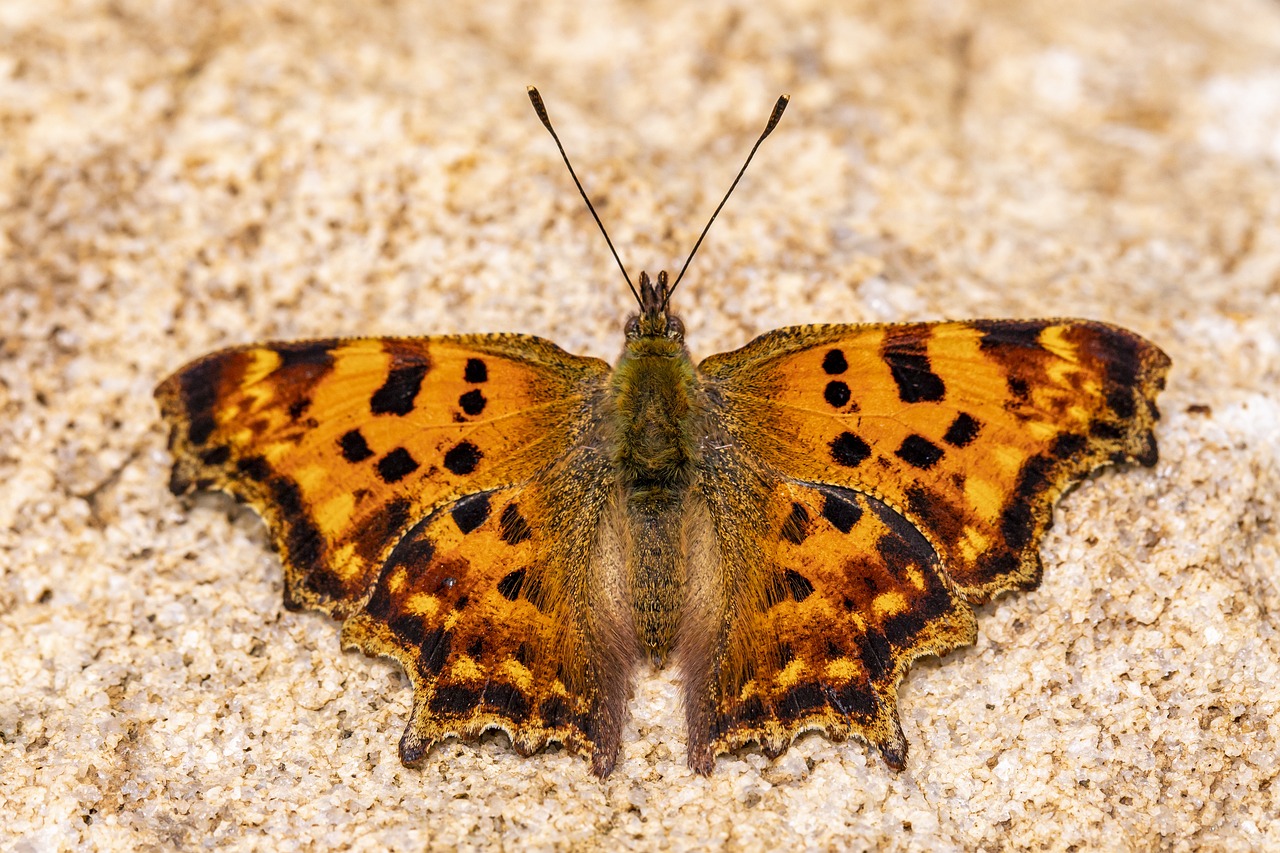
The Comma butterfly (Polygonia c-album) is one of the most distinctive and adaptable species in the Palearctic region. In Estonia (where it is known as Sass-päevaliblikas), it is a familiar sight in woodland edges and gardens, often being one of the first butterflies to appear in early spring after hibernating as an adult.
Based on the latest entries and high-resolution captures at karits.eu, here is a detailed profile of this “master of disguise.”
1. The “Withered Leaf” Mastery
The Comma’s most famous adaptation is its jagged, scalloped wing edges. This is a sophisticated form of disruptive coloration:
- The Mimicry: When the wings are closed, the irregular outline breaks up the butterfly’s silhouette. Its mottled brown and mossy-green underside mimics a dried, tattered leaf so perfectly that it becomes nearly invisible against bark or leaf litter.
- The “C” Signature: The common and scientific name (c-album, meaning “white C”) refers to the small, bright white or silver mark on the underside of each hindwing. This tiny “comma” is thought to mimic a crack in a leaf or a spot of reflected light.
2. The “hutchinsoni” Mystery: Dual Life Strategies
The Comma exhibits a fascinating biological trait called seasonal polyphenism, where a single species produces two different physical forms:
- Typical Form (Dark): These emerge in late summer, have darker undersides optimized for hibernation, and live for 9–10 months, overwintering in hollow trees or woodpiles.
- Form hutchinsoni (Pale): These emerge in mid-summer. They are brighter orange and have paler undersides. Unlike the typical form, they do not hibernate; they breed immediately to produce a second generation before dying after just a few weeks.
3. The “Great Northward March”
The Comma is a rare “climate change winner.” In the early 20th century, it was nearly extinct in some regions (like the UK), restricted to tiny pockets of habitat.
- Host Plant Shift: Originally heavily dependent on Hops, the species successfully transitioned to the ubiquitous Stinging Nettle (Urtica dioica).
- Range Expansion: Assisted by warmer summers, the Comma has staged a spectacular recovery, expanding its range hundreds of miles northward into Scotland and deeper into Scandinavia.
📸 Photographer’s Perspective: “Aggressive Basking”
Capturing a Comma is as much about understanding its psychology as it is about camera settings.
- Defending the Throne: Males are fiercely territorial. They choose a “throne”—a specific sunlit leaf—and will launch high-speed “interception” flights against anything that enters their airspace, including birds and humans. If they fly off, wait a few minutes; they almost always return to the exact same perch.
- Macro Detail of the Caterpillar: Don’t ignore the larvae. Comma caterpillars are famous for mimicking bird droppings (black and white with spiny hairs) in their middle growth stages. This “unappetizing” look is a brilliant defense mechanism against birds.
- Texture and Light: To highlight the “silver C,” use a side-profile angle. In the Golden Hour, backlighting the jagged wings can make the orange upper side glow like stained glass, emphasizing the dark spots and the unique silhouette.
Quick Identification: Comma vs. Southern Comma
| Feature | Comma (P. c-album) | Southern Comma (P. egea) |
| White Mark | A distinct “C” or “Comma” | A thinner “V” or “L” shape |
| Wing Edges | Extremely jagged/ragged | More delicately scalloped |
| Habitat | Woodlands and Gardens | Rocky walls and ruins |
Explore the latest 2026 gallery of the Comma butterfly and download CC0-licensed images at karits.eu.
Views: 1493
Subscribe to the newsletter: