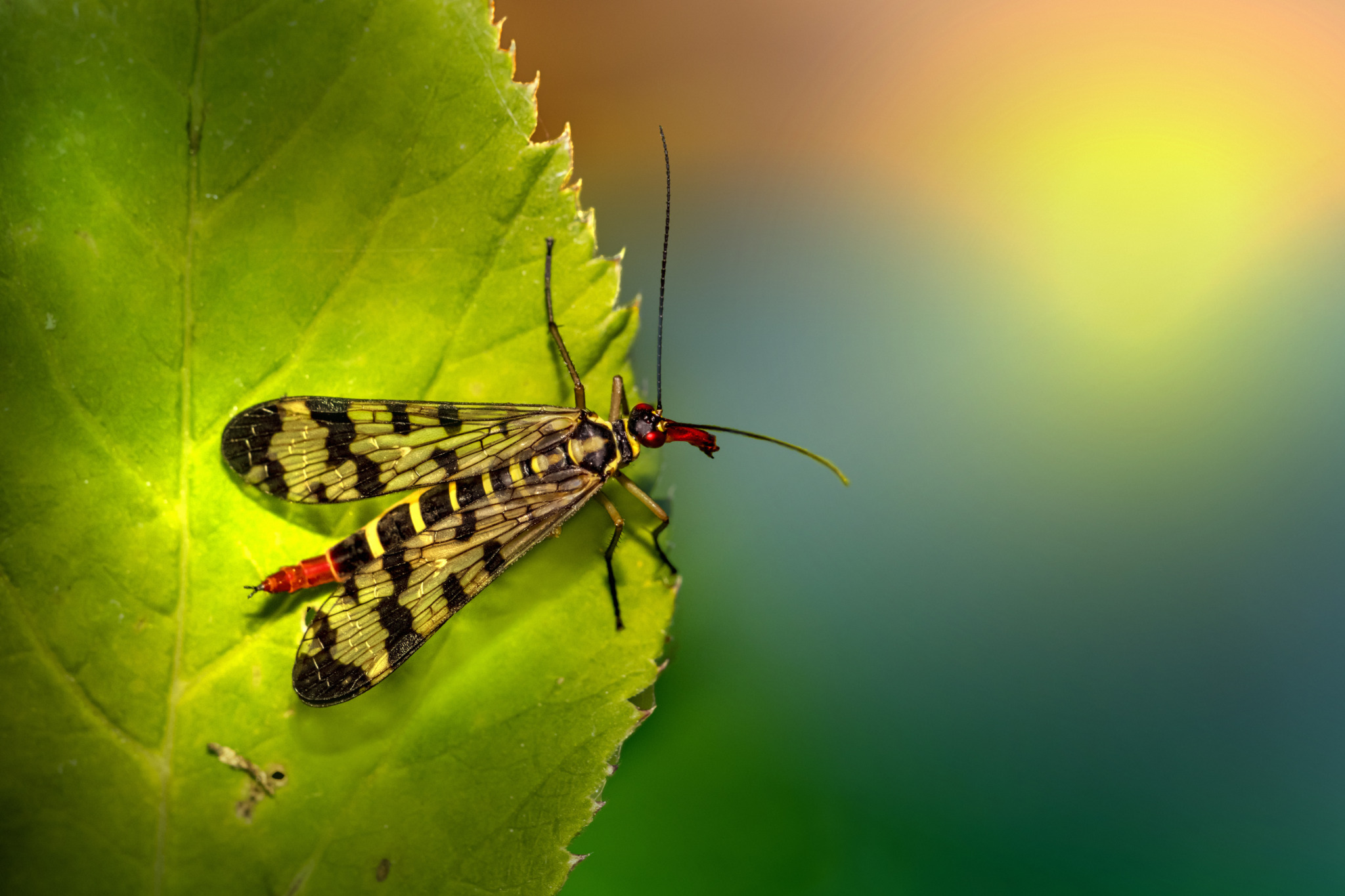
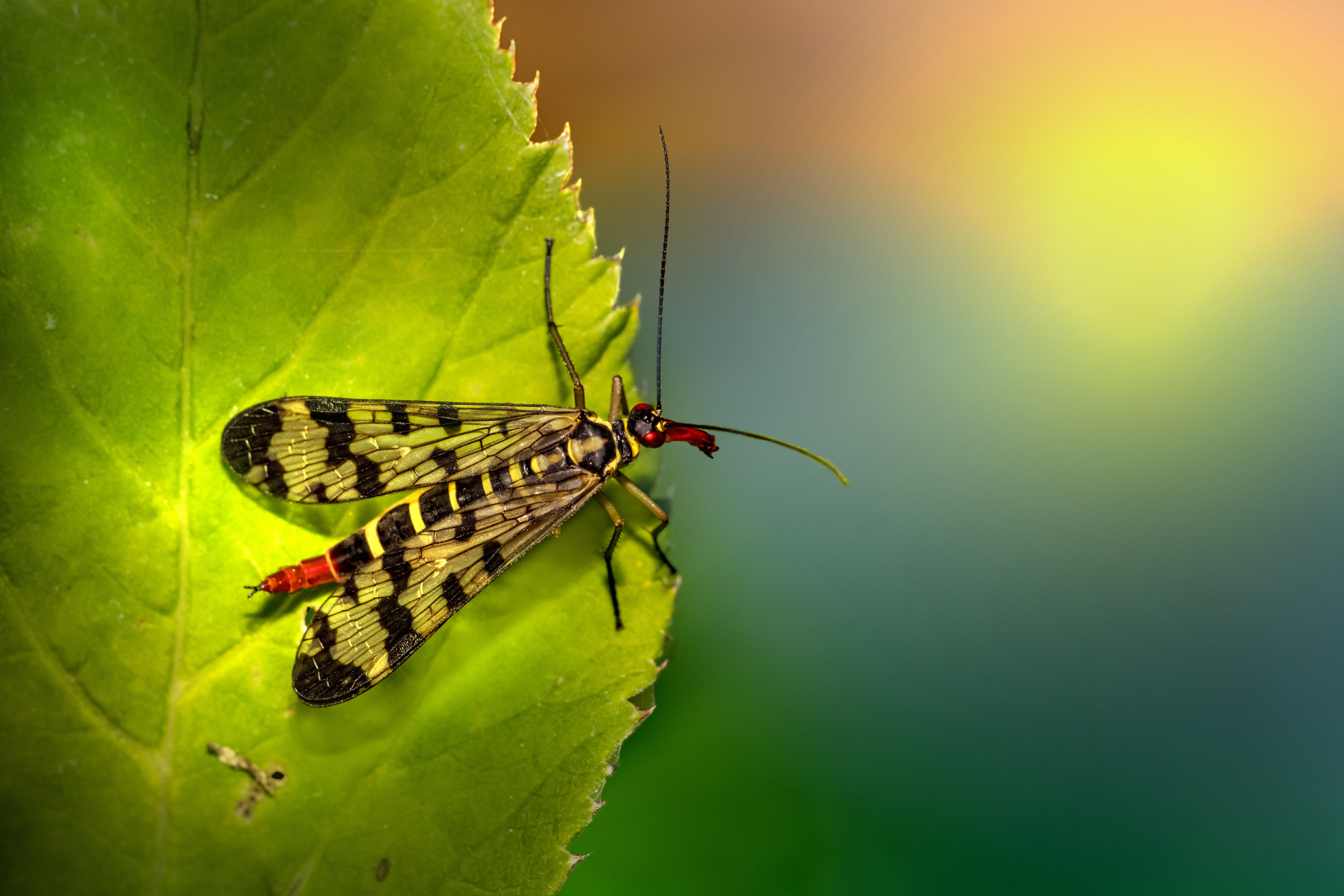
The Scorpion Fly (Panorpa communis) is one of the most misunderstood insects in the garden. With its elongated “beak” and the male’s menacing, upturned tail, it looks like a creature spliced together from a nightmare. In reality, it is a fascinating, ancient scavenger that is entirely harmless to humans.
Based on the macro photography at karits.eu, here is a breakdown of this peculiar “living fossil.”
1. The “Stinger” That Isn’t
The most famous feature of the Scorpion Fly is the male’s tail, which curves over its back exactly like a scorpion’s stinger.
- The Truth: This structure is actually an enlarged genital capsule (claspers) used during mating. It contains no venom and cannot sting. Females lack this feature entirely, having a straight, pointed abdomen instead.
- The Bluff: Evolution likely favored this shape as a Batesian mimicry tactic—predators like birds may avoid the fly, thinking they are about to get a face full of venom.
2. The Ultimate Romantic: Nuptial Gifts
Dating in the Scorpion Fly world is a high-stakes transaction. To convince a female to mate, the male must bring a “nuptial gift.”
- The Offering: This usually consists of a dead insect or, quite remarkably, a droplet of the male’s own nutrient-rich saliva.
- The Strategy: If the gift is high-quality, the female will feed on it while the male mates. If he arrives empty-handed, he risks being rejected or even attacked. Scientists have found that the larger the gift, the longer the mating session lasts, ensuring better reproductive success.
3. The Web-Robbing Scavenger
The Scorpion Fly has a unique, somewhat cheeky diet. It is a kleptoparasite, meaning it frequently steals food from others.
- Spider Web Raids: They are often seen landing on spider webs to pluck out trapped, dead insects.
- The “Beak”: Their long, downward-pointing rostrum (beak) is perfectly designed for reach. It allows them to probe into crevices or the sticky threads of a web to extract soft tissues from carrion without getting stuck themselves.
📸 Photographer’s Perspective: Macro on the Macabre
Capturing a Scorpion Fly is all about highlighting its alien-like anatomy.
- Focus on the Rostrum: The “face” of the Scorpion Fly is its most unique feature. A head-on or profile shot that captures the compound eyes and the elongated beak provides a truly “otherworldly” feel.
- The “Tail” Profile: For males, a side-on shot is essential to show the curve of the abdomen. This is best achieved by staying low and parallel to the insect’s body.
- Nettle Hunting: Look for them on the leaves of Stinging Nettles or in damp, shaded woodland edges. They aren’t the strongest fliers and tend to flutter short distances before landing, giving you multiple chances to get the shot.
- Diffused Lighting: Their wings are transparent with dark, mottled patches. In direct sunlight, these can create messy shadows. Using a diffuser helps reveal the delicate venation of the wings and the subtle orange-yellow hues of the body.
Quick Facts Table
| Feature | Detail |
| Scientific Name | Panorpa communis |
| Order | Mecoptera (Ancient group, over 250 million years old) |
| Size | 10–15 mm (length); 30 mm (wingspan) |
| Diet | Dead insects, decaying fruit, and spider-web leftovers |
| Activity | May to September (Peak in early summer) |
| Defense | Mimicry (looks like a scorpion) |
Explore the intricate “scorpio” details and download high-resolution images at karits.eu.
Views: 1703
Subscribe to the newsletter: