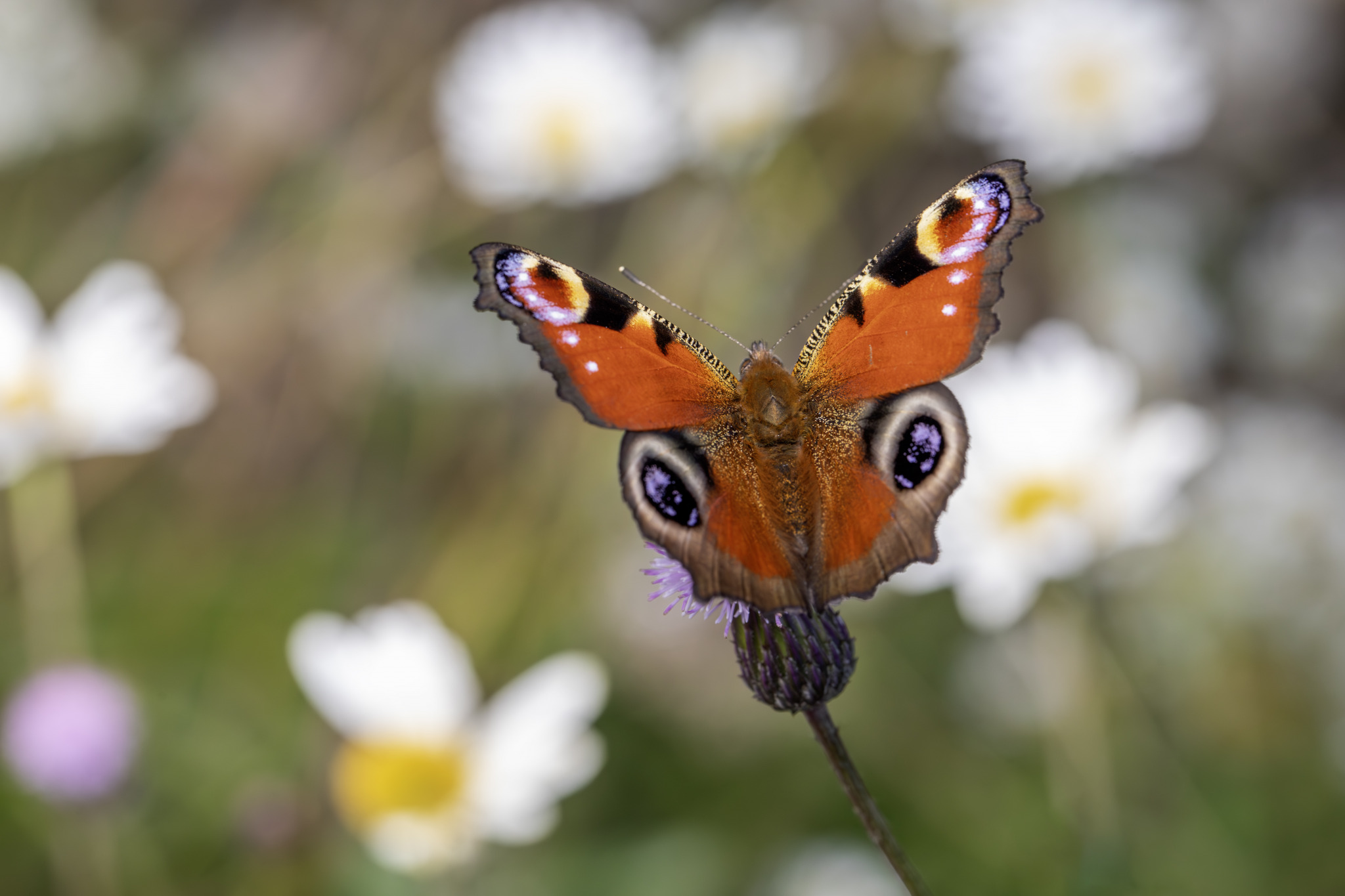
The European Peacock (Inachis io, recently also classified as Aglais io)—or Päevapaabusilm in Estonian—is perhaps the most recognizable butterfly in the Palearctic. It is the flamboyant showman of the summer meadow, carrying “eyes” that have evolved to terrify the very predators that would otherwise find it a tasty snack.
Drawing from the 2026 captures at karits.eu, here is a look at the natural history of this winged icon.
1. The “Four-Eyed” Defense
The Peacock’s primary survival strategy is psychological warfare. When resting, it looks like a charred, dead leaf—a masterclass in camouflage. However, if a bird or lizard approaches too closely, the butterfly suddenly snaps its wings open.
- The Startle Effect: The four massive, iridescent eyespots—complete with “pupils” of deep blue and violet—mimic the eyes of a much larger predator, like an owl.
- The Secret Hiss: If the visual display isn’t enough, the Peacock is one of the few butterflies that can actually “talk” back. By rubbing the veins of its wings together, it produces a low-frequency hissing sound (stridulation) that is audible to humans and remarkably effective at scaring off hungry rodents.
2. The Nettle-Bound Life
Like many of our most beautiful butterflies (including the Comma and Small Tortoiseshell), the Peacock’s existence is tied to the humble Stinging Nettle (Urtica dioica).
- The “Black Bear” Caterpillars: Peacock caterpillars are jet black and covered in formidable-looking spines with white dots. They are highly social when young, living in large silken “tents” on nettles to protect themselves from parasites.
- Tough Food: By feeding on nettles, the caterpillars ingest chemicals that make them unpalatable to some predators, though they are still a primary target for specialized parasitic wasps.
3. The Marathon Sleeper
The Peacock is one of the longest-lived butterflies in Europe, with adults surviving for up to 11 months.
- Early Birds: Because they overwinter as adults, they are often the very first butterflies seen in the Estonian spring, sometimes emerging in February or March on unseasonably warm days to drink the nectar of early Willows or Coltsfoot.
- Winter Shelters: During the freezing winter, they tuck themselves into hollow trees, woodpiles, or unheated attics. If you find one in your shed in January, it’s best to leave it alone; waking up too early burns through its fat reserves, which it needs to survive until the first flowers bloom.
📸 Photographer’s Perspective: Managing the Iridescence
The Peacock is a rewarding subject, but its intense colors can be tricky to render accurately in-camera.
- Focus on the Blue: The “pupils” of the eyespots are made of thousands of tiny, light-refracting scales. To capture the true metallic blue, try to shoot with the sun at your back (front-lighting). If the light is too harsh, the blue will turn a flat grey.
- The “Hissing” Close-up: If you are lucky enough to find one in a cool environment, you can get incredibly close. A true macro lens (1:1 magnification) will reveal that the eyespots aren’t just solid colors but a complex mosaic of yellow, black, and blue “pixels.”
- Wait for the Basking: Peacocks are “sun-worshippers.” They often sit on flat leaves with their wings spread perfectly wide to absorb heat. This is the ideal moment for a high-symmetry top-down shot.
- The Underside Contrast: For a compelling “story-telling” shot, try to capture the butterfly with its wings closed. The contrast between the drab, black underside and the hidden fire within is a powerful visual narrative.
Quick Facts Table
| Feature | Detail |
| Scientific Name | Inachis io (Synonym: Aglais io) |
| Estonian Name | Päevapaabusilm |
| Wingspan | 50–60 mm |
| Host Plant | Stinging Nettle (Urtica dioica) |
| Flight Period | March to October (Hibernates as adult) |
| Defense | Eyespots, wing hissing, and dead-leaf camouflage |
Check out the latest high-resolution 2026 gallery of the European Peacock and download free CC0-licensed images at karits.eu.
Views: 1589
Subscribe to the newsletter: