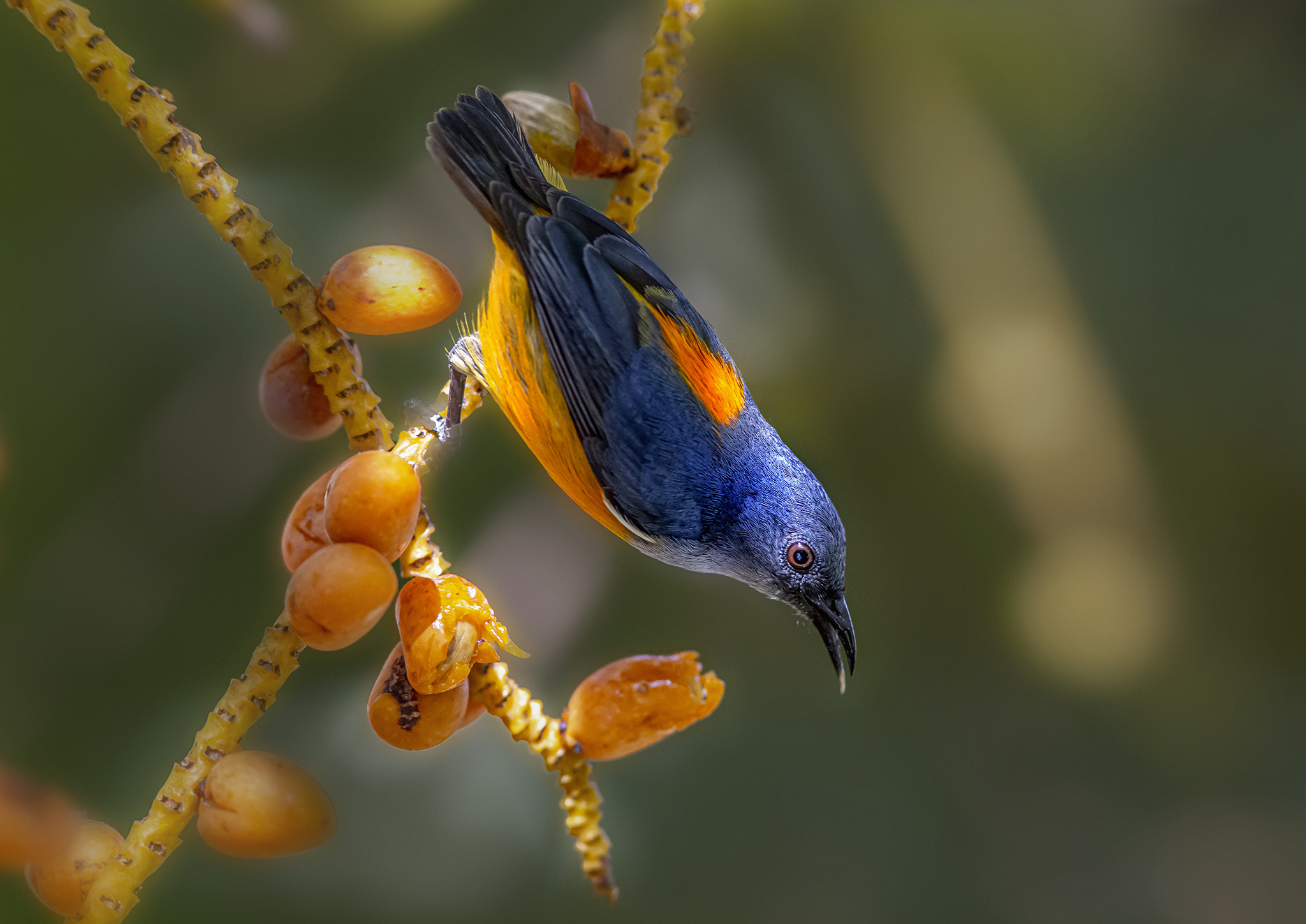

The Orange-bellied Flowerpecker (Dicaeum trigonostigma) is a tiny, high-octane jewel of the Southeast Asian canopy. Measuring just 8–10 cm in length, it is one of the smallest birds in the region—a hyperactive blur of orange and blue-gray that plays a massive role in the health of its tropical ecosystem.
Based on the wildlife photography and field observations at karits.eu, here is a closer look at this vibrant avian marvel.
1. The “Mantle” Signature
While many tropical birds are colorful, the male Orange-bellied Flowerpecker has a very specific and striking “uniform.”
- The Triad of Color: The male features a slate-blue head and wings, a fiery orange breast and belly, and a diagnostic triangular orange patch on its mantle (the upper back). This “saddle” of color is a key identification mark that distinguishes it from other similar flowerpeckers.
- The Subtle Female: In contrast, the female is a study in camouflage—mostly olive-green with a pale yellow-orange belly and a distinct orange-tinged rump. This helps her remain invisible to predators like tree snakes and hawks while she tends to the nest.
2. The Mistletoe Specialist
This bird is an ecological engineer. Its life is inextricably linked to the Mistletoe plant.
- A Symbiotic Bond: The Flowerpecker is the primary seed disperser for many mistletoe species. It has a specialized digestive system that processes the fruit rapidly.
- The “Sticky” Exit: The seeds are covered in a sticky substance called viscin. After eating the fruit, the bird often wipes its vent against a tree branch to dislodge the sticky seed, effectively “planting” the mistletoe in a new location where it can grow.
3. Behavior: The Acrobatic Nectar-Thief
Unlike sunbirds, which are famous for their hovering ability, flowerpeckers prefer to perch while they feed.
- The Energy Specialist: They are highly agile, often seen hanging upside down to reach nectar in tubular flowers or probing small berries with their short, slightly curved beaks.
- Social Pulse: They are rarely still. You will often hear them before you see them—listen for a sharp, metallic “tsip-tsip-tsip” call as they zip between flowering trees at high speeds.
📸 Photographer’s Perspective: Chasing the Speedster
Capturing a bird that weighs less than 10 grams and never stops moving is one of the ultimate tests of a wildlife photographer’s kit and reflexes.
- Shutter Speed is King: Because they flit so fast, a shutter speed of at least 1/2500s is often necessary to freeze their motion, especially if they are fluttering between branches.
- Predicting the “Flower Stop”: Don’t try to track them mid-flight. Instead, find a fruiting tree or a cluster of blossoms and wait. They are creatures of habit and will likely return to a “productive” branch multiple times.
- High ISO and the Jungle Floor: These birds often feed in the shaded understory or dense canopy where light is scarce. Modern cameras with good high-ISO performance are essential for maintaining fast shutter speeds without losing too much detail to grain.
- Focus on the Eye-Ring: The male has a dark eye that can get lost in its slate-blue head. Ensure your AF-point is locked onto the eye to provide that essential “spark” that brings the portrait to life.
Quick Facts Table
| Feature | Detail |
| Scientific Name | Dicaeum trigonostigma |
| Size | 8–10 cm (3–4 inches) |
| Weight | 7–12 grams |
| Primary Diet | Nectar, Mistletoe berries, and small insects |
| Distribution | Southeast Asia (Thailand, Malaysia, Indonesia, Philippines) |
| Status | Least Concern (IUCN) |
Explore more vibrant portraits and ecological stories of the Orange-bellied Flowerpecker at karits.eu.
Views: 2270
Subscribe to the newsletter: