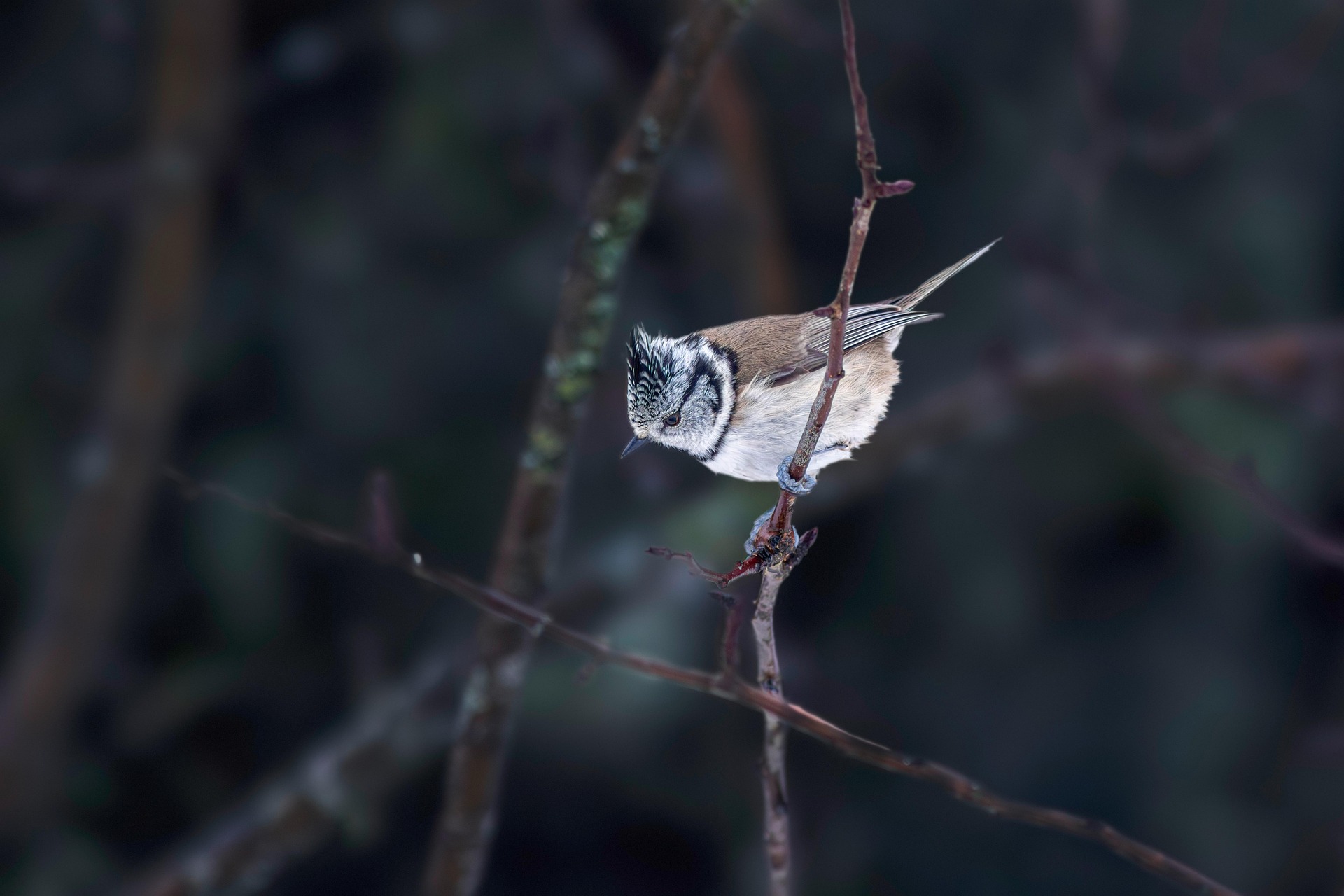
The European Crested Tit (Lophophanes cristatus)—known in Estonia as the Tutt-tihane—is the “punk rocker” of the bird world. While other tits are defined by their colors, the Crested tit is defined by its attitude and its remarkable, pointed Mohawk. It is a specialist of the ancient pine forests, rarely venturing far from the scent of resin and needles.
Based on the wildlife photography and field entries at karits.eu, here is a profile of this charismatic conifer dweller.
1. The Signature Crest
The most obvious feature is the prominent, triangular crest of black and white feathers.
- Expressive Anatomy: The bird can raise or lower this crest depending on its mood. When excited, aggressive, or curious, the crest stands bolt upright; when relaxed or flying, it may be flattened against the head.
- The Facial “C”: Look for the distinct black line that curves behind the eye and around the cheek, forming a bold “C” shape. This, combined with the crest, makes it impossible to confuse with any other European bird.
2. The Pine Specialist
While the Great tit and Blue tit are generalists that love gardens and broadleaf woods, the Crested tit is a conifer specialist.
- The Pine Bond: In Estonia and across Northern Europe, they are almost exclusively found in mature pine and spruce forests. Their thin, needle-like bills are perfectly adapted for extracting seeds from cones and finding small spiders hidden deep in the bark of evergreens.
- Sedentary Nature: Unlike many other songbirds, Crested tits are not migratory. They spend their entire lives in the same patch of forest, defending their territory even through the harshest Baltic winters.
3. The “Tit Party” Trill
The Crested tit is often the “lead singer” of winter roving flocks (often called “tit parties”).
- The Call: It has a very distinctive, vibrating trill: “pürrr-rit-rit-rit.” Once you learn this sound, you will realize the forest is full of them, even if they are hidden high in the canopy.
- Social Scavenging: They often travel with Goldcrests and Treecreepers, using the “strength in numbers” strategy to spot predators while they forage for frozen insects.
📸 Photographer’s Perspective: The Profile Master
Capturing a Crested tit requires a fast finger and an eye for composition among the needles.
- Profile is Everything: To truly capture the character of this bird, you need a side-on profile shot. This highlights the height of the crest and the intricate black-and-white patterning of the face.
- Managing “Pine Shadow”: Because they live in dense conifers, lighting is your biggest enemy. Pine needles create “jail-bar” shadows across the bird’s face. Wait for the bird to move to the outer edge of a branch into a pocket of sunlight.
- High Shutter Speed: Like the Coal tit, these birds are incredibly “fidgety.” A shutter speed of 1/2000s is recommended to ensure the crest feathers stay sharp as the bird tosses its head.
- The Winter Feeder Trick: While they prefer forest interiors, they will visit garden feeders if they are located near pine woods. They are particularly fond of suet and sunflower hearts.
Quick Facts Table
| Feature | Detail |
| Scientific Name | Lophophanes cristatus |
| Estonian Name | Tutt-tihane |
| Weight | 10–13 grams |
| Habitat | Mature coniferous forests (Pine/Spruce) |
| Diet | Conifer seeds, insects, and spiders |
| Nesting | Holes in rotten stumps or trees (often excavates its own) |
Explore more intimate forest portraits and download high-resolution CC0 images at karits.eu.
Views: 198
Subscribe to the newsletter: