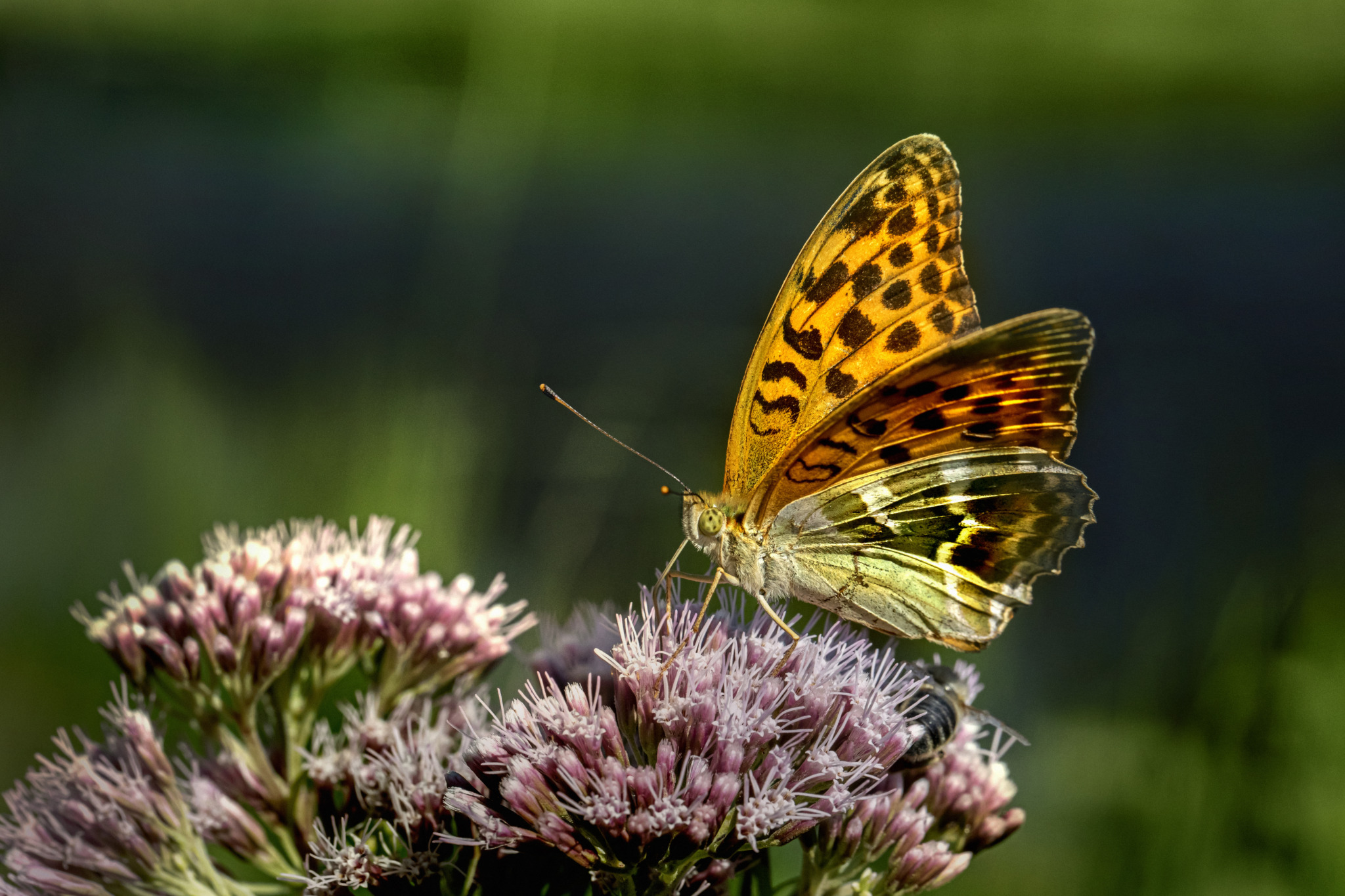
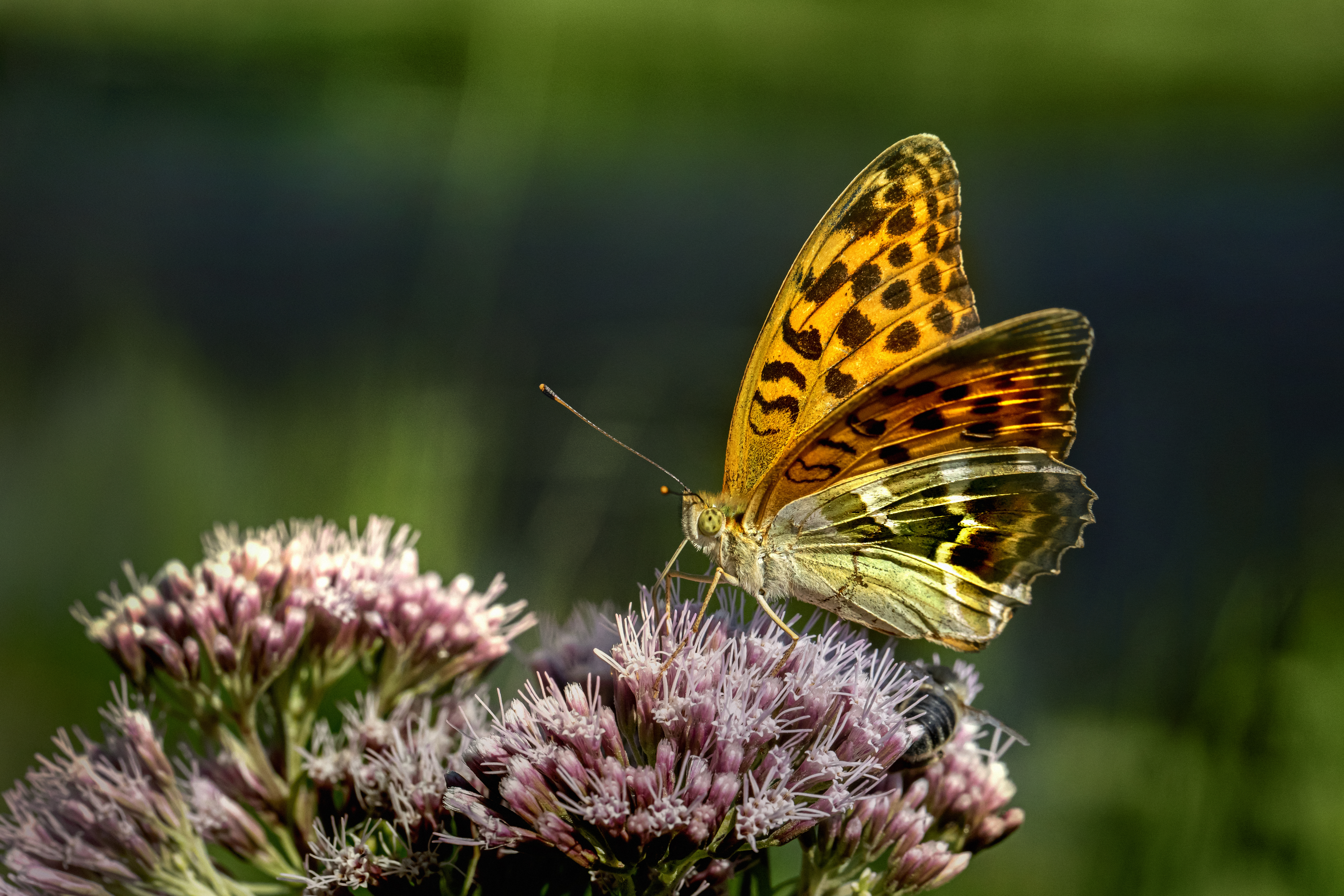
The Silver-washed fritillary (Argynnis paphia)—known in Estonian as the Rohetäpik—is the undisputed “King of the Woods.” As the largest fritillary in Europe, it is a majestic sight in July and August, gliding through sun-dappled forest glades and patrolling bramble thickets with a powerful, commanding flight.
While most fritillaries are defined by their “pearls” (white spots on the underside), the Silver-washed gets its name from a much more elegant, metallic finish.
1. The Signature “Silver Wash”
The most diagnostic feature of this species is found on the underside of the hindwing.
- The Washes: Unlike its relatives (such as the Dark Green or High Brown fritillary), it does not have distinct white spots. Instead, it features long, shimmering silver streaks or “washes” that look like they were applied with a metallic brush over a greenish-grey background.
- The Upperside: The male is a brilliant, fiery orange with black spots and four distinct dark “androconial” stripes (scent scales) on the forewings. The female is generally paler, with more rounded spots and no scent stripes.
2. The “Valesina” Mystery
In some populations, a fascinating genetic variation occurs: the form valesina.
- The Grey Ghost: About 5–15% of females (especially in warmer or more southerly regions) abandon the traditional orange upperside for a stunning, dusky bronze-green or brownish-grey.
- Evolutionary Edge: Scientists believe this form might offer better camouflage in the deep shade of the forest, or perhaps it helps the females avoid overly persistent males during the hottest parts of the day.
3. The Odd Egg Strategy
Most butterflies lay their eggs directly on the plant their caterpillars eat. The Silver-washed fritillary has a much stranger habit.
- The Oak/Pine Connection: The female flies into the forest and searches for cracks in the bark of trees (usually Oak or Pine) located near a patch of Common Dog-violet (Viola riviniana).
- The Long Wait: She lays the eggs on the tree trunk, roughly 1–2 meters above the ground. When the tiny caterpillar hatches in late summer, it doesn’t eat the tree—it immediately goes into hibernation in a bark crevice without eating a single leaf. Only in the spring does it crawl down the trunk to find the violets growing at the base.
📸 Photographer’s Perspective: Managing the Forest Light
Capturing a Silver-washed fritillary is often a race against the “spotlight” of shifting sunbeams in the woods.
- The Bramble Stakeout: If you want high-quality shots, find a patch of Bramble (Blackberry) in a sunny woodland ride. These butterflies are obsessed with bramble nectar. Once they settle to feed, they become quite approachable, allowing you to get the macro lens within inches.
- Watch for the “Shadow Play”: Because they live in forests, the background can often be a messy mix of bright highlights and deep shadows. Using a wide aperture ($f/2.8$ or $f/4$) will help melt the background into a soft green wash, making the orange checkers of the butterfly “pop.”
- The Underside Angle: Don’t just settle for the “wings open” shot. The greenish-silver underside is the species’ namesake. Wait for the butterfly to close its wings or hang vertically from a flower to capture that metallic shimmer.
- ISO Control: In the shade of the canopy, light levels can drop fast. Be prepared to bump your ISO to 800 or 1600 to maintain a shutter speed of at least 1/500s, as their movements are very jerky and fast.
Quick Facts Table
| Feature | Detail |
| Scientific Name | Argynnis paphia |
| Estonian Name | Rohetäpik |
| Wingspan | 54–70 mm |
| Flight Period | Late June to August (Peak in July) |
| Host Plant | Common Dog-violet (Viola riviniana) |
| Habitat | Broadleaf and mixed forests with bramble-rich edges |
Explore more “shimmering” details and high-resolution forest photography at karits.eu.
Views: 1758
Subscribe to the newsletter: