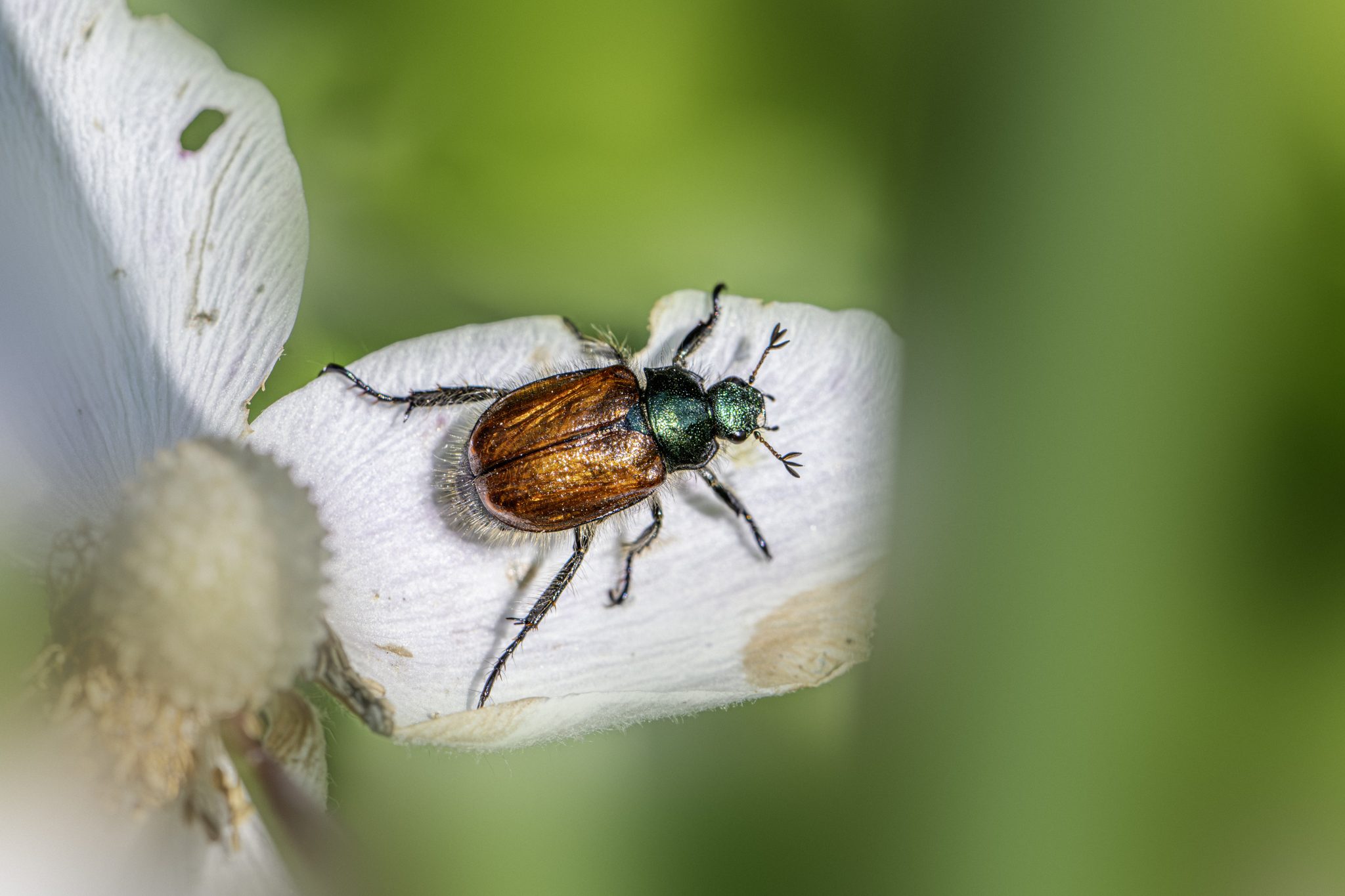
The Garden chafer (Phyllopertha horticola)—known in Estonian as the Aiapõrnikas—is a small, bicolored beetle that often makes its presence known through dramatic “mass emergences” in early summer. While it may look like a miniature version of the larger Cockchafer (May bug), it has a personality and lifecycle all its own.
1. The “Little Green-Head”
The Garden chafer is easily distinguished from other scarabs by its striking color contrast and hairy texture.
- The Metallic Mask: Its head and thorax (the “neck shield”) are a deep, shimmering metallic green or bluish-black.
- Chestnut Wings: Its wing cases (elytra) are a warm chestnut-brown. Under a macro lens, you’ll see these wings are covered in long, upright hairs, giving the beetle a somewhat scruffy, “uncombed” appearance.
- Fan-like Antennae: Like all chafers, they possess specialized antennae that end in three leaf-like clubs (lamellae), which they use as sensitive “noses” to detect the pheromones of mates and the scent of food.
2. The “June Bug” Swarms
In many parts of Europe, these beetles are the quintessential “June Bugs.”
- Synchronized Emergence: They spend nearly a year underground as larvae before emerging almost all at once in late May or June.
- The Morning Rush: On sunny mornings, you may see hundreds of them swarming low over lawns. These are primarily males looking for females that have just emerged from the soil. They are highly active in the sunshine but disappear the moment a cloud covers the sun.
3. The Lawn’s Underground Nemesis
While the adults are relatively harmless, feeding on the leaves of roses, oaks, and birches, their larvae (grubs) are a different story.
- C-Shaped Grubs: The larvae are white, fleshy, and permanently curled into a “C” shape. They live just below the surface of the soil, voraciously eating the roots of grasses.
- Secondary Damage: Often, the most visible damage to a garden isn’t caused by the grubs themselves, but by birds (like starlings and crows) or mammals (like badgers) that tear up the turf to get to these protein-rich snacks.
📸 Photographer’s Perspective: Macro on the Move
Capturing a “good” shot of an Aiapõrnikas requires catching them during their brief inactive windows.
- Catch the Morning Dew: Since they are solar-powered, the best time to photograph them is early morning before the sun has fully warmed them up. They will be perched on leaves or grass stalks, often covered in dew, which adds a beautiful “diamond” effect to their hairy bodies.
- Focus on the “Fan”: If you can catch a male while he is sensing the air, his lamellae (antenna fans) will be spread wide. Locking your focus on these tiny structures creates a highly “charismatic” insect portrait.
- The “Drop” Reflex: Garden chafers are famously nervous. If you get too close or cast a shadow over them, they will tuck their legs in and drop into the grass to hide. Approach slowly and avoid breaking the horizon line with your silhouette.
- Background Contrast: Use the metallic green head to your advantage. A dark, out-of-focus background (like the shade of a bush) will make the iridescence of the beetle’s head truly “pop.”
Quick Facts Table
| Feature | Detail |
| Scientific Name | Phyllopertha horticola |
| Estonian Name | Aiapõrnikas |
| Size | 8–12 mm |
| Flight Period | Late May to July (Peak in June) |
| Diet | Adults: Leaves/Flowers; Larvae: Grass roots |
| Lifecycle | 1 year (Egg to Adult) |
Explore more tiny titans of the garden and high-resolution macro studies at karits.eu.
Views: 445
Subscribe to the newsletter: