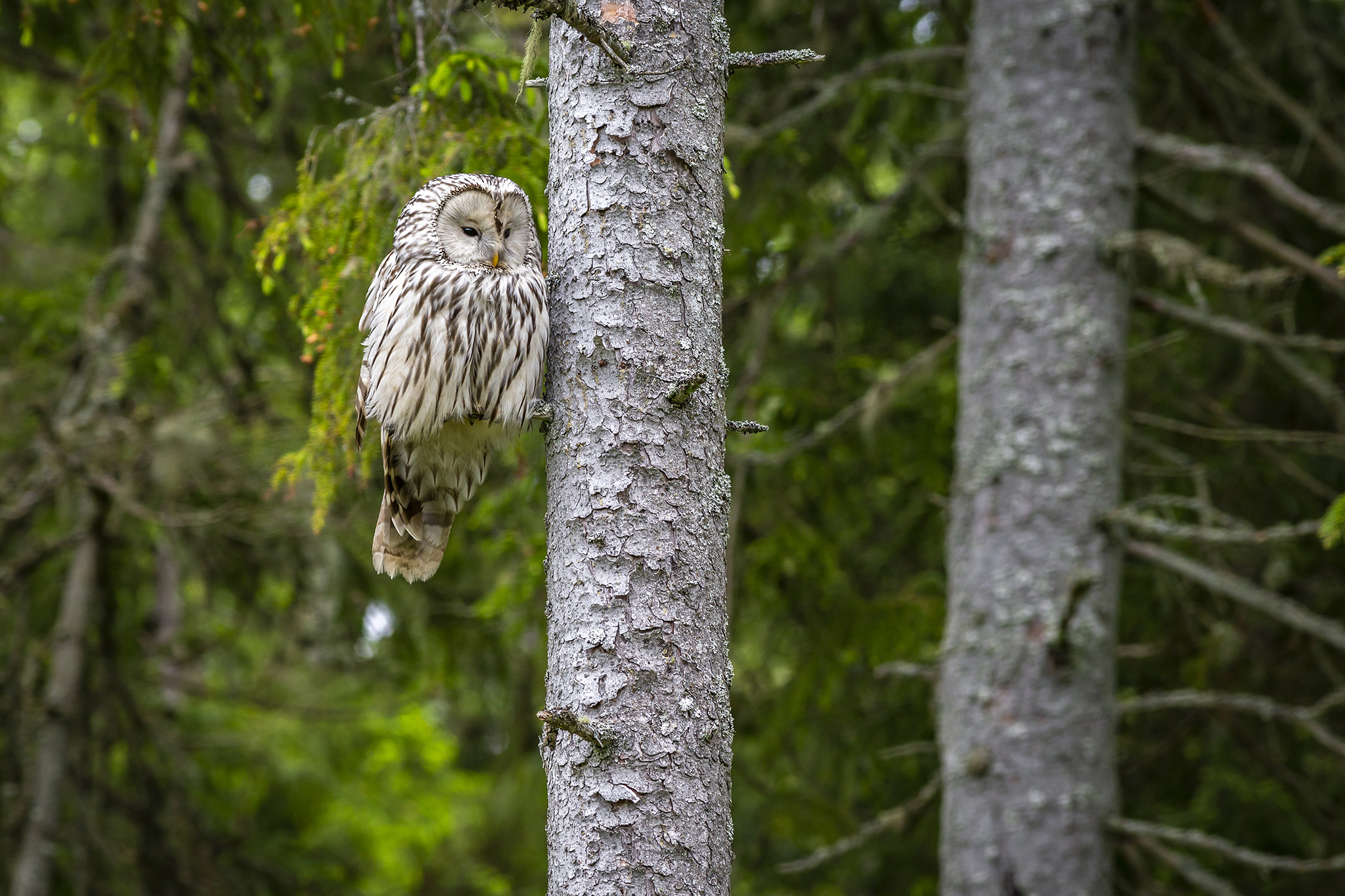

The Ural owl (Strix uralensis)—known in Estonian as the Händkakk—is a ghost of the deep northern forests. While its name suggests a connection to the Ural Mountains, it is a wide-ranging resident of the Palearctic, stretching from Scandinavia through the Baltics to Japan.
In Estonia, it is the quintessential forest owl, often called the “Tiger of the Woods” due to its size and remarkably fearless temperament.
1. The “Long-Tailed” Ghost
The Estonian name Händkakk (from händ, meaning tail) highlights its most distinctive silhouette feature.
- The Tail: Unlike the short, rounded tails of many other owls, the Ural owl has an exceptionally long, wedge-shaped tail. In flight, it often appears “slung downward,” giving the owl a hawk-like profile.
- The Eyes: While many forest owls like the Long-eared or Eagle owl have fiery orange or yellow eyes, the Ural owl has deep, jet-black, almond-shaped eyes. Set against a very pale, “clean” facial disc, these eyes give the owl a gentle, almost cat-like expression that belies its predatory power.
- Plumage: Its feathers are a pale grey-brown with heavy, vertical dark streaking, providing perfect camouflage against the bark of birch and spruce trees.
2. The “Tiger of the Woods”
The Ural owl is legendary among researchers for its lack of fear.
- Fearless Defense: During the breeding season (March–June), the female is notoriously aggressive. She will dive-bomb anything she perceives as a threat—be it a human, a bear, or a larger raptor—specifically aiming her talons at the intruder’s head and eyes.
- Sedentary Lifestyle: Unlike the Great Grey owl, which may irrupt and wander based on food supply, the Ural owl is a resident. Once it establishes a territory in an old-growth forest, it typically stays there for life, maintaining a pair bond with a “divorce rate” of less than 3%.
3. The Vole Specialist
While they are dietary generalists, they are heavily dependent on vole cycles.
- The “Larder” Strategy: They are “perch and pounce” hunters. In years when vole populations crash, they shift their diet to hunt birds (up to the size of a Black Grouse), squirrels, and even other smaller owls.
- Nesting: They are “lazy” nesters, rarely building their own structures. They prefer large tree cavities, broken-off stumps (known as “chimney” nests), or the abandoned stick nests of hawks. They have also adapted remarkably well to man-made nest boxes.
📸 Photographer’s Perspective: Respect the Territory
Capturing a Händkakk is a highlight for any wildlife photographer, but it requires a mix of stealth and caution.
- Safety First: If you are shooting near a known nest site during the breeding season, wear a helmet or keep a safe distance. They are silent when they attack; you won’t hear them coming until they hit.
- The “Yellow and Black” Contrast: The bright yellow bill provides a stunning focal point against the pale face and dark eyes. Try to catch the light at an angle that puts a small “glint” in the black eyes to avoid them looking like flat, lifeless holes.
- Background Compression: Because they sit in dense, “messy” forest environments, use the longest telephoto lens possible (at least 500mm or 600mm) to melt the foreground and background branches into a smooth green or grey bokeh.
- Low Light Performance: These owls are most active at twilight. Shooting at ISO 3200 or 6400 is common. Modern AI noise reduction is a lifesaver for preserving the fine detail of their streaked feathers.
Quick Comparison Table
| Feature | Ural Owl (Händkakk) | Tawny Owl (Kodukakk) |
| Size | Large (50–62 cm) | Medium (37–46 cm) |
| Tail | Long, wedge-shaped | Short, rounded |
| Facial Disc | Large, very pale, “clean” | Darker, more “cluttered” |
| Eyes | Jet black | Dark brown |
| Temperament | Highly aggressive (nesting) | Shy and retiring |
View the full 2025/2026 gallery of Ural owl captures and forest encounters at karits.eu.
Views: 1572
Subscribe to the newsletter: