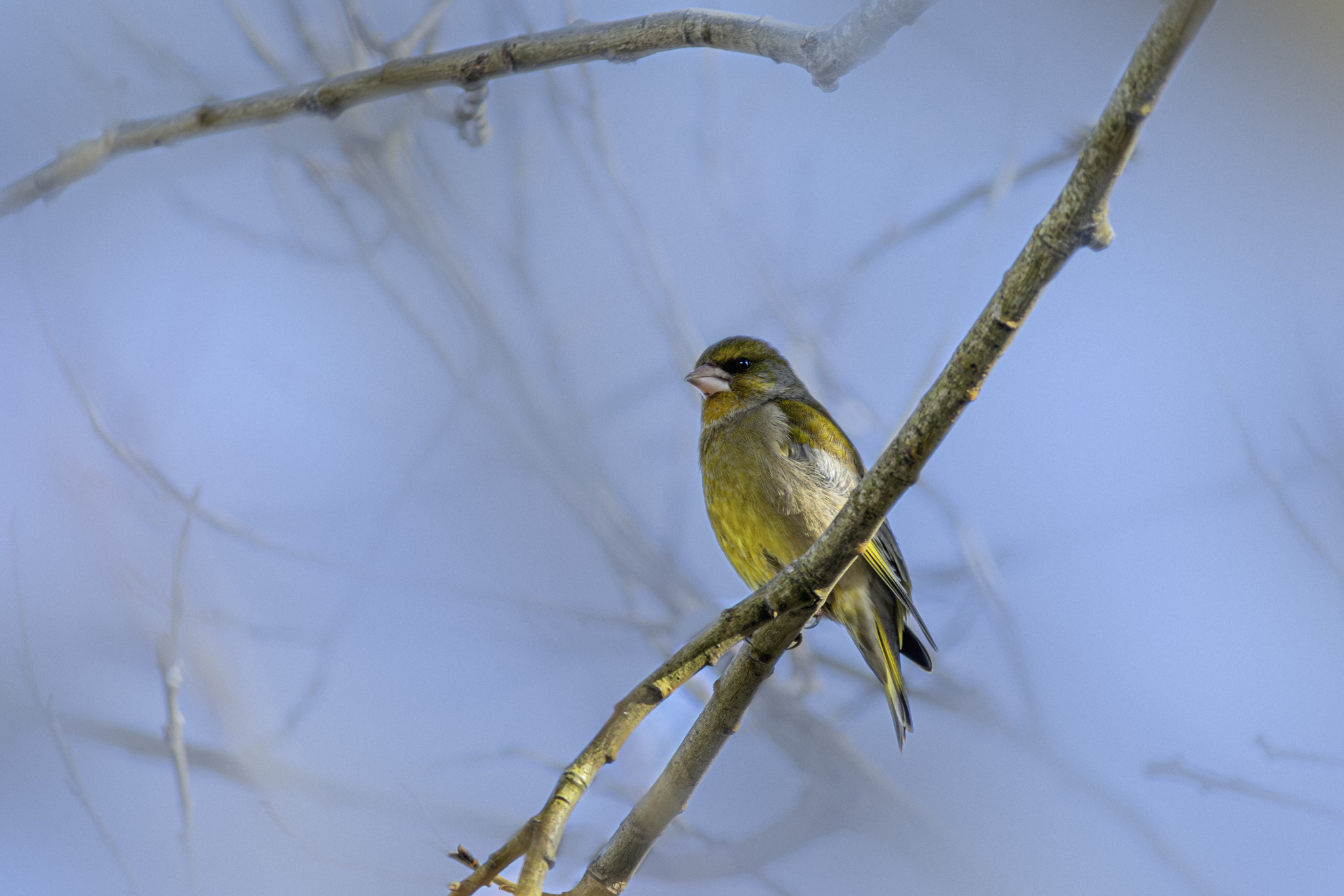
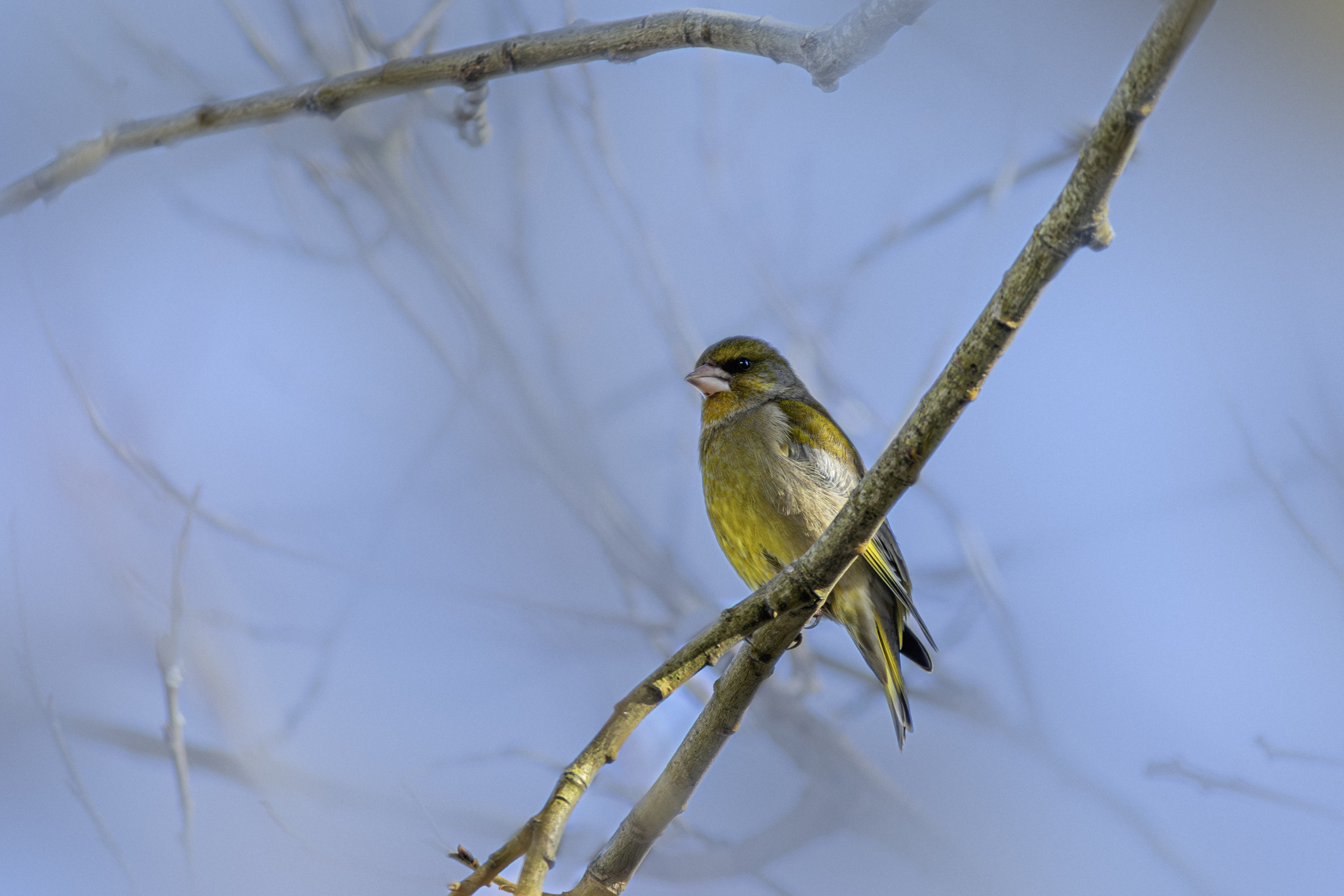
The European greenfinch (Chloris chloris) is often described as the “bruiser” of the bird table. Known for its chunky build, powerful beak, and surprisingly aggressive social life, it is a staple of European gardens. However, in the last two decades, it has also become the face of one of the most significant avian health crises in modern history.
1. Physical Profile: The Heavyweight Finch
The greenfinch is noticeably larger and more “bull-necked” than most other common garden finches.
- Plumage:
- Males: Clad in a dull olive-green with a brighter yellow-green breast. Their most defining feature is the vivid yellow flash on the primary wing feathers and the sides of the tail, which is most obvious in flight.
- Females: Much more subdued—brownish-grey with only faint hints of green and yellow.
- The Bill: It possesses a massive, conical beak designed specifically for cracking open tough seeds like sunflower and rosehips.
- Dimensions: Roughly 15 cm in length, weighing 25–30g (nearly double the weight of a Goldfinch).
2. Behavior: Feeder Politics
If you have a bird feeder, you’ve likely seen the “Greenfinch Glower.”
- Social Dominance: Despite being gregarious, they are famously grumpy. They will often crouch low, open their beaks, and “hiss” or lunge at other birds to defend a perch.
- The “Wheezing” Song: Their song is a pleasant medley of trills, but it is always interrupted by a very distinct, long, nasal “tswee-eee” or “wheeze.” It sounds remarkably like a person letting air out of a balloon.
- The “Butterfly” Flight: During the breeding season, males perform a circular display flight with slow, deep wingbeats, making them look somewhat like large, green butterflies.
3. The Trichomonosis Crisis
You cannot discuss the greenfinch without addressing the parasite Trichomonas gallinae.
- The Impact: Starting around 2005, the UK and European populations suffered a catastrophic collapse. In the UK alone, the population plummeted by nearly 60%.
- Symptoms: Infected birds appear “fluffed up,” lethargic, and often have difficulty swallowing, leading to “wet” or messy faces.
- Transmission: It spreads primarily at bird feeders and water baths through contaminated saliva.
- 2025/2026 Status: While they are still Red Listed in several countries, there are early signs of a slow recovery. Surviving populations appear to have a slightly higher resistance, though feeder hygiene remains the single most important factor in their survival.
4. Habitat & Diet
- Habitat: They are “edge” specialists. You’ll find them in woodland edges, hedgerows, and increasingly in suburban gardens and parks. They avoid deep, unbroken forests.
- Diet: Specialists in fat-rich seeds. They love sunflower seeds, peanuts, and the seeds of yew, hornbeam, and elm. In the wild, they are one of the few birds that can handle the tough seeds of the Bramble.
5. Comparison: Greenfinch vs. Siskin
These two are frequently confused at garden feeders.
| Feature | European Greenfinch | Eurasian Siskin |
| Size | Large (Chunky) | Small (Petite) |
| Beak | Thick, Pale, Conical | Fine, Sharp, Pointed |
| Markings | Plain green/grey wings | Heavy black and yellow wing bars |
| Tail | Short, forked, yellow edges | Deeply forked, black and yellow |
| Vibe | Aggressive, stationary | Energetic, acrobatic |
Visited 100 times, 1 visit(s) today
Views: 253
Subscribe to the newsletter: