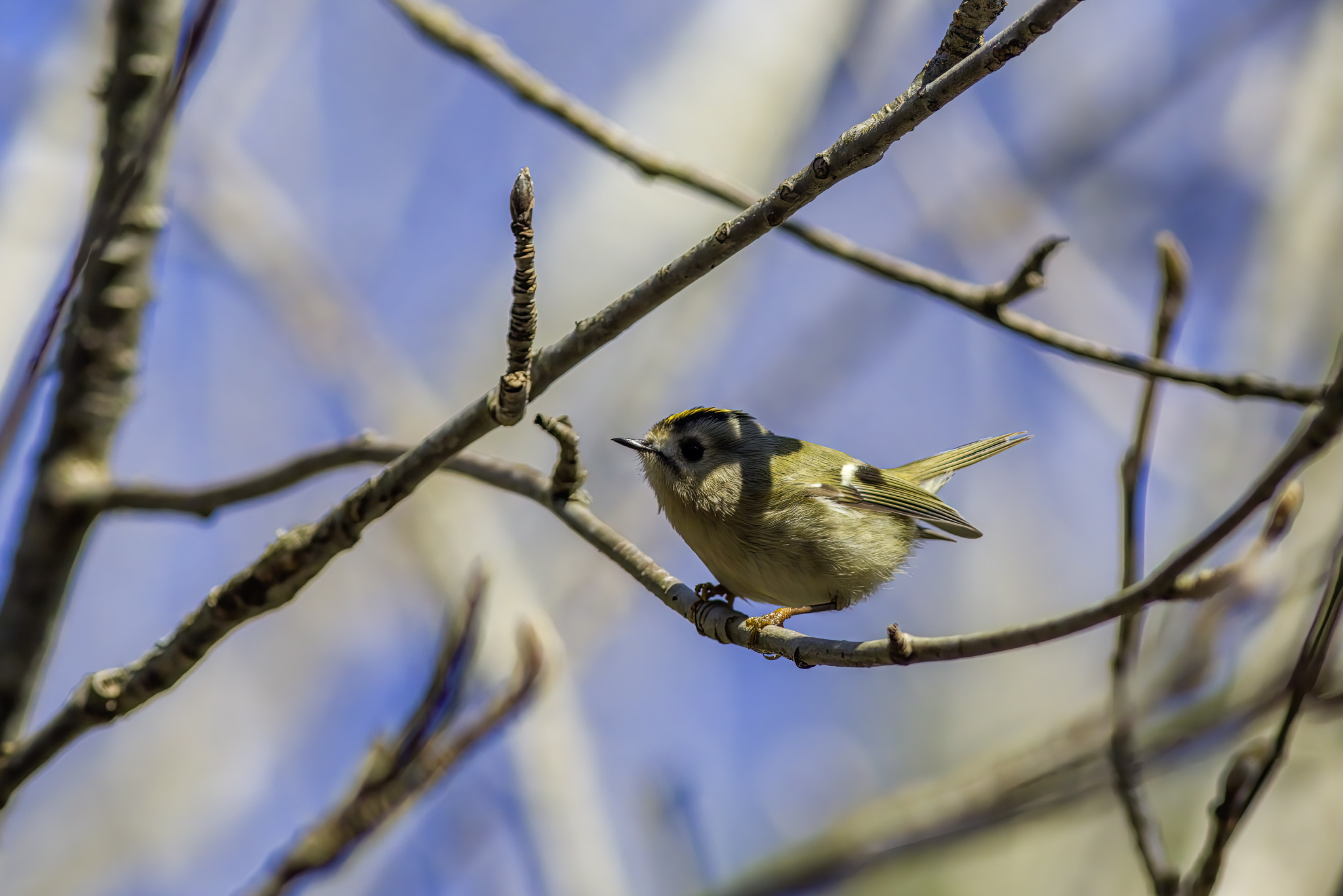
🐦 Deep Review: Goldcrest (Regulus regulus)
The Goldcrest holds a very specific title: it is the smallest bird in Europe. Despite its tiny stature, this feathered “lightweight” is a ball of pure energy, known for its restless movement and its surprisingly hardy nature during the harsh northern winters.
📏 Physical Characteristics
- Size: They are truly minuscule.
- Length: About 8.5–9.5 cm.
- Weight: A mere 5 to 6 grams—roughly the same as a single teaspoon of sugar or a 2-euro coin.
- The “Crown”: Their most defining feature is the bright stripe on top of their head, bordered by black.
- Males: Have a bright orange center within the yellow stripe.
- Females: Have a purely yellow stripe.
- Coloration: The body is a soft olive-green above and a pale, buff-white below. They have a very “round” appearance, often looking like a tiny green puffball with a thin, needle-like beak.
- Eyes: They have large, dark eyes surrounded by a pale area, giving them a perpetually “surprised” expression.
🌲 Habitat and Range
- Geographic Range: Widespread across most of Europe and temperate Asia.
- The Conifer Lover: While they can be found in gardens and deciduous woods, they have a strong preference for coniferous forests (especially Spruce and Pine). Their thin beaks are perfectly evolved to pick tiny insects from between narrow pine needles.
- Migration: Many populations are sedentary, but birds from Scandinavia and the Baltic states perform a massive migration across the North Sea. Because they are so small, it was once folklore that they hitched rides on the backs of migrating Short-eared Owls (the “Woodcock Pilot” myth).
🐛 Diet and High-Speed Metabolism
- Insectivores: They eat almost exclusively tiny insects and spiders.
- Constant Movement: Because they are so small, they lose body heat rapidly. To survive, a Goldcrest must eat almost constantly during daylight hours.
- Foraging Style: They are masters of the “hover-glean”—they can hover momentarily in front of a branch to pluck a spider or aphid from the underside of a needle, a feat usually reserved for hummingbirds.
🏠 Nesting and Reproduction
- The Hanging Nest: The Goldcrest builds one of the most sophisticated nests in the bird world. It is a deep, hammock-like cup made of moss, cobwebs, and lichen, usually suspended from the very tip of a conifer branch.
- Insulation: The interior is lined with thousands of feathers to keep the tiny eggs warm.
- Large Broods: To compensate for high mortality rates (especially in winter), they lay large clutches of 7 to 12 eggs. They often have two broods a year, sometimes starting the second while the first is still being fed by the father.
🎵 Communication
- High-Pitch Specialists: Their song and calls are exceptionally high-pitched—so high, in fact, that many older people lose the ability to hear them at all.
- The Call: A repetitive, thin zee-zee-zee that helps them keep in contact while moving through dense foliage.
⚠️ Conservation and Threats
- IUCN Status: Least Concern.
- The Winter Threat: While their numbers are stable, they are extremely vulnerable to prolonged cold snaps. A single severe winter can wipe out up to 80% of a local population. However, their ability to lay large clutches allows them to bounce back numerically within just a few years.
- Habitat Loss: Modern forestry that replaces native conifers with different species can impact their food supply.
Fun Fact: The Goldcrest’s Latin name, Regulus, means “little king.” This refers to the golden crown on its head, which features in various European fables about how the tiniest bird outwitted the Eagle to become the King of Birds.
Visited 58 times, 1 visit(s) today
Views: 434
Subscribe to the newsletter: