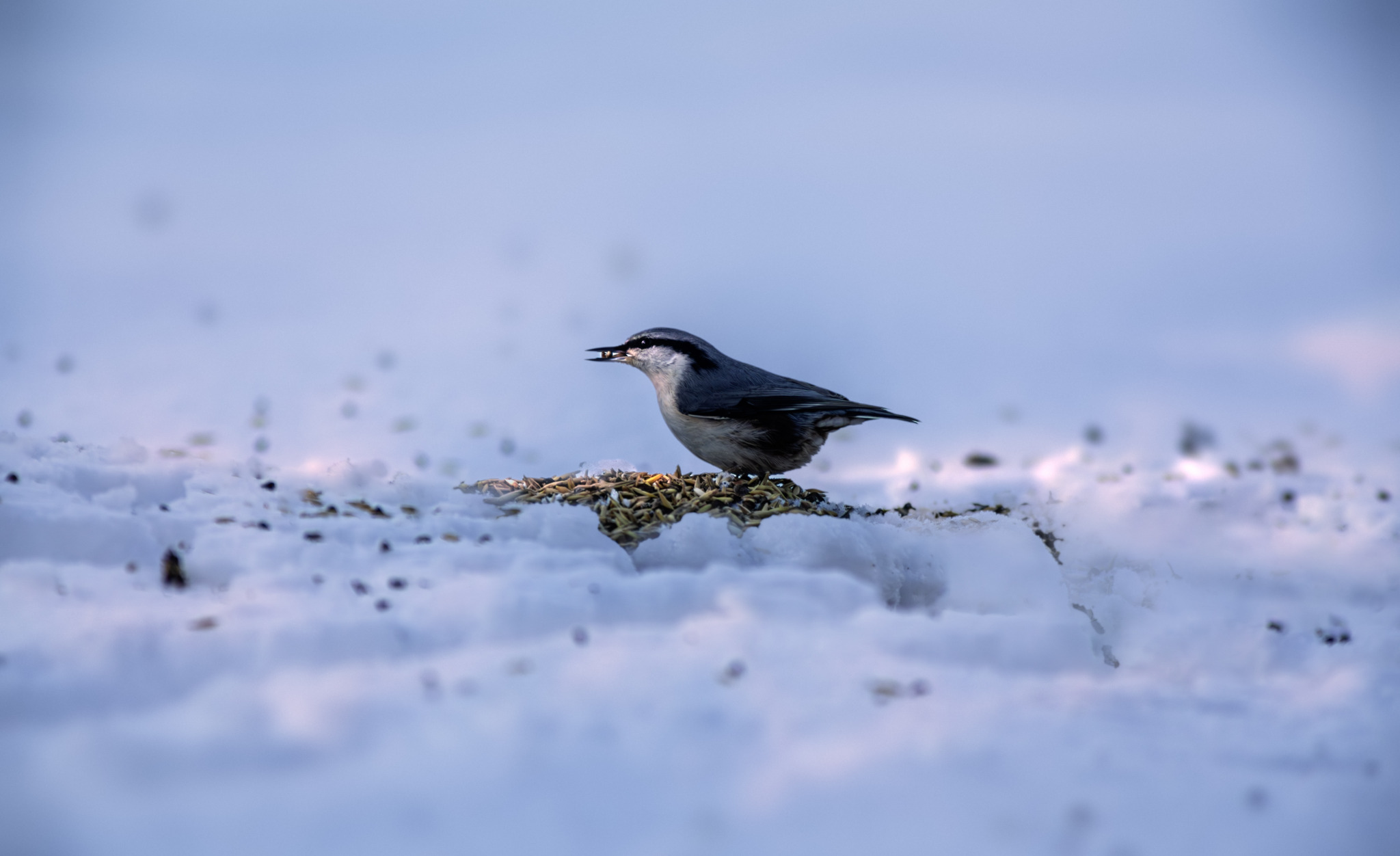
🐦 Deep Review: Eurasian Nuthatch (Sitta europaea)
The Eurasian nuthatch is the “parkour specialist” of the bird world. If you see a small, blue-grey bird sprinting head-first down a tree trunk like gravity is merely a suggestion, you’ve found a nuthatch. While most birds climb up or shimmy sideways, the nuthatch has mastered the vertical world in every direction.
📏 Physical Characteristics
- Appearance: They have a compact, “bullet-shaped” body with a short tail and a powerful, dagger-like bill.
- The “Bandit Mask”: Their most striking feature is a sharp black eye-stripe that runs from the base of the beak, through the eye, and onto the shoulder, giving them a permanent “superhero” look.
- Coloration: * Upperparts: A sleek, clean blue-grey (often described as “slate”).
- Underparts: Varies by region—birds in Western Europe tend to have buff or orangey bellies, while Northern and Eastern populations have white underparts with chestnut-colored flanks.
- Feet of Steel: Unlike woodpeckers, they don’t use their tails for balance. Instead, they rely on exceptionally strong legs and long-toed claws to grip the bark.
| Feature | Measurement |
| Length | 12–14.5 cm |
| Wingspan | 22–27 cm |
| Weight | 17–28 grams |
🧗 The “Downstairs” Specialist
The nuthatch is the only bird in Europe that can climb down a tree trunk head-first.
- How? They don’t use their tail as a prop. Instead, they keep one foot higher than the other, using the upper foot to hang and the lower foot to steady themselves.
- Why? By moving downward, they see the tree from a perspective that upward-climbing birds (like woodpeckers or treecreepers) miss, allowing them to find insects hidden in the “top” side of bark crevices.
🛠️ The “Mason” of the Woods
The name “nuthatch” actually comes from the Old English word for “nut-hacker,” but they are equally famous for their masonry skills.
- The Mud Wall: They usually nest in old woodpecker holes or natural tree cavities. If the entrance is too large, the female will gather mud and plaster the entrance until the hole is exactly the right size for her to fit through, but too small for predators like starlings or squirrels to enter.
- Home Improvement: Even when using a man-made nest box, they will often insist on “improving” it by plastering mud around the lid or the hole.
🍎 Diet and “Hatching” Behavior
- Summer Diet: Primarily insects, spiders, and caterpillars found in bark.
- Winter Diet: Seeds, hazelnuts, beechmast, and acorns.
- The “Hatch” Technique: They have a unique way of eating large seeds. They wedge a nut firmly into a crack in the bark (using the tree as a “vice”) and then hammer at it with their strong beak until it splits open—hence the name “nut-hatch.”
- The Pantry: They are compulsive hoarders. In autumn, they will hide thousands of seeds in bark crevices, moss, or under lichen to ensure they survive the winter.
🌏 Habitat and Distribution
- Range: Found throughout Europe and temperate Asia, all the way to Japan.
- Habitat: They are birds of the “old growth.” They prefer mature deciduous or mixed woodlands, especially those with large oaks or beeches. However, they are very common in old parks, orchards, and gardens with large trees.
- Territoriality: They are highly sedentary and territorial. Once a pair establishes a territory, they will often stay there for life, defending it year-round.
⚠️ Conservation Status
- IUCN Status: Least Concern.
- Trend: Their populations are actually expanding in many areas, particularly northward into Scotland and Scandinavia, likely due to milder winters and the increased popularity of garden bird feeding.
- Garden Tip: They are big fans of sunflower seeds and suet blocks. If you have a feeder, you’ll notice they don’t linger; they usually grab one seed and fly off immediately to hide it elsewhere.
Fun Fact: Nuthatches are notoriously “bossy” at bird feeders. Despite their small size, they will often drive away larger birds like Greenfinches or House Sparrows with a sharp, aggressive flick of their wings and a loud, metallic twit-twit-twit call.
Views: 2133
Subscribe to the newsletter: