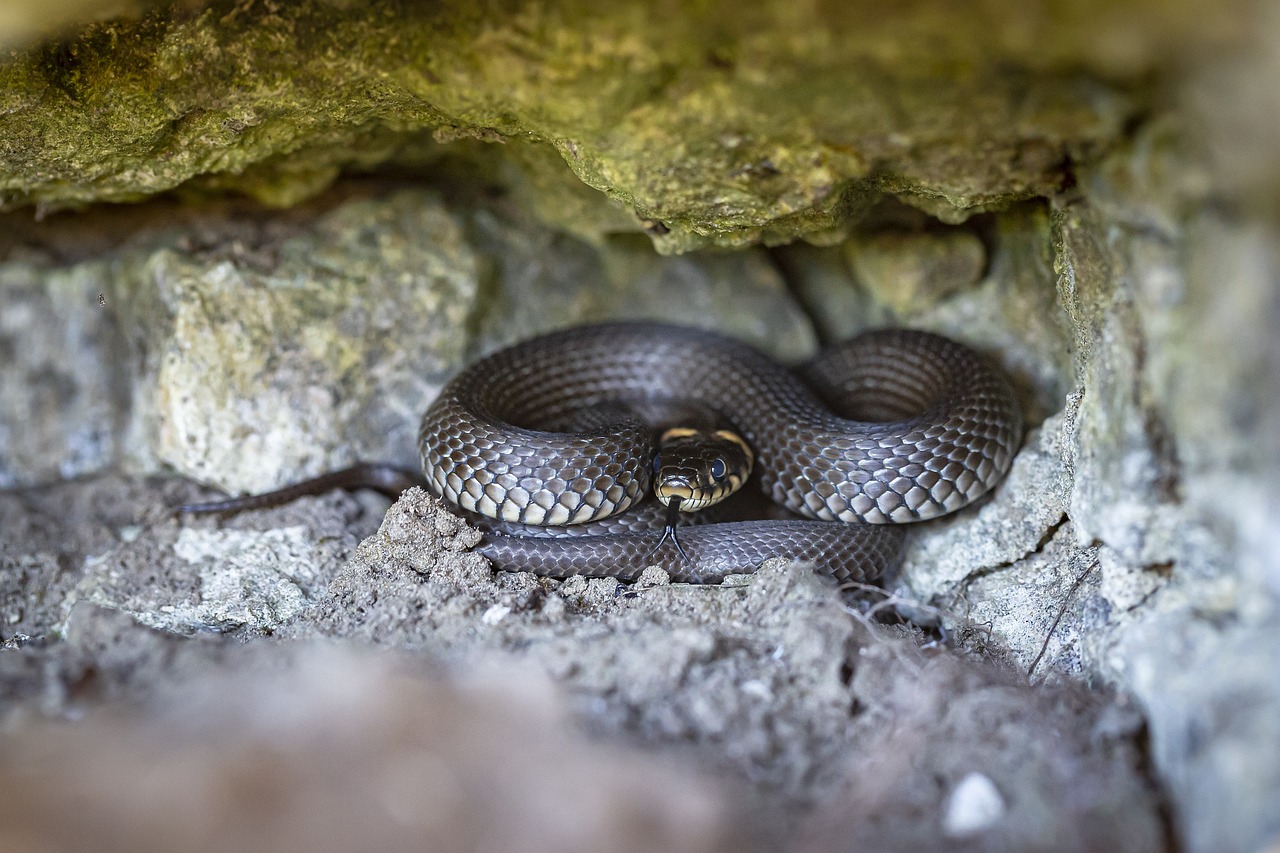
🐍 Deep Review: Grass Snake (Natrix natrix)
If you catch a glimpse of a large, elegant snake slipping effortlessly into a garden pond or basking on a warm bank, you are likely looking at the Grass Snake. Also known as the Water Snake or Ringed Snake, Natrix natrix is Western Europe’s largest native reptile. It is completely harmless, highly intelligent in its survival strategies, and a vital component of wetland ecosystems.
📏 Physical Characteristics: The Collar Tells the Tale
The Grass Snake is a long, slender serpent with a distinct look that makes it fairly easy to identify (provided you aren’t looking at the rare melanistic variant we discussed earlier!).
- The Iconic Collar: Its most defining feature is a bright crescent-shaped collar right behind the head. This band is usually yellow, white, or occasionally orange, and it is bordered immediately to the rear by a sharp black collar.
- Coloration: The body is typically an earthy olive-green, grey, or brownish-green, peppered with small, dark bars or spots along its flanks. The belly is checkered with black and white patterns unique to each individual snake.
- The Eyes: They have large, expressive eyes with perfectly round pupils. This is a crucial detail for anyone worried about venomous look-alikes.
| Feature | Measurement / Detail |
| Average Length | 70–100 cm (Females can exceptionally reach up to 150 cm) |
| Weight | 100–400 grams |
| Pupil Shape | Round (Indicates a non-venomous species in Europe) |
| Lifespan | Up to 15–20 years in the wild |
🎭 Defense Mechanisms: The Oscar-Winning Actor
Because Grass Snakes lack venom and have relatively weak jaws, they cannot fight off large predators. Instead, they have evolved a theatrical toolkit of defensive behaviors:
- The “Macho” Bluff: If cornered, they will puff up their bodies, hiss loudly, and flatten their heads to look like a venomous viper. They may even strike, but they do so with a closed mouth—it’s entirely a bluff.
- The Chemical Weapon: If picked up, they will release a terribly foul-smelling, pungent fluid from their anal glands. The smell mimics rotting meat and is incredibly difficult to wash out of clothes.
- Thanatosis (Playing Dead): If the bluff and the smell fail, the snake goes completely limp. It rolls onto its back, opens its mouth, lets its tongue hang out, and sometimes even secretes a drop of blood from its gums. To a predator that prefers live prey, it looks and smells like a rotting carcass. Once the danger passes, the snake “miraculously” revives and slinks away.
💧 Habitat and Diet: The Amphibian Hunter
Grass snakes are semi-aquatic. While they do wander into fields and woodlands, they are rarely found far from water.
- Environment: They thrive in marshes, riverbanks, lakes, ditches, and increasingly in suburban garden ponds. They are magnificent swimmers, moving through the water with a graceful, undulating motion, head held just above the surface.
- The Menu: They are strict carnivores with a heavy preference for amphibians.
- Primary Prey: Common Frogs, Common Toads, and Newts.
- Alternative Snacks: Small fish, tadpoles, and occasionally small mice or voles.
- Hunting Strategy: They hunt using both sight and their keen sense of smell (by tasting the air with their flicking tongues). They swallow their prey alive and whole, usually hind-legs-first.
🥚 Reproduction: The Compost Heap Connection
Unlike the European Adder and Smooth Snake, which give birth to live young, the Grass Snake is oviparous (an egg-layer).
- Incubation Warmth: Because northern European summers can be cool, the female needs external heat to incubate her eggs. She seeks out rotting vegetation, leaf litter, or man-made compost heaps and manure piles. The natural decomposition process in these heaps creates a perfect, warm microclimate.
- The Clutch: In mid-summer, she lays between 10 and 40 leathery, white eggs, which often stick together in a big clump.
- The Hatchlings: Tiny, fully independent pencil-sized snakes (about 15 cm long) hatch in late summer, already sporting their miniature yellow collars.
🚨 Grass Snake vs. Adder (How to Tell the Difference)
It is common for people to panic when seeing a snake in Europe. Here is how to immediately separate the harmless Grass Snake from the venomous European Adder (Vipera berus):
- The Pupil: Grass Snake = Round 🟢 | Adder = Vertical Slit (Cat-like) 👁️
- The Pattern: Grass Snake = Plain/Spotted with a collar | Adder = Distinct dark zigzag down the spine.
- The Head: Grass Snake = Oval/Streamlined with large scales | Adder = V-shaped/Triangular with small, rough scales.
Garden Tip: If you are lucky enough to have a Grass Snake in your garden, celebrate! They are exceptional at keeping rodent and slug-producing pest populations in check. To make your space friendly for them, leave a corner of your yard wild, build a compost heap, and avoid using netting around your pond, which can trap and accidentally suffocate them.
Views: 1851
Subscribe to the newsletter: