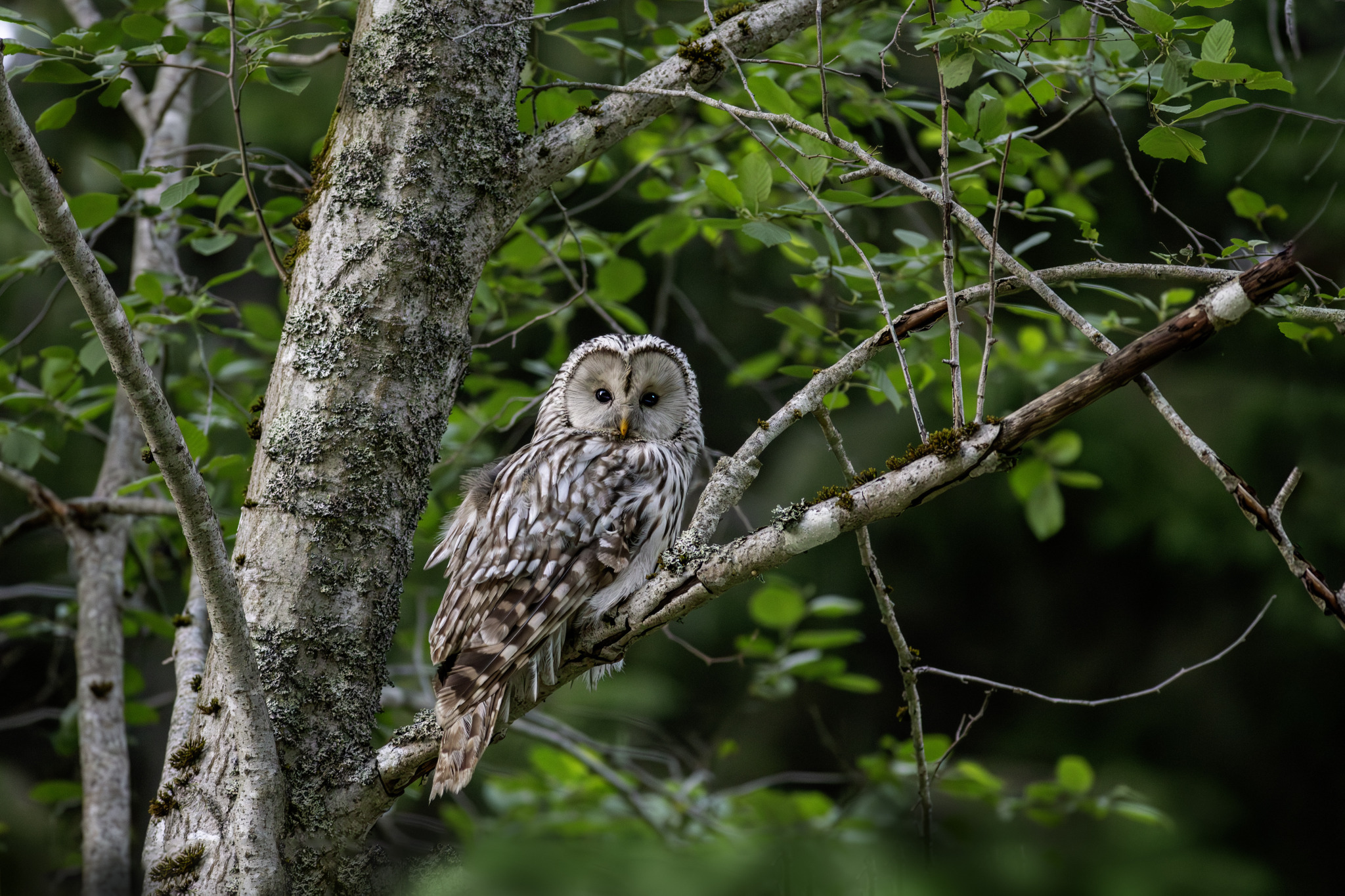
The Ural Owl (Strix uralensis) is a large, powerful owl native to the forests of Northern Europe, Eastern Europe, and Asia. It is known for its striking appearance, distinct calls, and territorial behavior.
Key Characteristics:
- Appearance:
- Size: Ural Owls are relatively large, with a body length ranging from 50 to 59 cm (19.7 to 23.2 inches) and a wingspan of 115 to 125 cm (45 to 49 inches). Females tend to be slightly larger than males.
- Coloration: Their plumage is predominantly pale grey or brown with dark streaks. The streaking pattern helps them blend into the forested environment. The underparts are paler with thin, dark streaks.
- Face: They have a round face with a distinctive facial disc, similar to other owls, but with no visible ear tufts. Their facial disc is framed by darker streaks.
- Eyes: Their eyes are dark brown, giving them a deep, serious expression, and their beak is pale yellow.
- Tail: One of the distinguishing features of the Ural Owl is its long, rounded tail, which is relatively longer compared to many other owl species.
- Behavior:
- Nocturnal: Ural Owls are primarily nocturnal, but they can also be active during the day, particularly in northern regions where daylight extends through much of the summer.
- Territorial: They are highly territorial, especially during the breeding season. Both males and females aggressively defend their nests, sometimes even attacking humans or larger animals that come too close.
- Call: The Ural Owl’s call is a loud, far-carrying series of hoots, often used by males to defend their territory or attract a mate. Females have a similar but softer call.
- Hunting: They are stealthy hunters, using their excellent hearing and vision to locate prey. Ural Owls typically hunt from a perch, swooping down silently on their prey.
- Habitat:
- Ural Owls are found primarily in dense, old-growth forests, particularly those with a mix of coniferous and deciduous trees. They prefer habitats with a lot of tree cover for nesting and hunting.
- They are widespread across northern Europe, including Scandinavia and the Baltic region, extending eastward into Russia, Central Asia, and parts of Japan.
- Diet:
- Ural Owls are carnivorous, feeding on a wide variety of prey. Their diet consists mostly of small mammals such as voles, mice, and rats, but they will also hunt birds, amphibians, and insects.
- In times of food scarcity, they may even prey on larger animals such as squirrels or small hares.
- Reproduction:
- Nesting: Ural Owls nest in large tree cavities or use old nests of other birds, such as hawks or crows. They may also use specially provided nest boxes in conservation areas.
- Breeding Season: The breeding season typically begins in late winter or early spring. Females lay 2 to 4 eggs, which they incubate for around 27 to 29 days.
- Chicks: After hatching, the chicks are cared for by both parents, with the female staying at the nest and the male providing food. The young owls fledge after about 4 to 5 weeks but remain dependent on their parents for several more weeks.
- Conservation Status:
- The Ural Owl is currently listed as a species of Least Concern by the IUCN, thanks to its wide range and stable population. However, in some areas, habitat destruction and deforestation pose threats to their populations.
Conclusion:
The Ural Owl (Strix uralensis) is a majestic forest-dwelling owl known for its territorial nature, haunting calls, and impressive size. Its adaptability to a variety of forest habitats across Europe and Asia has helped it maintain stable populations, but the loss of old-growth forests in some regions remains a potential threat to the species. With its distinct appearance and behavior, the Ural Owl is a fascinating species of nocturnal bird.
Visited 2,065 times, 20 visit(s) today
Views: 2043
Subscribe to the newsletter: