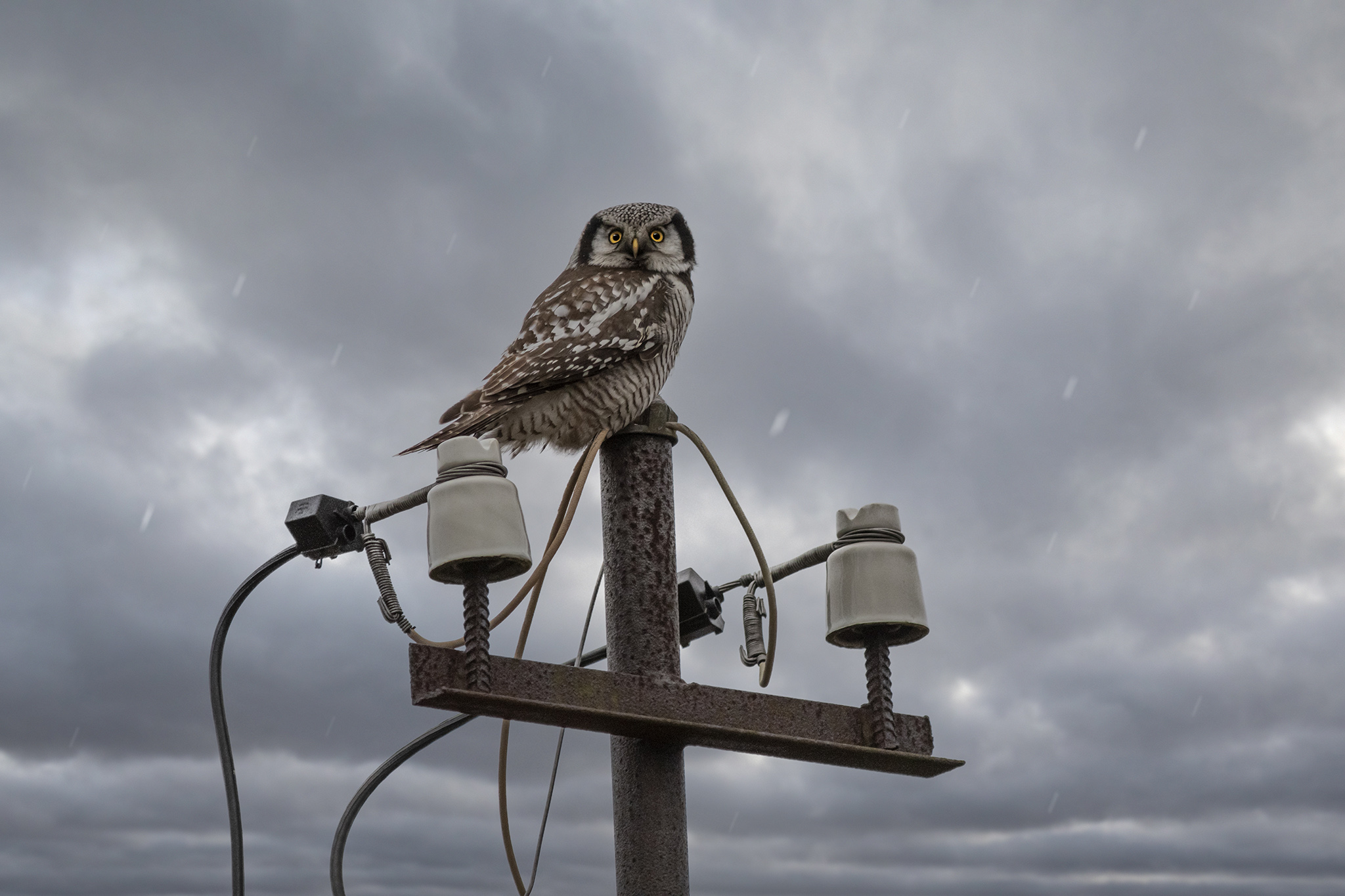

🦅 Deep Review: Northern Hawk-Owl (Surnia ulula)
The Northern Hawk-Owl is the “anomalous bird” of the owl family. It is a biological hybrid in behavior, possessing the stocky, silent flight of an owl, but the silhouette, hunting style, and even the aggressive habits of a hawk. It is a rare, elusive resident of the northern coniferous forests and a true master of the boreal wild.
📏 Physical Characteristics: The Owl in a Hawk’s Disguise
The Hawk-Owl looks and acts remarkably like a raptor, a result of convergent evolution to dominate the northern forest edge.
- Silhouette: Unlike the round, “soft” shape of a Tawny or Ural Owl, the Hawk-Owl has a sleek, tapered body and an exceptionally long, graduated tail.
- The Facial Mask: It has a distinct, pale facial disk bordered by a heavy black “frame” or mask on the sides of its head, which gives it a fierce, alert expression.
- Eyes: Brilliant, piercing yellow eyes that sit forward, providing the binocular vision needed for high-speed hunting.
- Size:FeatureMeasurementLength36–43 cmWingspan69–82 cmWeight250–370 grams
🏹 Hunting: The “Raptor-Owl”
If you see a bird sitting on the very tip of a tall, dead spruce, upright and stiff, and it suddenly dives at a steep angle toward the ground, you might be excused for calling it a hawk.
- Diurnal Hunter: Unlike 90% of owls, the Hawk-Owl is primarily diurnal (day-active). It hunts during the daylight hours, particularly at dawn and dusk, though it will hunt at night if the moonlight is bright enough.
- The Dive: It uses the same “perch-and-pounce” strategy as a sparrowhawk. It can spot a rodent movement from over 100 meters away and will plunge through the air with incredible agility, even crashing through thick branches to reach its prey.
- The Menu: They are specialists in voles, but they are also known to hunt small birds (like thrushes or buntings) in mid-air—a behavior almost unheard of in other owl species.
🌍 Habitat and Range: The Boreal Ghost
- Environment: They inhabit the Taiga (boreal forest) across the northern hemisphere—from Scandinavia and Russia through to Canada and Alaska. They love open, boggy forests, burnt-out woodland, and the transition zones between dense trees and tundra.
- Nomadic Nature: They are not as strictly territorial as other owls. If the food supply (voles) drops in one area, they will move on, sometimes hundreds of kilometers, in a nomadic search for better hunting grounds. This makes them notoriously difficult to track.
🐣 Breeding and Behavior
- The “Tree-Topper”: They don’t typically dig their own nests. They prefer to use old woodpecker holes or the hollowed-out tops of broken-off snags.
- Defensive Parents: They are extremely protective. During the nesting season, they have been known to dive-bomb predators—and unsuspecting hikers—who get too close to their brood, often making loud, harsh chattering calls as they strike.
- Communication: Their call is not the typical “hoot.” It is a long, rolling, musical trill—hu-hu-hu-hu-hu-hu—which carries for massive distances across the quiet, frozen northern forests.
⚠️ Conservation and Status
- IUCN Status: Least Concern.
- The “Ticking Clock”: Their populations fluctuate wildly based on the boom-and-bust cycles of northern small mammals.
- Climate Sensitivity: As the climate changes, the forest composition of the Taiga is shifting. Because they rely on specific types of dead trees for nesting, forestry practices that “clean up” the forest by removing dead snags are a significant threat to their ability to breed.
Peer Insight for 2026: Because the Northern Hawk-Owl is a nomad, spotting one is considered a major highlight for any birder in Estonia or Northern Europe. If you are exploring the boggy forests of the north, look for the absolute highest point of a dead conifer. That is the throne of the Hawk-Owl.
Views: 1988
Subscribe to the newsletter: