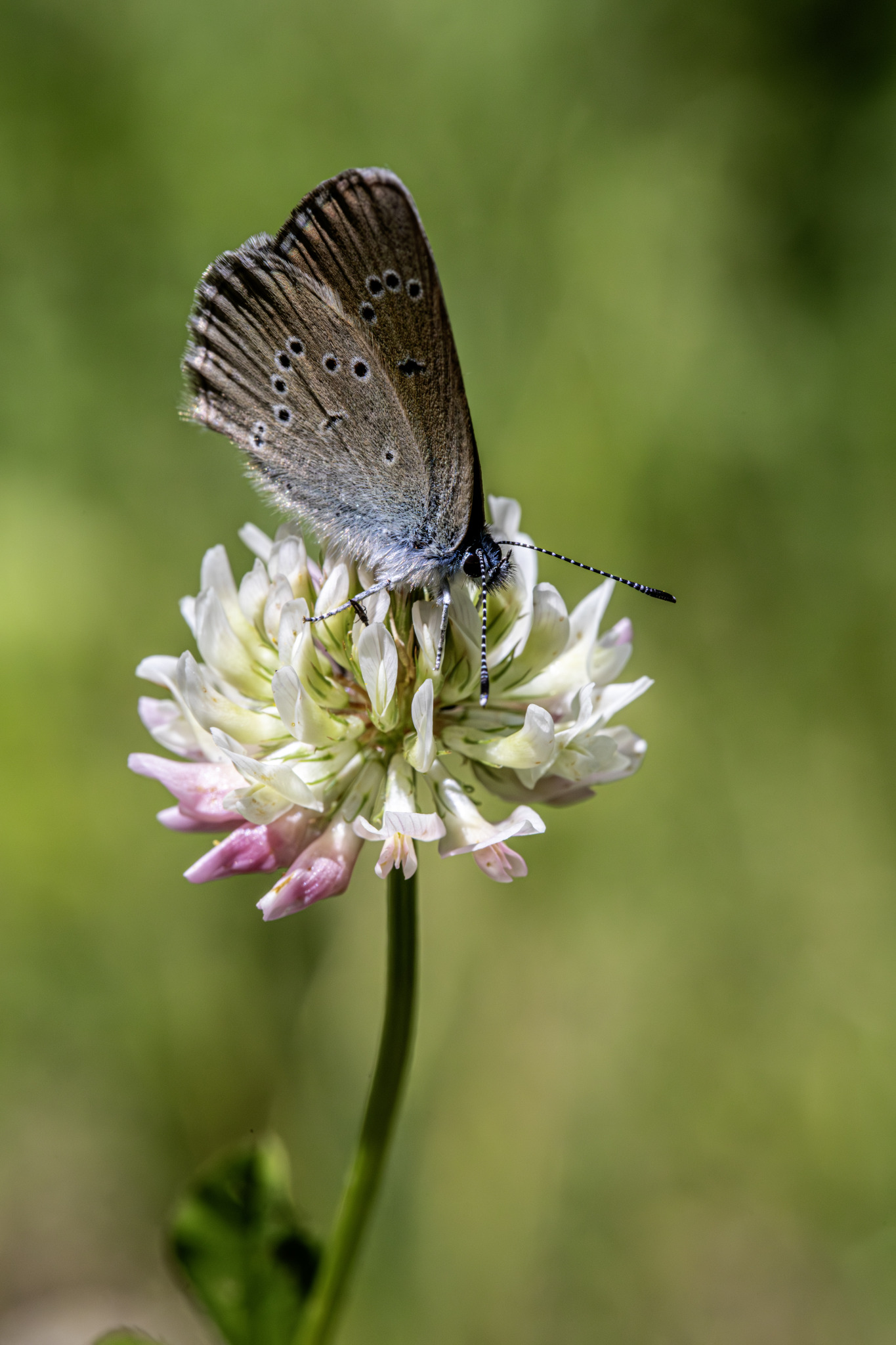
🦋 Deep Review: Mazarine Blue (Polyommatus semiargus)
The Mazarine Blue is one of the most elegant and elusive jewels of the northern meadow. While many of its relatives in the Polyommatus genus sport brilliant, sky-blue wings with narrow black borders, the Mazarine Blue takes a softer, more velvety approach to its coloration, making it a favorite for sharp-eyed lepidopterists wandering through late-spring and mid-summer grasslands.
📏 Physical Characteristics: The Velvet Violet
- The Upper Side:
- Males: Boast a deep, rich, violet-blue or dark indigo-blue with a very clean, dark border along the wing edges. Crucially, they lack the black central “discoidal spot” on the forewing that many other blues possess, giving the wing a smooth, uninterrupted color field.
- Females: Are a uniform, rich dark brown, completely devoid of blue scales (though very rarely, a female might show a slight dusting of blue at the base of the wings).
- The Underside: Both sexes share a soft, warm greyish-brown or warm taupe underside. The signature feature is the absence of the white “discal streak” (the little comma-shaped white mark) that usually sits among the neat arc of black spots, leaving the spots floating on a clean background.
- Size: A small butterfly with a wingspan ranging from 28 to 34 mm.
🥗 Diet and Host Plants: The Clover Connection
- Host Plants: The caterpillars of the Mazarine Blue are highly specialized feeders, relying almost exclusively on members of the legume family (Fabaceae). Their primary favorite is Red Clover (Trifolium pratense), though they will also use sweet-vetches (Hedysarum).
- Myrmecophily (Ant Partnerships): Like many blues, the larvae have a fascinating symbiotic relationship with ants. They secrete a sweet fluid (honeydew) from a dorsal gland that ants love to drink. In return, the ants provide protection against parasitic wasps and spiders, sometimes even coaxing the caterpillar down into their underground nests for the winter.
- Adult Diet: Adults are frequent visitors to damp ground or mud for “puddling” to extract vital minerals, and they nectar heavily on a wide variety of meadow flowers, including clover, vetch, and buttercups.
🌍 Habitat and Distribution
- Environment: They thrive in unimproved, damp or mesic (moderately moist) meadows, forest clearings, flowery road verges, and calcareous grasslands.
- Range: Widespread across temperate Europe and through temperate Asia to Japan. In Estonia and the Baltic region, they are a classic summer sight, though their populations can be somewhat localized depending on traditional meadow management.
- Seasonality: Right now, in late July 2026, you are likely catching the tail end of their flight period or a partial second brood, though their primary peak is usually from late May through June.
🛡️ Conservation Status and Vulnerability
- Status: Generally stable across its wider European range, but has faced local declines.
- The Agricultural Threat: Because the Mazarine Blue relies on traditional, unfertilized hay meadows where Red Clover grows alongside other wildflowers, intense agricultural intensification is its biggest enemy. Modern farming practices—such as early, frequent silage cutting and the heavy use of artificial fertilizers that favor aggressive grasses over wildflowers—destroy both the caterpillars’ food sources and their winter shelters.
Observation Tip for July: If you are tracking butterflies in a damp Estonian meadow, look closely at low-growing clover patches. When resting, Mazarine Blues close their wings tightly to display their subtle taupe undersides, making them look like a fallen seed pod or a bit of dried debris until they suddenly flutter up to reveal that flash of deep violet-blue.
Views: 180
Subscribe to the newsletter: