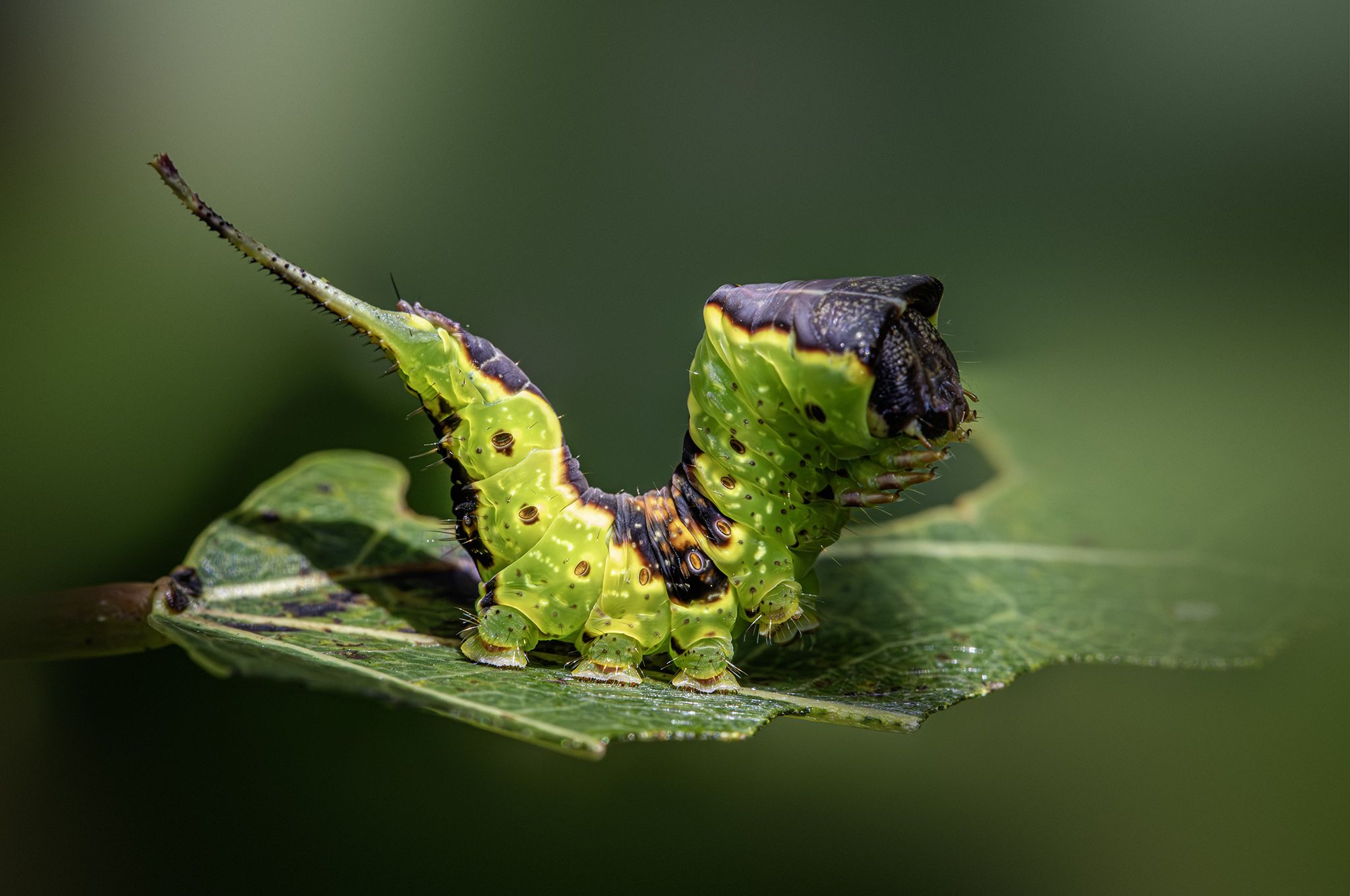
🦋 Deep Review: Alder Kitten (Furcula bicuspis)
If the larger prominent moths are the heavy-duty aircraft of the lepidoptera world, the Alder Kitten (Furcula bicuspis) is a high-contrast, sharply tailored fighter jet. Belonging to the family Notodontidae (the prominents), the “Kitten” moths earn their playful common name from the peculiar, cat-like posture of their caterpillars and their generally compact, furry appearance.
📏 Physical Characteristics: The Monochrome Masterpiece
The Alder Kitten is a striking moth that stands out among its close relatives (like the Sallow and Poplar Kittens) due to its bold, dramatic patterning.
- Wingspan:A modest 30–35 mm (though some regional specimens stretch up to 40 mm).
- The Forewings:Dominated by a crisp, snowy white background overlaid with a very broad, dark slate-grey or blackish-brown central band.It also features distinct dark patches near the apex (tip) of the wing and a series of sharp black dots running along the margins.
- Thorax and Abdomen:The thorax is heavily clothed in dense, dark grey-brown fur, while the abdomen features alternating white and grey banding.
🌿 Host Plants and the “Kitten” Niche
As its common name implies, this species is heavily dependent on trees associated with damp or marshy environments.
- Primary Food Plants:The caterpillars feed almost exclusively on Alder (Alnus glutinosa) and various Birch (Betula species).
- The Larval Form: The caterpillar is an evolutionary marvel. It has a swollen thoracic region and a unique split, tail-like appendage at the rear (a hallmark of the Furcula and Cerura genera). When disturbed, it can whip out bright red, thread-like flagella from its tail to scare off parasitic wasps, all while adopting a defensive, curled posture that resembles a tiny mammal.
- The Cocoon Fortress:When the caterpillar finishes feeding in late summer (typically July to September), it spins an exceptionally tough, woody cocoon directly onto the bark of the trunk or a branch of its host tree, chewing up and incorporating wood fibers into the silk to camouflage itself completely as a bark bump.It overwinters safely inside as a pupa.
🌍 Habitat and Distribution
- Environment:They are creatures of damp woodlands, river valleys, fens, bogs, and the margins of alder carrs where moisture levels are high.
- Range:Distributed widely across the Palearctic realm—stretching from Western Europe all the way east to Siberia. However, it tends to be local and uncommon throughout much of its range, making it a prized find for mothers.
- Seasonality:The adults fly in a single generation from mid-May through July, perfectly aligning with the lush canopy growth of early summer.They are nocturnal and are readily attracted to artificial light sources.
🛡️ Conservation and Status
- Status:Generally categorized as Least Concern globally, but locally scarce because of its reliance on undisturbed, damp woodland ecosystems and mature native alders and birches.
- Ecological Indicator: Because they require specific wetland-adjacent woodland habitats with healthy populations of native trees, their presence is often a good indicator of a healthy, ecologically diverse local river basin or marsh margin.
Observation Tip for Mid-Summer: If you are running a light trap near a damp alder-birch forest in June or July, keep an eye out for a small, intensely patterned black-and-white moth resting with its wings tightly roofed over its back. Its sharp, high-contrast monochrome bands make it stand out immediately from its more drably colored woodland cousins.
Views: 179
Subscribe to the newsletter: