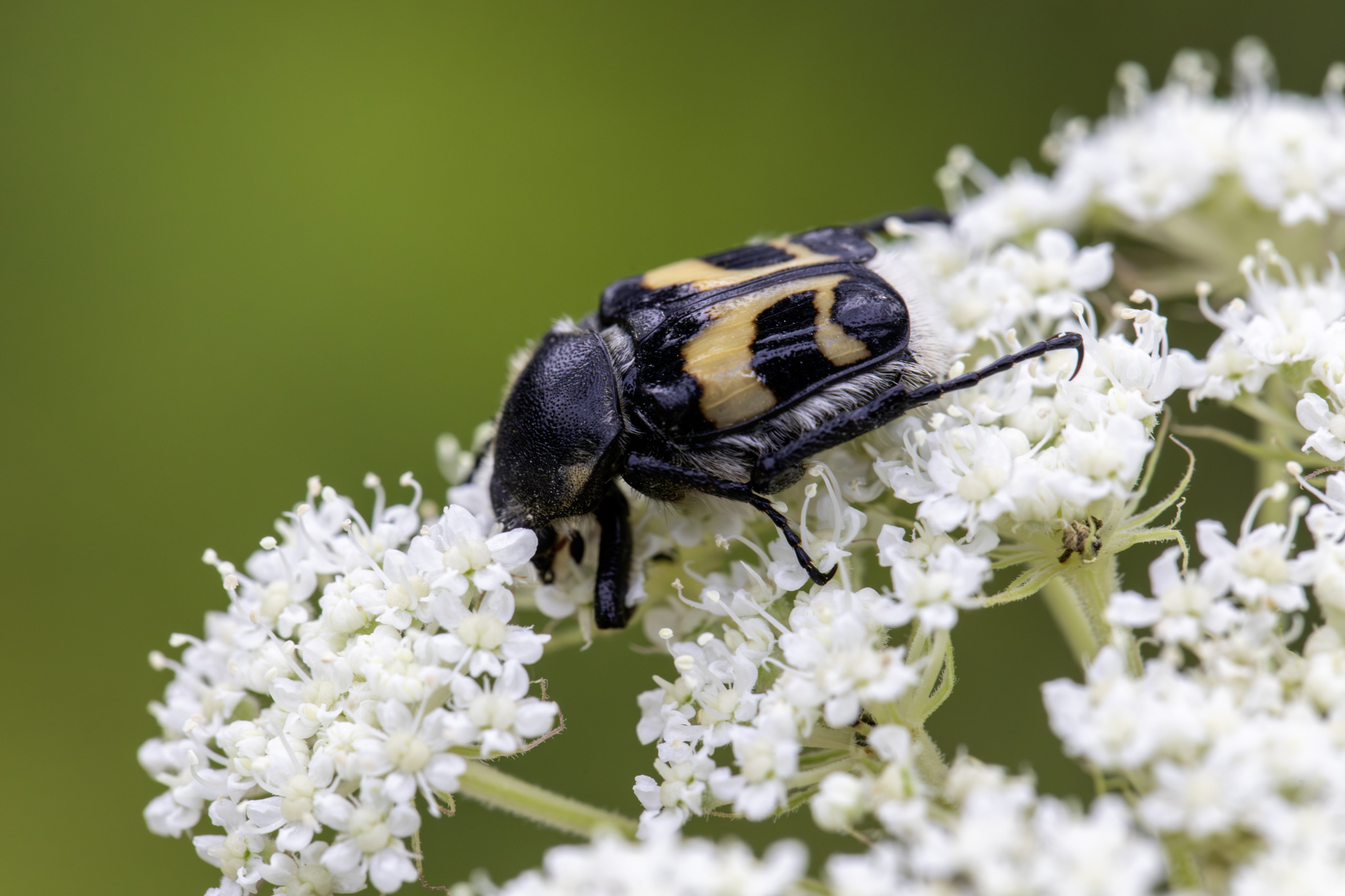
🐝 Deep Review: Eurasian Bee Beetle (Trichius fasciatus)
If you spot what looks suspiciously like a bumblebee clumsily rummaging around inside a flower head, but upon closer inspection, you realize it has a hard, shiny shell and tiny armored clubs for antennae, you have encountered one of nature’s greatest masqueraders: the Eurasian Bee Beetle (Trichius fasciatus).
Belonging to the scarab beetle family (Scarabaeidae) and the subfamily of flower chafers (Cetoniinae), this insect is a masterclass in Batesian mimicry.
📏 Physical Characteristics: The Armored Bumblebee
The Eurasian Bee Beetle has evolved a striking color palette specifically designed to trick predators into thinking it is a stinging, foul-tasting bumblebee.
- The Furry Jacket: Unlike most smooth, polished beetles, Trichius fasciatus is covered in dense, velvety hairs. Its thorax is a rich, tawny-orange, while its underside features a soft, pale pubescence.
- The Warning Stripes: Its elytra (wing covers) are a bright, contrasting mix of creamy-yellow and bold, jagged black transverse bands. The pattern varies slightly between individuals, but it unfailingly mimics the abdominal warning stripes of a bumblebee.
- Size: A medium-sized beetle, typically measuring 10 to 15 mm in length.
🥗 Diet: The Nectar and Pollen Enthusiast
While many scarab beetles spend their adult lives feeding on leaves or decaying matter, the Bee Beetle is a dedicated floral tourist.
- Favorite Hangouts: You will find them actively feeding on open, pollen-rich flowers during the warmest hours of the day. They have a particular fondness for members of the Apiaceae (carrot/umbellifer family) like hogweed and cow parsley, as well as roses, brambles, and scabious.
- The Messy Eater: Because they push deep into flower heads to gorge on pollen and nectar, their furry bodies get completely caked in yellow pollen dust. This accidental “dusting” actually makes them surprisingly effective pollinators as they bumble clumsily from flower to flower.
- The Larval Life: While the adults live a sunny, high-flying life in the meadows, the larvae are underground or inside rotting wood. The females lay eggs in decaying stumps, dead roots, or old logs (particularly birch, willow, or pine). The plump, C-shaped grubs feed on white-rotted wood for up to two to three years before pupating.
🌍 Habitat and Distribution
- Environment: They thrive in semi-wooded landscapes, forest edges, woodland clearings, hedgerows, and damp meadows where an abundance of flowering shrubs meets decaying timber (providing both adult food and larval homes).
- Range: Widespread across most of Europe and northern Asia. In the Baltic region, including Estonia, they are a delightful and relatively frequent sight during the height of summer.
- Seasonality: They are strictly warm-weather flyers. Adults emerge in late spring and peak during June, July, and August, perfectly aligning with the height of the meadow blossom season.
🛡️ Defensive Strategy: The Bumblebee Bluff
The beetle’s disguise is its primary line of defense, but it doesn’t stop at looks.
- Behavioral Mimicry: When disturbed on a flower, they don’t just sit there. They will often buzz loudly by rapidly vibrating their wings, mimicking the angry, territorial hum of a real bumblebee preparing to sting.
- Fright and Flight: If the bluff fails, they are surprisingly fast fliers. Unlike heavy chafers that take ages to launch, a Bee Beetle can unclip its elytra, pop out its wings, and dart away with a surprisingly agile, bee-like buzz.
⚠️ Conservation and Status
- IUCN Status:Least Concern globally, though populations can be locally sensitive to changes in forestry practices.
- The Dead-Wood Dilemma: Because their larvae depend entirely on standing or fallen decaying timber, “too tidy” modern forestry—which clears out old logs and dead trees—can rob them of their nurseries. Leaving old stumps and dead wood in gardens and woodland margins is the single best way to support them.
Observation Tip for August: If you are walking along a sunlit forest path or an overgrown meadow edge in mid-to-late summer, keep a close eye on large white flower clusters (like hogweed). If you see a furry, yellow-and-black insect that looks like it’s having a clumsy, pollen-dusted party right in the center, lean in close—you’re looking at a beetle wearing a bee’s Halloween costume!
Views: 161
Subscribe to the newsletter: