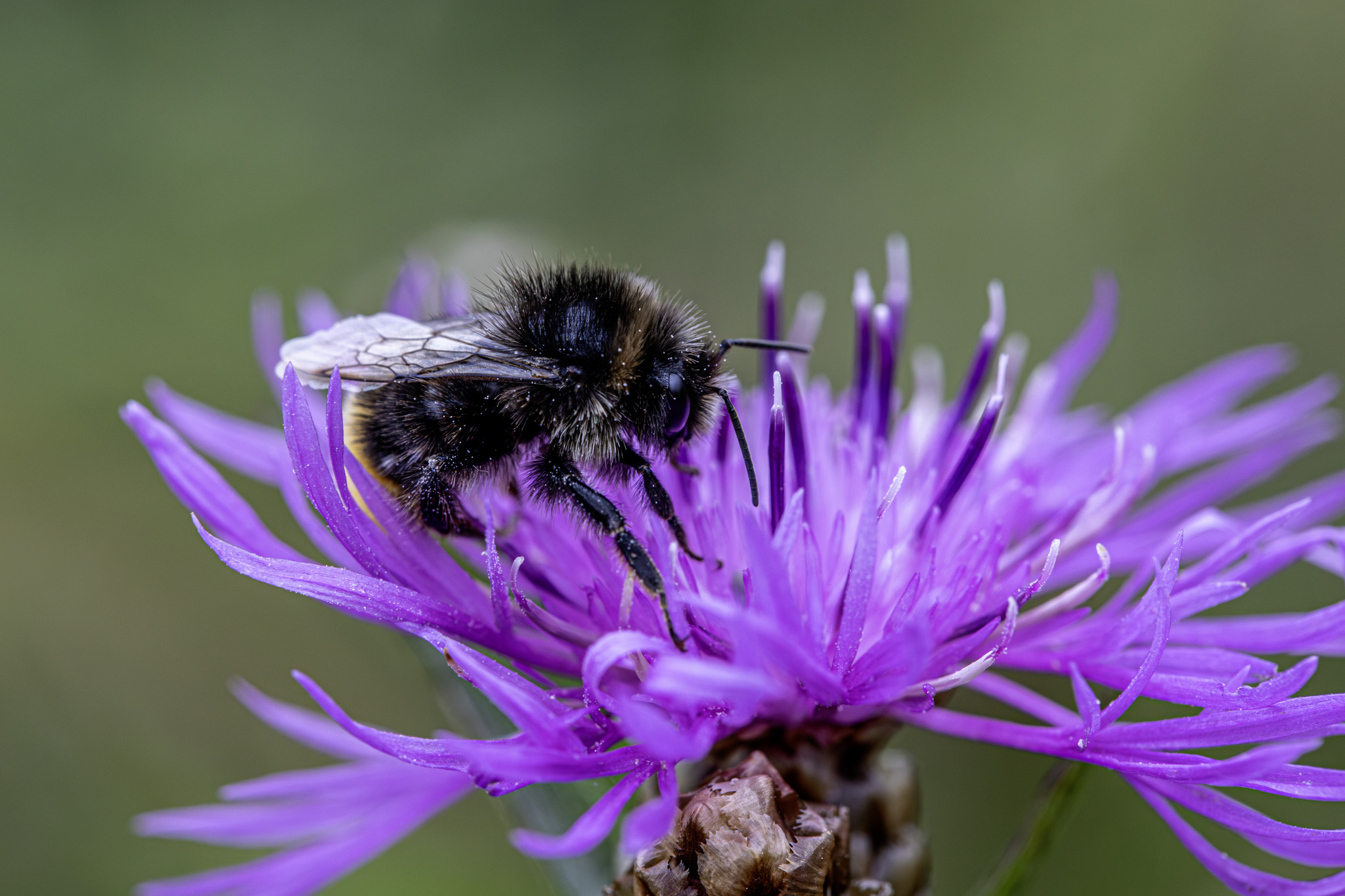
🐝 Deep Review: Red-Tailed Bumblebee (Bombus lapidarius)
If you are walking through a meadow or a garden and spot a velvety-black insect sporting a vibrant, glowing cherry-red tail, you have just encountered one of Europe’s most unmistakable and charismatic pollinators: the Red-Tailed Bumblebee (Bombus lapidarius).
As a cornerstone species of the genus Bombus, this bee is not only a heavy-duty agricultural and wild pollinator, but also a brilliant study in social insect design.
📏 Physical Characteristics: Velvet and Vermilion
The Red-Tailed Bumblebee is exceptionally easy to identify, making it a favorite for beginner and expert entomologists alike.
- The Coat: The body of the female (worker and queen) is covered in a dense, uniform coat of deep, jet-black hair. There are no yellow bands on the thorax or abdomen—it is completely black until you reach the tail.
- The Tail: The final segments of the abdomen are covered in striking, bright orange-red or vermilion fur, giving it the appearance of carrying a tiny flame.
- The Males (Drones): The males deviate slightly from the uniform black look. They sport a distinct yellow collar around their neck/thorax and have a more yellowish face, though they still retain the signature bright red tail.
- Size:
- Queen: 20–22 mm (Large and imposing)
- Worker: 12–16 mm
- Male: 14–16 mm
🥗 Diet and Foraging: The Long-Tongued Generalist
Red-Tailed Bumblebees are energetic, year-round foragers, but they have distinct preferences when it comes to gathering nectar and pollen.
- Tongue Length: They possess a medium-to-long proboscis, which allows them to easily access deep-throated flowers that shorter-tongued insects struggle with.
- Favorite Plants: They have a strong affinity for native and garden flowers in the Fabaceae (pea/bean) family (like red clover, vetches, and bird’s-foot trefoil), as well as thistles, knapweed, dead-nettles, and lavender.
- The Pollination Powerhouse: Because they are heavy and vibrate their flight muscles to shake pollen loose (a process called “buzz pollination”), they are exceptionally efficient at pollinating crops like tomatoes, peppers, and orchard fruits.
🏰 Social Structure and Nesting
Like most true bumblebees, Bombus lapidarius lives in an annual, eusocial colony governed by a single queen.
- Underground Fortresses: Unlike some species that nest in grass tussocks, Red-Tailed Bumblebees heavily favor subterranean nests. They frequently take over abandoned rodent burrows (like old field mouse nests), stone walls, cavities beneath rocks, or even gaps in garden masonry.
- Colony Cycle:
- Spring: Overwintered queens emerge in early spring, feed, and scout for a nesting site.
- Summer: The colony builds up rapidly, peaking in mid-summer with populations reaching anywhere from 100 to 300 workers.
- Autumn: By late summer, the queen produces new males and fertile queens. The old colony dies off, and only the newly mated young queens enter diapause (hibernation) to restart the cycle next year.
🌍 Habitat and Distribution
- Environment: They are remarkably adaptable, thriving in semi-open habitats, agricultural land, chalk or limestone grassland, woodland edges, and urban parks and gardens.
- Range: Widespread across most of Europe, stretching east into parts of Asia. In Estonia and the Baltic region, they are a common and welcome fixture of the summer landscape.
- Seasonality: Queens emerge as early as March or April, and workers can be seen buzzing through meadows right through August and September.
🛡️ Temperament and Defense
Despite their imposing size and bright warning coloration (aposematism) that tells predators “I can sting!”, Red-Tailed Bumblebees are remarkably gentle.
- Docile Nature: They are not aggressive. Workers will almost never sting unless they are physically trapped, squeezed, or directly swatted at. If you gently brush past one while it’s feeding on a thistle or clover head, it will usually just ignore you and keep eating.
- The Cuckoo Threat: Like many bumblebees, they are vulnerable to social parasites like the Cryptic Cuckoo Bumblebee (Bombus rupestris), which invades the nest, kills or deposes the resident queen, and forces the worker bees to raise the cuckoo’s young instead.
Garden Tip: If you want to attract and support Red-Tailed Bumblebees in your garden, avoid “tidy” gardening in stone walls or rockeries. Leaving undisturbed, slightly rough areas with cavities, combined with planting a continuous succession of bee-friendly perennials (like red clover, buddleia, and campanulas), will make your yard a paradise for these striking velvet flyers.
Views: 169
Subscribe to the newsletter: