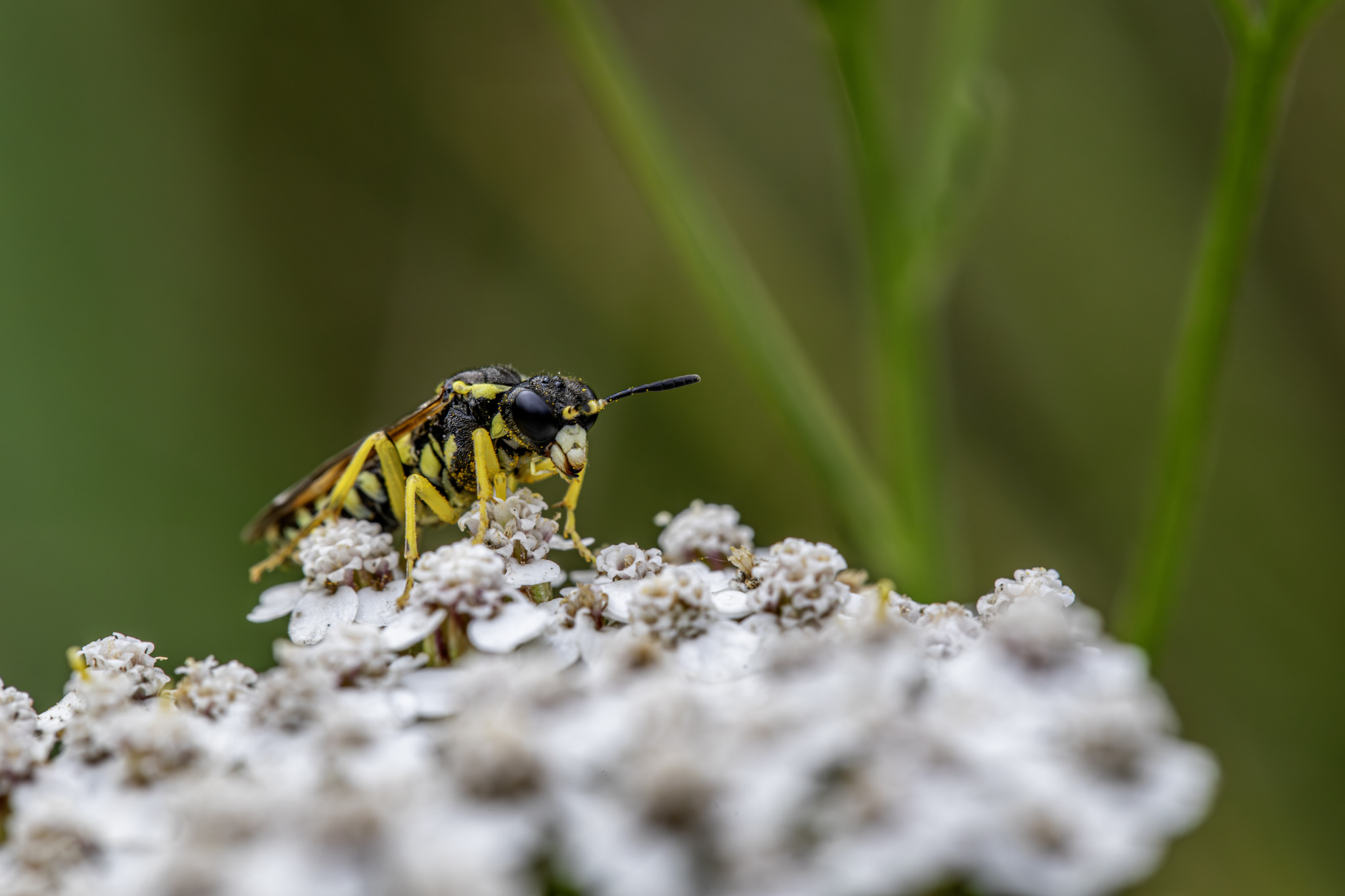
🐝 Deep Review: Yellow-sided Clover-Sawfly (Tenthredo notha)
While many people are familiar with bees, wasps, and ants, the order Hymenoptera hides a fascinating sub-group: the sawflies. Among them, the Yellow-sided Clover-Sawfly (Tenthredo notha) stands out as a striking, brightly colored insect that easily tricks casual observers into thinking it is a wasp.
As a member of the large Tenthredo genus within the family Tenthredinidae, this species is a masterclass in deceptive mimicry and specialized ecological habits.
📏 Physical Characteristics: The Wasp Imposter
The Yellow-sided Clover-Sawfly features a bold, high-contrast wardrobe that helps protect it from predators through batesian-style mimicry (looking dangerous even though it is completely harmless).
- Coloration:Its body is predominantly black with bright lemon-yellow to greenish-yellow markings.It features a distinctive broad yellow band across the first abdominal segment (tergite) that broadens and continues down its sides—giving the insect its common name.
- The Legs:The legs are largely yellow, but a crucial identification detail for experts is that its hind tibiae are tipped with black at the apex.
- The Sawfly “Waist”: Unlike true wasps, which have a narrow, pinched “wasp waist,” sawflies possess a broad, boxy connection between the thorax and abdomen. They also lack a stinger; females instead use a saw-like ovipositor to cut plant tissue when laying eggs.
- Size:A medium-sized sawfly, typically measuring between 8 to 11 mm in length.
🥗 Diet: From Predator to Pollen-Eater
The life cycle of Tenthredo notha features a dramatic shift in dietary habits between its immature stage and adulthood.
- The Larvae (The Plant Munchers):The caterpillar-like larvae feed primarily on the foliage of leguminous plants, specializing in White Clover (Trifolium repens), as well as vetches like Meadow Vetchling (Lathyrus pratensis) and Tufted Vetch (Vicia cracca).
- The Adults (The Floral Tourists): Adult sawflies turn away from leaves entirely. You will find them actively visiting open flowers—especially favoring members of the Apiaceae (carrot/umbellifer family) like hogweed and cow parsley—where they feed on nectar and pollen, while occasionally preying on smaller, soft-bodied insects.
🌍 Habitat and Distribution
- Environment:They thrive in open, sunlit habitats where wildflowers and legumes flourish, such as woodland edges, hedgerows, damp meadows, and grassy road verges.
- Range:Widely distributed across Europe and the British Isles.
- Seasonality: They are mid-to-late summer flyers. While some related species emerge earlier in spring, Tenthredo notha is typically active from June through August or September, peaking right in the heart of summer.
⚠️ The “Look-Alike” Challenge
Tenthredo notha belongs to a notorious species complex alongside close relatives like Tenthredo arcuata, Tenthredo brevicornis, and Tenthredo schaefferi. Telling them apart in the field can be exceptionally difficult, requiring a close look under a microscope at minute structural details, such as the exact black markings on the hind legs and the precise shape of the yellow abdominal bands.
Observation Tip: If you are walking along a lush hedgerow or examining a cluster of white umbellifer flowers in mid-summer, keep an eye out for small, wasp-like insects with broad bodies and bright yellow side-stripes. If it’s lingering lazily on the flower heads rather than aggressively defending a nest, you’re likely looking at one of these harmless, beautiful sawflies!
Views: 148
Subscribe to the newsletter: