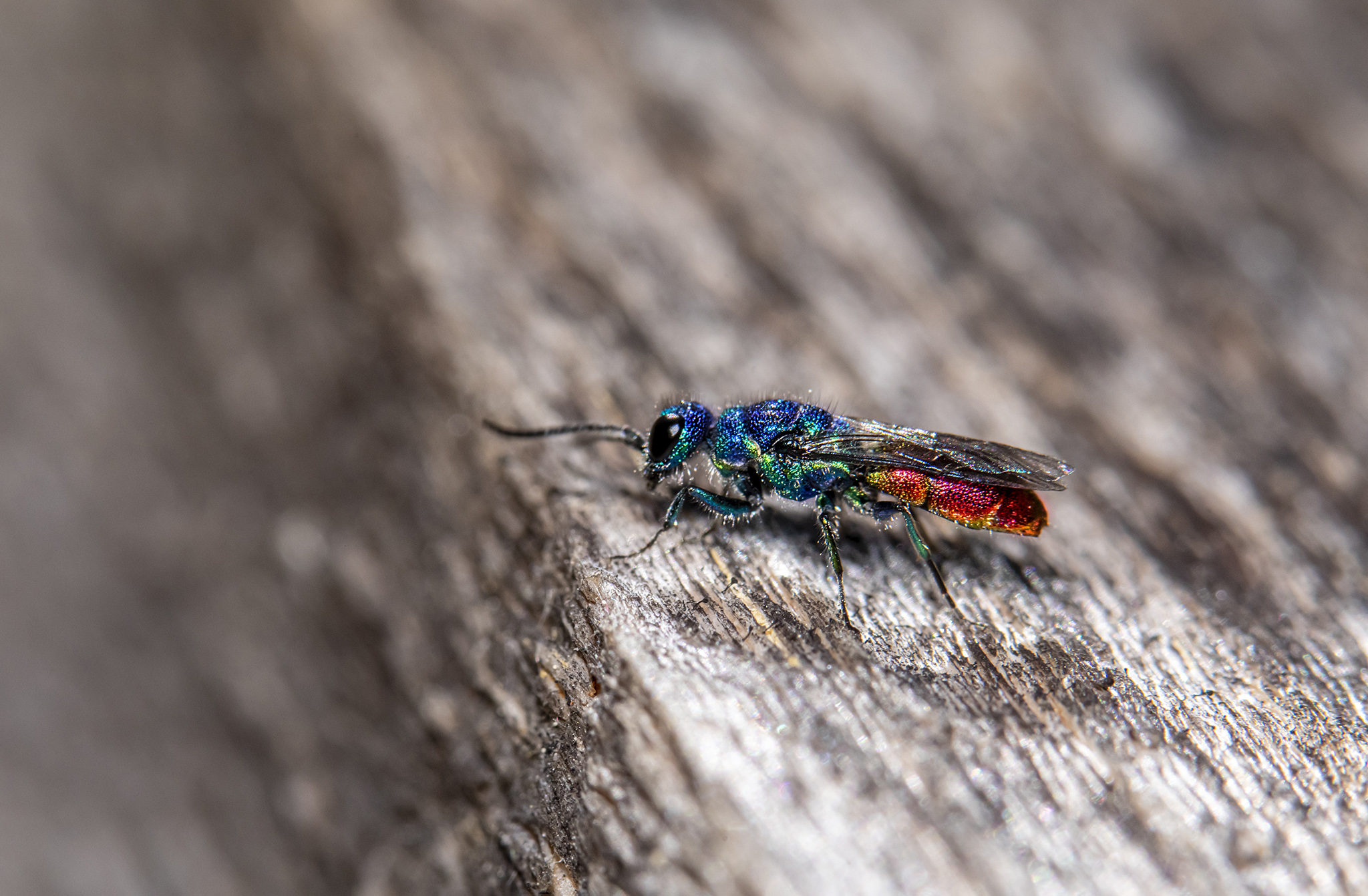
Here’s a detailed overview and description of the Cuckoo Wasp (Family Chrysididae) — one of the most beautiful and intriguing insects, known for its brilliant metallic colors and parasitic lifestyle.
🐝 Cuckoo Wasp (Family Chrysididae)
Taxonomy
- Kingdom: Animalia
- Phylum: Arthropoda
- Class: Insecta
- Order: Hymenoptera
- Superfamily: Chrysidoidea
- Family: Chrysididae
- Common name: Cuckoo wasp
- Representative genus: Chrysis
General Description
Cuckoo wasps are small, brilliantly metallic wasps, often shimmering in shades of blue, green, and red. They are famous for their jewel-like appearance, earning them the nickname “jewel wasps.”
- Size: Typically 4–15 mm long, depending on species.
- Color: Metallic blue, green, red, or gold due to structural coloration — microscopic surface textures that refract light.
- Body: Compact, heavily sculptured, and covered with pits.
- Wings: Transparent or lightly tinted; fold neatly over the body when at rest.
- Antennae: Elbowed and short, usually 13 segments in males and 12 in females.
- Legs: Slender; adapted for crawling rather than digging or carrying.
Distribution
Cuckoo wasps are cosmopolitan, found on every continent except Antarctica.
- Particularly common in warm, sunny habitats like open woodland, meadows, sand dunes, and gardens.
- Species diversity peaks in southern Europe, Africa, and Asia.
In Europe alone, over 150 species of Chrysididae are known, with Chrysis ignita, Chrysis fulgida, and Hedychrum nobile among the most familiar.
Habitat
They are typically found in:
- Sunny, dry, sandy areas
- Dead wood, old walls, and rocks where host insects nest
- Gardens, fields, and forest edges
They are often seen searching walls or logs, flying low and inspecting crevices — looking for nests of other insects.
Behavior and Ecology
Cuckoo wasps are kleptoparasitic or parasitoid insects — they lay their eggs in the nests of other solitary bees and wasps.
- The name “cuckoo” comes from the bird that lays its eggs in other birds’ nests.
- When the cuckoo wasp larva hatches, it either eats the host egg/larva or feeds on the stored food (such as pollen or paralyzed prey).
- Adults feed mainly on nectar or honeydew.
Hosts include:
- Solitary wasps (Eumeninae, Vespidae)
- Solitary bees (Megachilidae, Halictidae)
Defensive Adaptations
Cuckoo wasps are armored and resilient, with several unique defenses:
- Concave underside: Allows them to curl tightly into a ball (a behavior called conglobation) when threatened — like a pill bug — protecting their vulnerable parts.
- Thick exoskeleton: Hard and puncture-resistant, shielding them from stings or bites by host insects.
- Brilliant coloration: May serve as warning or camouflage through light reflection.
Life Cycle
- Host detection:
The female searches for active nests of solitary bees or wasps. - Egg laying:
When the host leaves its nest temporarily, the cuckoo wasp sneaks in and lays an egg on the host’s egg or food supply. - Larval development:
- The cuckoo wasp larva hatches earlier and either kills the host larva or consumes its stored provisions.
- It develops inside the host cell, pupates, and later emerges as an adult.
- Adult stage:
Adults are strong fliers and can live several weeks, feeding on flowers and sap.
Identification
| Feature | Description |
|---|---|
| Size | 4–15 mm |
| Color | Bright metallic blue, green, red, or gold |
| Body | Hard, sculptured, compact |
| Behavior | Parasitic; curls into a ball when threatened |
| Wings | Clear or iridescent |
| Host | Solitary bees and wasps |
| Flight period | Late spring to early autumn |
Common European Species
| Scientific Name | Common Name | Notes |
|---|---|---|
| Chrysis ignita | Ruby-tailed wasp | Widespread across Europe; iridescent red abdomen |
| Chrysis fulgida | Cuckoo wasp | Common in warm forest edges; parasitizes mason wasps |
| Hedychrum nobile | – | Often found near sand wasp nests |
| Trichrysis cyanea | – | Metallic blue species; nests in beetle holes |
Predators
- Birds
- Spiders
- Larger wasps
Their metallic color and tough exoskeleton provide some protection against predators.
Ecological Role
Although parasitic, cuckoo wasps are part of a balanced ecosystem:
- They help control populations of solitary wasps and bees.
- Adults serve as pollinators when visiting flowers for nectar.
- Their presence indicates healthy, insect-rich habitats.
Interesting Facts
- Their shimmering color is structural, not pigment-based — created by microscopic ridges that bend light.
- Some species can detect chemical cues from host nests.
- They can survive extreme heat due to their reflective metallic cuticle.
- Cuckoo wasps are often solitary and rarely aggressive toward humans.
Conservation Status
- Most species: Least Concern
- Some localized or specialized species are threatened by habitat loss, especially where old wood or sandy nesting sites are removed.
- Conservation efforts focus on preserving natural nesting habitats of their host species.
Summary
| Trait | Description |
|---|---|
| Scientific Family | Chrysididae |
| Common Name | Cuckoo Wasp / Jewel Wasp |
| Size | 4–15 mm |
| Coloration | Metallic green, blue, red, or gold |
| Behavior | Parasitic on solitary bees and wasps |
| Habitat | Sunny, dry areas; wood, sand, walls |
| Distribution | Worldwide except Antarctica |
| Conservation | Mostly common; some species declining |
Views: 786
Subscribe to the newsletter: