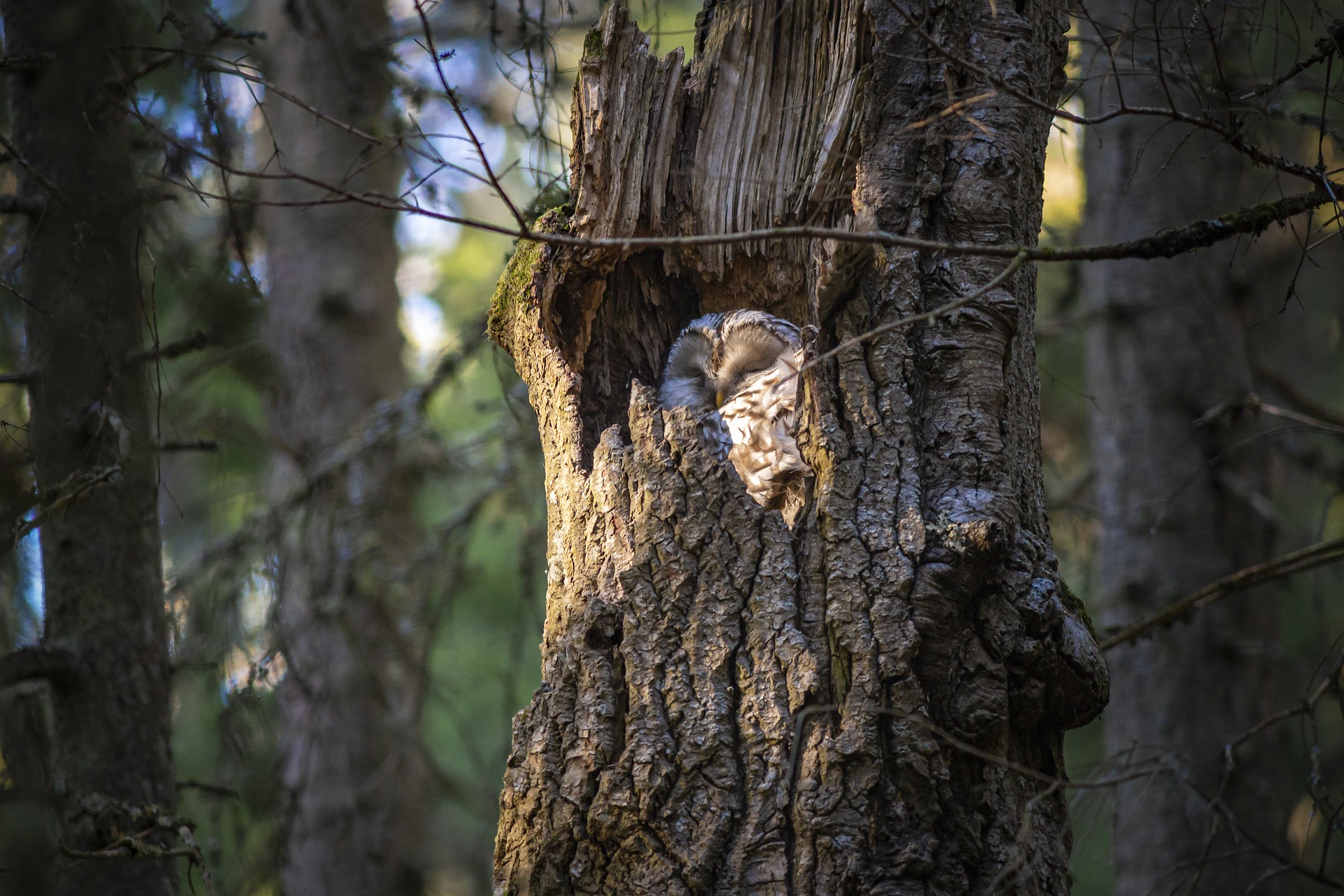
Here’s a complete overview of the Ural Owl (Strix uralensis), one of Europe and Asia’s most powerful forest owls — a silent and commanding predator of the northern woods.
🦉 Ural Owl (Strix uralensis)
Taxonomy
- Kingdom: Animalia
- Phylum: Chordata
- Class: Aves
- Order: Strigiformes
- Family: Strigidae (Typical owls)
- Genus: Strix
- Species: S. uralensis
General Description
The Ural Owl is a large, broad-winged owl with a long tail and a rounded head lacking ear tufts. Its calm, expressive face and ghostly pale plumage give it an almost ethereal appearance in its dense forest habitat.
- Length: 50–62 cm
- Wingspan: 110–134 cm
- Weight: 500–1300 g (females heavier than males)
- Plumage: Pale grayish-brown with fine dark streaks; the underparts are lighter with longitudinal stripes.
- Face: Round, pale gray face with dark concentric rings and large black eyes.
- Tail: Long and square-ended — one of its key identification features.
Distribution
The Ural Owl has a wide Palearctic range, extending across:
- Northern and Central Europe – Scandinavia, the Baltic states, Poland, Czechia, Austria, Germany, and Finland.
- Eastern Europe & Russia – Widespread through the boreal forests to Siberia.
- Asia – Found as far east as Japan and northern China.
In Europe, the species is most common in Finland, Sweden, and Russia, but small, stable populations exist in Central Europe and parts of the Alps and Carpathians.
Habitat
- Prefers mature mixed or coniferous forests, often near clearings, wetlands, or meadows that support abundant prey.
- Tends to occupy remote woodland areas, far from human disturbance.
- Uses large tree cavities, old raptor nests, or nest boxes for breeding.
Behavior and Ecology
- Activity: Mostly nocturnal, but also hunts at dawn and dusk. In northern regions with long summer days, it can be active even in daylight.
- Flight: Strong, silent, and gliding with deep wingbeats; often seen flying low over forest openings.
- Diet:
- Feeds mainly on small mammals — voles, mice, and shrews.
- Occasionally takes birds, amphibians, and insects.
- May store surplus prey near the nest.
- Hunting: Uses elevated perches to silently watch and swoop down on prey detected by its exceptional hearing.
Reproduction
- Breeding season: February–May (depending on latitude).
- Nest: Occupies tree cavities, broken stumps, or old nests of buzzards or ravens; readily accepts nest boxes.
- Clutch size: 3–6 white eggs.
- Incubation: ~28–34 days, done mostly by the female.
- Fledging: Chicks leave the nest after about 4–5 weeks, but remain dependent on parents for another month or more.
- Defensive behavior: Females are extremely protective of nests and can be aggressive toward intruders, even humans.
Vocalizations
- Male’s territorial call: A deep, resonant “hoo-hoo-hoo-hoo” with clear rhythm, carrying over long distances through forests.
- Female: Gives shorter, harsher calls and alarm notes.
- Young: Emit high-pitched “squeaky gate” begging calls at night.
Conservation Status
- IUCN Red List: 🟢 Least Concern
- Population trend: Stable or increasing in many parts of Europe due to reforestation and nest-box programs.
- Threats:
- Loss of old-growth forest and large nesting trees.
- Collisions with vehicles or power lines.
- Habitat fragmentation and logging in breeding areas.
Ecological Role
- Plays a critical role as a top nocturnal predator, controlling populations of small rodents.
- Serves as a bioindicator of healthy, mature forest ecosystems.
Identification Tips
- Large size with long tail and rounded head (no ear tufts).
- Pale grayish-brown plumage with fine streaking.
- Dark eyes — unlike many other Strix owls which have dark brown or blackish eyes.
- Deep, resonant hooting call heard mainly at dusk or dawn.
Interesting Facts
- The Ural Owl’s hearing is so sensitive it can locate prey under snow or dense vegetation.
- Territorial pairs may remain together for many years, defending the same nesting area year-round.
- In Finland and central Europe, it has successfully expanded its range thanks to conservation efforts and artificial nest boxes.
Visited 90 times, 1 visit(s) today
Views: 118
Subscribe to the newsletter: