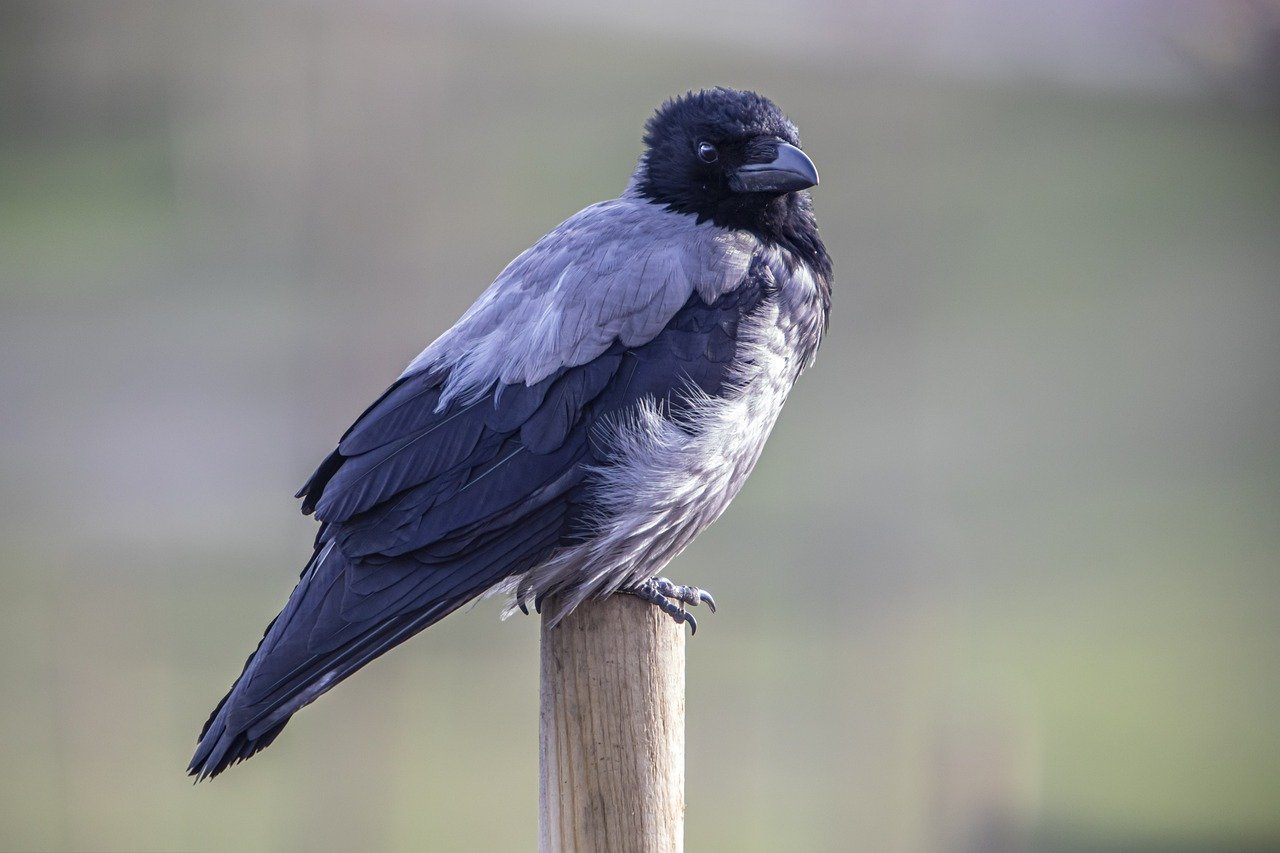
🐦 Deep Review: Hooded Crow (Corvus cornix)
The Hooded Crow—often called the “Hoodie”—is the stylish, grey-and-black intellectual of the bird world. While many see crows as monolithic black shadows, the Hooded Crow stands out with its distinct “two-tone suit,” high-level problem-solving skills, and a social complexity that rivals some primates.
📏 Physical Characteristics: The Grey Vest
- Coloration: Unlike its cousin, the all-black Carrion Crow, the Hooded Crow features a striking contrast. It has an ash-grey torso and back, while its head, “bib” (throat), wings, and tail are a deep, iridescent black.
- The “Hood”: The black plumage on the head gives it the appearance of wearing a dark hood or cowl.
- Bill: Heavy, powerful, and slightly curved at the tip—perfect for everything from cracking nuts to scavenging carcasses.
- Size:FeatureMeasurementLength48–52 cmWingspan92–100 cmWeight370–650 grams
🧬 The “Cousin” Controversy: Hooded vs. Carrion
For a long time, the Hooded Crow and the Carrion Crow (Corvus corone) were considered the same species.
- The Split: Modern taxonomy generally treats them as separate species, though they are genetically almost identical.
- The Hybrid Zone: Where their ranges meet (a narrow strip running through Scotland and Central Europe), they frequently interbreed. The resulting hybrids often show “smudged” or intermediate grey-and-black patterns.
- Geographic Divide: Generally, the Hooded Crow takes the North and East (Ireland, Scotland, Scandinavia, Eastern Europe, Italy), while the Carrion Crow takes the West and South (England, France, Spain).
🧠 Intelligence: The “Feathered Ape”
As members of the Corvidae family, Hooded Crows are exceptionally intelligent.
- Tool Use: They have been observed using sticks to extract insects and dropping hard-shelled nuts or mollusks onto roads so that passing cars will crush them.
- Counting & Memory: They can recognize individual human faces and remember who has been kind to them—and who has shooed them away—for years.
- Social Play: They are known to engage in “play,” such as sliding down snow-covered roofs or playing tug-of-war with sticks, which is a sign of a highly developed brain.
🍎 Diet: The Opportunistic Scavenger
The Hooded Crow is the ultimate generalist. Their diet is dictated entirely by what is available in their environment.
- The Menu: Insects, seeds, grain, small mammals, frogs, and bird eggs.
- Scavenging: They are highly efficient scavengers, often seen on “roadkill duty” or raiding trash cans in urban areas.
- Coastal Specialists: In coastal regions, they are famous for stealing fish from nets or dropping crabs from great heights onto rocks to shatter their shells.
🏠 Habitat and Social Life
- Environment: They are incredibly adaptable, thriving in open moorland, coastal cliffs, farmland, and busy city centers.
- Mobbing: Hooded Crows are the “neighborhood watch.” If a bird of prey (like a Buzzard or Owl) enters their territory, the crows will gather in a noisy group to “mob” the intruder, diving at it until it leaves.
- Nesting: They build large, sturdy nests of sticks lined with wool or animal hair, usually high in a tree or on a cliff edge. They are monogamous and tend to stay with their partner for life.
⚠️ Conservation and Human Interaction
- IUCN Status: Least Concern. Their ability to live alongside humans has made them very successful.
- The “Pest” Label: Because they occasionally take the eggs of game birds or peck at livestock (especially vulnerable lambs), they are often persecuted by farmers and gamekeepers.
- Cultural Symbolism: In many cultures, the “Hoodie” is a symbol of wisdom and cunning, but also a harbinger of war or death due to its presence on old battlefields as a scavenger.
Peer Insight: If you see a Hooded Crow tilting its head at you, it isn’t just being cute—it’s likely calculating. They are known to watch humans to see where they hide food or to wait for a specific person who usually drops a piece of a sandwich. In 2026, as urban environments expand, these birds are becoming even more bold and integrated into city life.
Views: 2335
Subscribe to the newsletter: