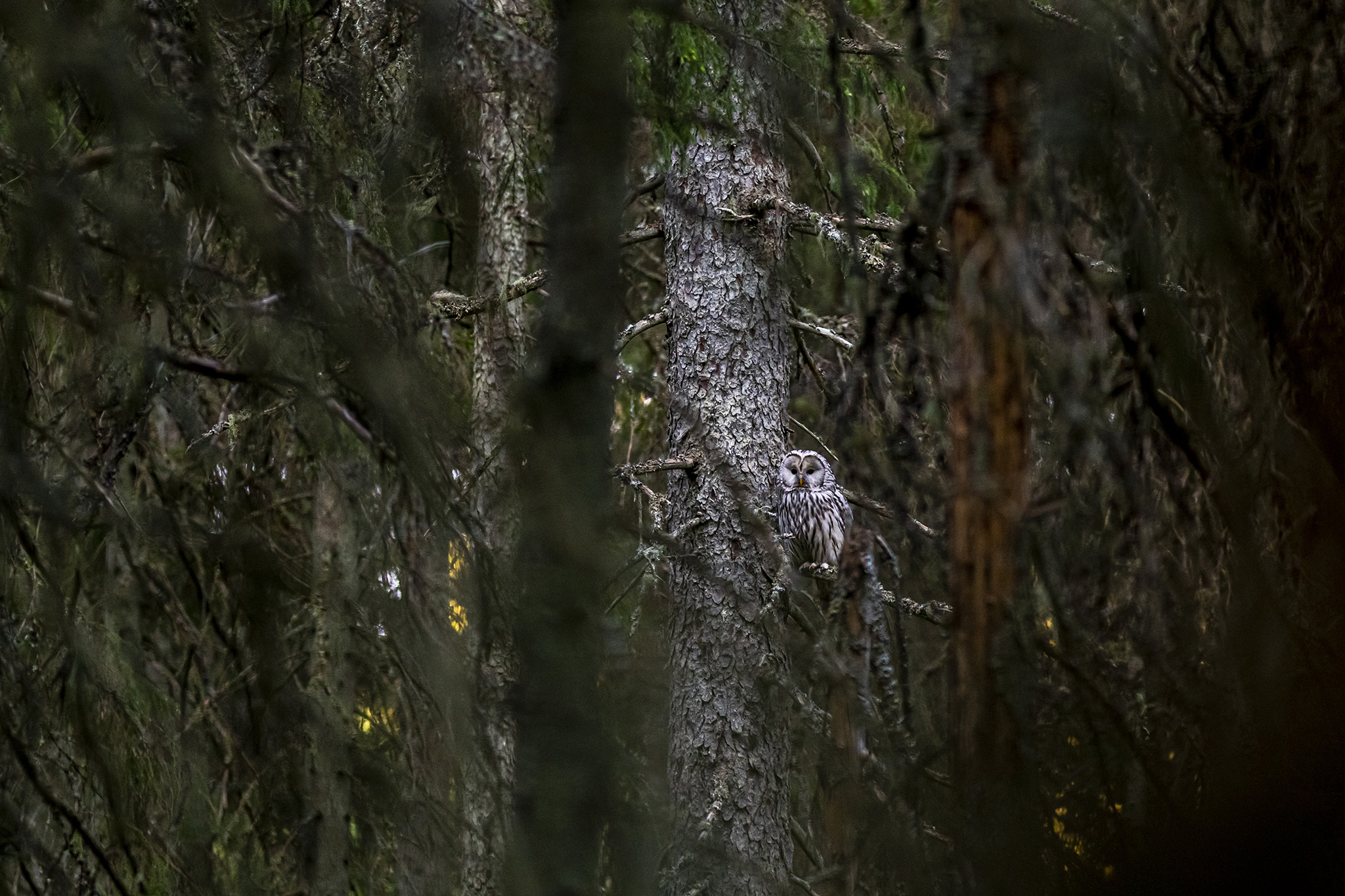
🦉 Deep Review: Ural Owl (Strix uralensis)
The Ural Owl is the “ghost of the boreal forest.” Large, pale, and surprisingly bold, it sits taxonomically and physically between its smaller cousin, the Tawny Owl, and the massive Great Grey Owl. It is famous among birders and hikers not just for its beauty, but for its fierce, uncompromising defense of its territory.
📏 Physical Characteristics
- The “Long-Tailed” Owl: One of the best ways to identify a Ural Owl in flight or perched is its exceptionally long, wedge-shaped tail. This feature makes it appear much larger and more “stretched” than the stockier Tawny Owl.
- Facial Features: It has a very large, rounded head with a pale, silvery-grey facial disk that lacks any “ear” tufts. Its eyes are relatively small and jet-black, giving it a piercing, focused gaze.
- Plumage: Its feathers are a mix of soft greys and browns with heavy, vertical dark streaking on its creamy-white underparts. This provides perfect “dead wood” camouflage.
- Size:FeatureMeasurementLength50–62 cmWingspan125–135 cmWeight600–1,300 grams (Females are significantly larger)
🌍 Habitat and Range
- Geographic Range: They are birds of the Palearctic, stretching from Scandinavia and Eastern Europe (the Carpathians and Balkans) all the way across Russia to Japan.
- The Taiga Specialist: They thrive in old-growth coniferous and mixed forests. They prefer “edge” habitats—areas where dense forest meets a bog or a clearing—allowing them to nest in the trees and hunt in the open.
- Sedentary Nature: Unlike many northern birds, the Ural Owl is non-migratory. Once it establishes a territory, it usually stays there for life, surviving even the most brutal sub-arctic winters.
⚔️ The “Strike Owl”: Aggression and Behavior
In Sweden, the Ural Owl is known as Slaguggla (literally “Strike Owl”). This name is well-earned.
- Fearless Defense: During the breeding season (especially when the chicks are fledging), the female becomes incredibly aggressive. They have no fear of humans and will dive-bomb intruders who get too close to the nest.
- The Target: They are known to aim specifically for the head and eyes. Their sharp talons can cause serious injury, often striking from behind with total silence. Researchers often wear reinforced helmets and face shields when checking Ural Owl nest boxes.
- Nocturnal but Flexible: While primarily nocturnal, they often hunt during the day during the long northern summer or when they have hungry chicks to feed.
🍴 Diet and Hunting
- The Vole Specialist: Like many northern owls, their survival is closely tied to vole populations (especially field and bank voles).
- The Menu: When voles are scarce, they are highly opportunistic. They will take squirrels, frogs, and even other birds (up to the size of a pigeon or a Jay).
- Hunting Style: They are “perch-and-pounce” hunters. They sit motionless on a low branch, using their incredible hearing to locate the rustle of a rodent under the grass (or even under the snow) before dropping down for the kill.
🏠 Nesting and Life Cycle
- The “Chimney” Nest: Their preferred nesting site is the top of a hollow, broken tree stump (natural chimneys). However, they have adapted well to large, deep nest boxes provided by conservationists.
- Family Life: They are monogamous and often mate for life. The female incubates the eggs (usually 2–4) for about 28 days, while the male does all the hunting, bringing food to the nest rim.
- The “Brancher” Phase: The young leave the nest before they can fly. They use their beak and talons to climb up nearby branches, where they hide and wait for their parents to bring food—this is the most dangerous time to be near a Ural Owl territory.
⚠️ Conservation and Threats
- IUCN Status: Least Concern.
- The Forestry Problem: Their main threat is modern, “clean” forestry. By removing old, dead, or hollow trees, humans inadvertently destroy their natural nesting sites.
- Conservation Success: In Central Europe (Germany and Austria), the Ural Owl went extinct in the 20th century but has been successfully reintroduced to national parks like the Bavarian Forest.
Pro-Tip: If you are hiking in the Scandinavian or Carpathian woods in late spring and hear a loud, bark-like hu-wuhu-hu-wu or a sharp wau-wau, and you see a large pale owl watching you—keep moving. If the owl starts snapping its beak (a loud “clacking” sound), you are officially in the “strike zone.”
Views: 1777
Subscribe to the newsletter: