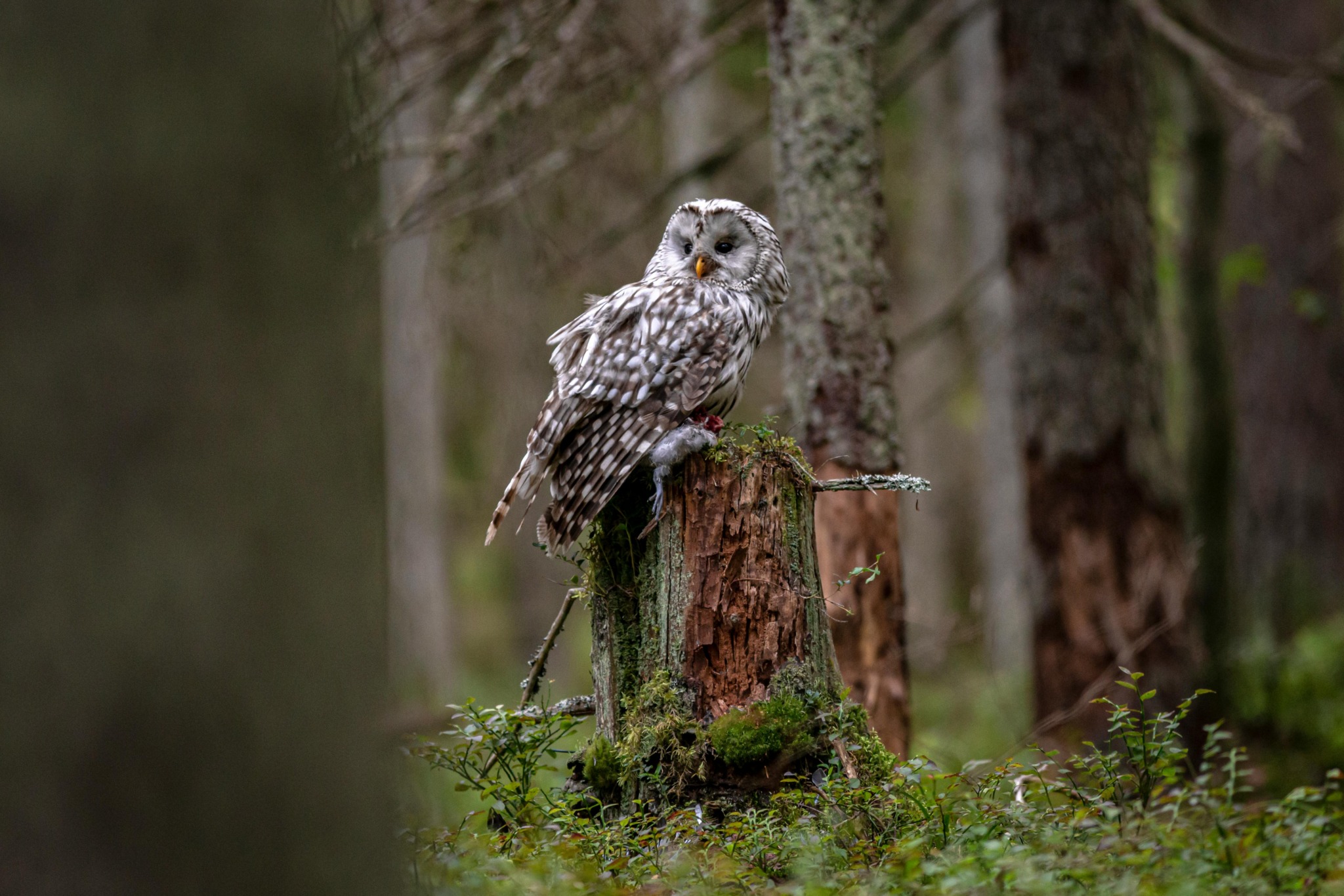
Here’s a full and detailed overview of the Ural Owl (Strix uralensis), one of Europe and Asia’s most impressive forest-dwelling owls.
🦉 Ural Owl (Strix uralensis)
Taxonomy
- Kingdom: Animalia
- Phylum: Chordata
- Class: Aves
- Order: Strigiformes
- Family: Strigidae
- Genus: Strix
- Species: S. uralensis
Common name: Ural Owl
Scientific name: Strix uralensis
Identification
The Ural Owl is a large, long-tailed owl with a round head and no ear tufts. It is easily recognized by its pale facial disc, dark eyes, and softly streaked plumage.
- Length: 50–59 cm
- Wingspan: 110–134 cm
- Weight: 500–1300 g (females larger than males)
- Plumage:
- Greyish-brown or pale grey with fine dark streaks
- Whitish facial disc bordered by a darker rim
- Long, rounded tail with light and dark bands
- Eyes: Dark brown to almost black
- Beak: Yellow, strong, and slightly curved
- Legs: Fully feathered for insulation in cold climates
Its flight is silent and buoyant, with deep wingbeats, often gliding between trees.
Distribution and Range
The Ural Owl is widespread across northern Eurasia, from Scandinavia through eastern Europe, Russia, and Siberia, extending into Japan and Korea.
In Europe, it is found in:
- Scandinavia (Sweden, Finland, Norway)
- Central and Eastern Europe (Estonia, Poland, Czechia, Slovakia, Austria, Romania)
- The Balkans and the Alps
It favors boreal and temperate forest zones with large, old trees.
Habitat
Prefers dense mixed or coniferous forests with:
- Old trees suitable for nesting
- Nearby clearings, meadows, or forest edges for hunting
Also found in mountainous regions and mature deciduous forests.
Nesting sites include tree cavities, abandoned nests of other large birds, or nest boxes.
Behavior
- Activity: Mostly nocturnal, though may hunt during the day—especially in northern regions during long daylight hours.
- Territorial: Extremely defensive near the nest; known to dive aggressively at intruders, including humans.
- Vocalization:
- Deep, far-carrying hoots: “hoo-hoo-hoo-hooo”
- Females utter shorter, sharper calls
- Calls are most frequent during courtship and breeding season
Diet
The Ural Owl is a powerful hunter, feeding mainly on:
- Small mammals — voles, mice, shrews, and sometimes squirrels
- Small birds
- Frogs, insects, and occasionally fish
It hunts from perches, gliding silently to seize prey with its strong talons.
Reproduction
- Breeding season: March–June (earlier in southern areas)
- Nest: In tree hollows, old raptor nests, or large nest boxes
- Clutch size: 2–6 white eggs
- Incubation: 27–34 days (female only; male provides food)
- Fledging: 30–35 days after hatching
Chicks are fed by both parents. The female fiercely protects the nest, often attacking perceived threats.
Lifespan
- Average: 10–12 years
- Maximum recorded: Over 20 years in the wild
Conservation Status
- IUCN Red List: Least Concern (LC)
- Population trend: Stable to increasing in many areas
- Threats:
- Deforestation and loss of old-growth forest
- Habitat fragmentation
- Traffic accidents and human disturbance near nests
Nest-box programs have successfully supported populations in Central and Northern Europe.
Ecological Role
- Key predator regulating rodent populations
- Indicator species of healthy, mature forest ecosystems
- Contributes to maintaining biodiversity by controlling small mammal numbers
Predators and Threats
- Natural predators: Rare; large raptors like eagles or goshawks may occasionally prey on juveniles.
- Main threats: Logging, road mortality, and nest disturbance.
Key Identification Points
| Feature | Description |
|---|---|
| Scientific name | Strix uralensis |
| Common name | Ural Owl |
| Family | Strigidae |
| Length | 50–59 cm |
| Wingspan | 110–134 cm |
| Eyes | Dark brown |
| Plumage | Pale grey, streaked |
| Habitat | Mixed and coniferous forests |
| Diet | Small mammals, birds |
| Conservation status | Least Concern |
Interesting Facts
- The Ural Owl is one of Europe’s largest owls, nearly the size of the Great Grey Owl but more compact.
- It can attack humans who approach its nest too closely — bird researchers wear helmets for protection.
- Known for silent flight and exceptional low-light vision.
- In Finland and Estonia, it’s considered a symbol of old, wild forests.
Summary
The Ural Owl (Strix uralensis) is a powerful, long-tailed owl inhabiting the vast forests of northern and central Eurasia. With its pale streaked plumage and haunting hoots, it epitomizes the deep, undisturbed woodlands it calls home. Fiercely territorial and an efficient hunter of small mammals, the Ural Owl plays a vital role in forest ecosystems and remains one of Europe’s most charismatic nocturnal predators.
Views: 1519
Subscribe to the newsletter: