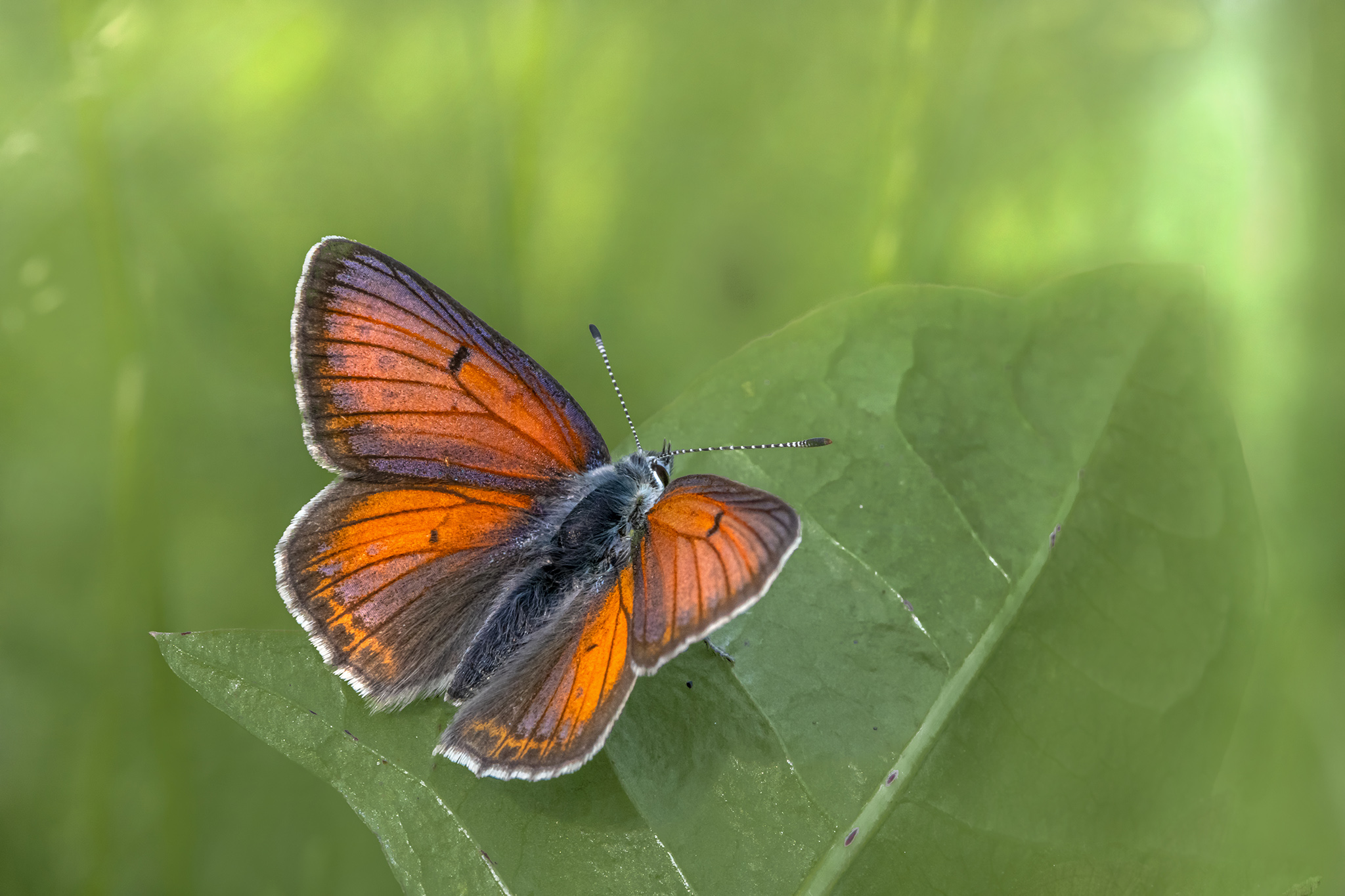
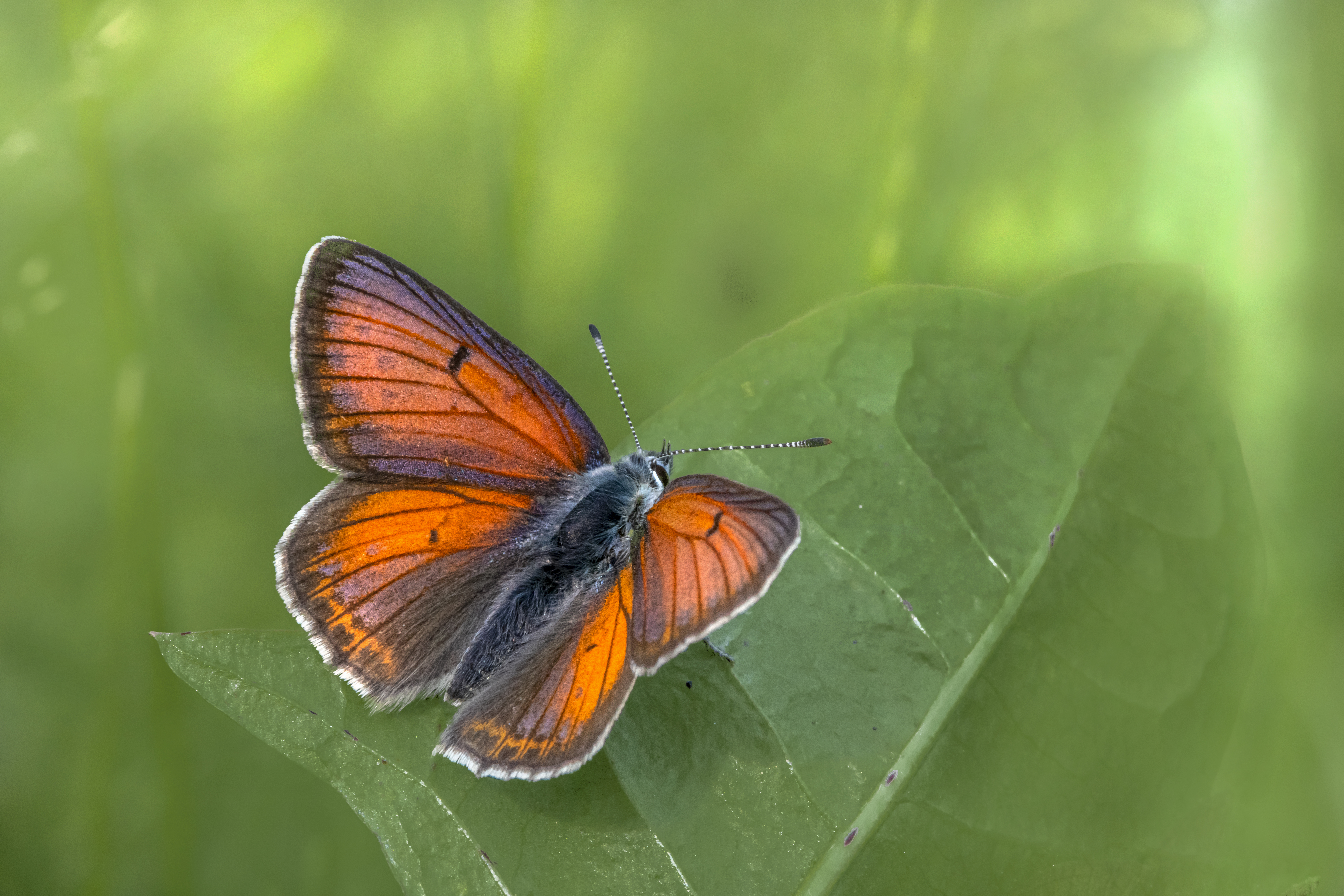
The Purple-edged copper (Lycaena hippothoe) is a breathtakingly beautiful butterfly that serves as an indicator species for the health of damp, flower-rich grasslands. While the Small copper is a gritty generalist, the Purple-edged copper is a refined specialist, often restricted to pristine wetlands and subalpine meadows.
1. Physical Profile
This species is larger than the Small copper and possesses a unique iridescent quality that is rare among the “coppers.”
- Sexual Dimorphism: * Males: Brilliant, deep orange-red upperside. Its hallmark is the shimmering violet-purple sheen that runs along the wing margins and sometimes suffuses the entire hindwing.
- Females: Highly variable but generally much darker. They typically have dark brown uppersides with a few orange spots on the forewings and an orange band on the hindwings.
- Underside: Both sexes share a similar underside: a soft, pale orange-grey base covered in distinct black spots ringed with white. The hindwing usually features a subtle orange submarginal band.
- Wingspan: Approximately 32–38 mm (noticeably larger than L. phlaeas).
2. Behavior & Habitat
This butterfly is a “wetland specialist,” rarely found in the dry, urban environments where the Small copper thrives.
- Preferred Biotopes: It is a resident of boggy meadows, damp forest clearings, and lush mountain pastures up to 2,000 meters. They require high humidity and an abundance of nectar-rich flowers like Common Bistort (Bistorta officinalis) and Yarrow.
- Territorial Basking: Males are highly territorial. They sit on tall grass stems or flower heads with their wings held at a 45-degree angle (half-open). This specific “V” posture allows them to maximize sun absorption while showing off their purple iridescence to passing females.
- Flight: They have a fast, fluttering flight, but they are less “nervous” than other coppers and will often allow a close approach if they are feeding on nectar.
3. Lifecycle & Diet
The Purple-edged copper is deeply tied to its host plants, and its disappearance is often the first sign that a meadow has become too dry.
- Larval Food Plants: Primarily Common Sorrel (Rumex acetosa) and Bistort.
- The “Winter Sleep”: Unlike many butterflies that overwinter as eggs or pupae, the Purple-edged copper overwinters as a young caterpillar. They hide at the base of the host plant, enduring frost and snow, before waking up in the spring to finish feeding.
- Broods: Generally univoltine (one generation) in the north and at high altitudes (June–July). In warmer southern regions, it can have two broods (May/June and August).
4. Subspecies & Notable Forms
The Purple-edged copper is famous for its geographical variation:
- L. h. eurydame: Found in the high Alps. The males lack the purple sheen entirely, appearing bright, solid orange.
- L. h. stiberi: Found in Scandinavia and the Arctic. Both males and females are much brighter and more vibrant than their southern counterparts.
- L. h. amurensis: A giant form found in the Far East (Siberia/China).
Quick Comparison: The “Purple” Coppers
| Feature | Purple-edged (L. hippothoe) | Purple-shot (L. alciphron) |
| Male Sheen | Violet edge/margins | Overall purple “dusting” |
| Underside Spots | Arranged in a gentle arc | Arranged in pairs (jagged) |
| Habitat | Wet, boggy meadows | Dry, sandy/flowery hills |
| Female | Mostly dark brown/black | Often has more orange “flushes” |
5. Distribution & Conservation
The Purple-edged copper is a species of concern across Europe.
- Status: Listed as Least Concern globally, but it is Extinct in the United Kingdom (last seen in the mid-19th century) and critically endangered in many parts of Western Europe.
- Primary Threat: Agricultural Drainage. When damp meadows are “improved” for farming or drained to prevent flooding, the host plants disappear, and the local colony vanishes almost immediately. It is a classic “glacial relict” species that is struggling with the warming and drying of its habitat.
Pro-Tip for Photographers: To capture the “purple” in the wings, you must photograph the male at an angle to the sun. The color is structural, not pigment-based, meaning it only appears when the light hits the wing scales at the correct trajectory.
Views: 1596
Subscribe to the newsletter: