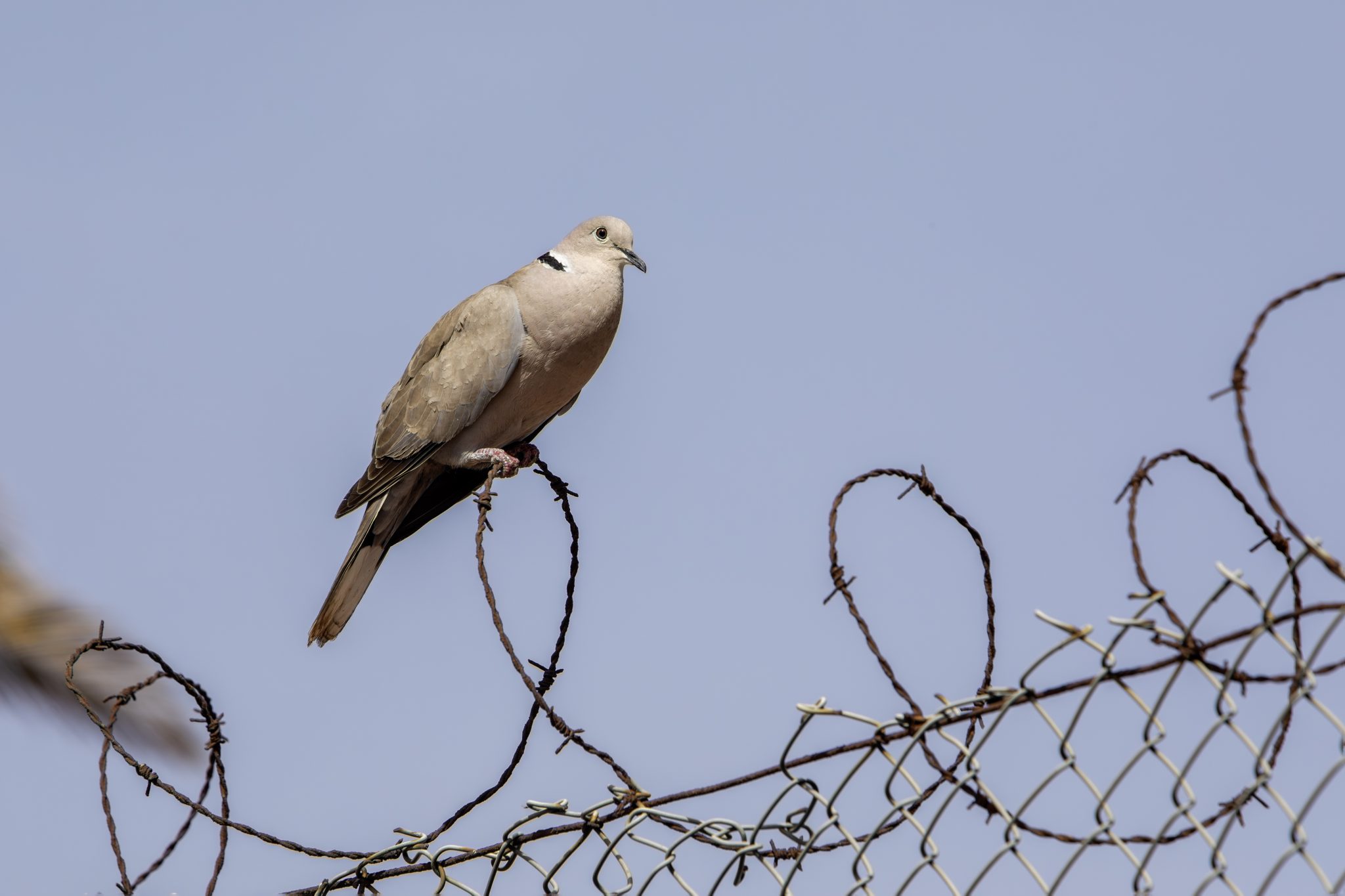
The European (or Eurasian) Collared-Dove (Streptopelia decaocto) is one of the great success stories of the avian world. In less than a century, it has transformed from a regional specialist in South Asia into one of the most common birds across Europe and North America—a feat achieved through an almost unparalleled ability to live alongside humans.
1. Physical Profile
The Collared-Dove is a study in subtle elegance. It lacks the gaudy colors of some pigeons but possesses a clean, “creamy” aesthetic.
- The Collar: Its defining feature is the narrow black half-collar on the nape of the neck, finely edged with white. Note that juveniles do not have this collar until they are a few months old.
- Plumage: A soft, uniform sandy-grey or beige-grey. In good light, you can see a delicate pinkish flush on the breast. The primary wing feathers are a darker, contrasting grey-brown.
- Eyes and Legs: They have striking deep-red irises and dark pink-to-red legs and feet.
- Dimensions: Roughly 32 cm in length with a 51 cm wingspan—significantly slimmer and more graceful than the chunky Woodpigeon.
2. Behavior: The “Triple-Coo”
The Collared-Dove is known for being remarkably tame around humans, often nesting in garden trees just feet from windows.
- Vocalization: Their song is a rhythmic, three-syllable coo: “koo-KOO-kook”, with the emphasis on the middle note. It is often mistaken for a cuckoo or a Woodpigeon (which has a five-note call).
- The “Flight Call”: When taking off or landing, they often emit a harsh, nasal, screeching sound—a sharp contrast to their gentle cooing.
- Reproductive Powerhouse: One secret to their success is their high breeding rate. A single pair can raise up to six broods in a year. They have a very long breeding season, sometimes nesting even in mid-winter if the weather is mild and food is available.
3. The Great Expansion: A 20th-Century Invader
The most fascinating aspect of the Collared-Dove is its rapid colonisation of the globe.
- Europe: Originally native to warm parts of Asia (India/Sri Lanka), they began a northwestward march in the early 1900s. They reached Turkey in 1930, Germany in 1945, and the UK in 1955. By 1970, they had reached the Arctic Circle.
- North America: Their arrival in the New World was accidental. In the mid-1970s, a few birds escaped a pet shop in the Bahamas. They reached Florida in 1982 and have since exploded across the continent, reaching Alaska and Canada in roughly 30 years.
4. Habitat & Diet
- The “Human Shadow”: They are strictly synanthropic, meaning they prefer to live near people. You will rarely find them in deep forests or remote moorlands; they prefer gardens, farmyards, and urban parks.
- Diet: Primarily ground-feeders. They eat seeds, grain, and occasionally berries or insects. They are frequent visitors to bird feeders, where they can be quite territorial, chasing off smaller birds with a flurry of wings.
Quick Identification: Collared-Dove vs. Woodpigeon
| Feature | Collared-Dove | Woodpigeon |
| Size | Small & Slender | Large & Heavy |
| Neck Marking | Single black “ring” | Large white “smudge” |
| In Flight | Long, square tail | White bars on the wings |
| Song | 3 syllables (koo-KOO-kook) | 5 syllables (coo-COO-coo-coo-coo) |
5. Conservation Status
- Global Status: Least Concern.
- Current Trends: While they remain incredibly common, populations in some regions (like the UK) have seen a slight downturn since 2005. This is partly due to Trichomonosis, a parasite that also affects finches, though the doves remain resilient due to their high reproductive rate.
Pro-Tip for Birders: If you see a Collared-Dove that looks exceptionally pale or almost white, it may be an escapee “Barbary Dove” (Streptopelia risoria), a domesticated form of the African Collared-Dove often used by magicians or kept as pets.
Views: 202
Subscribe to the newsletter: