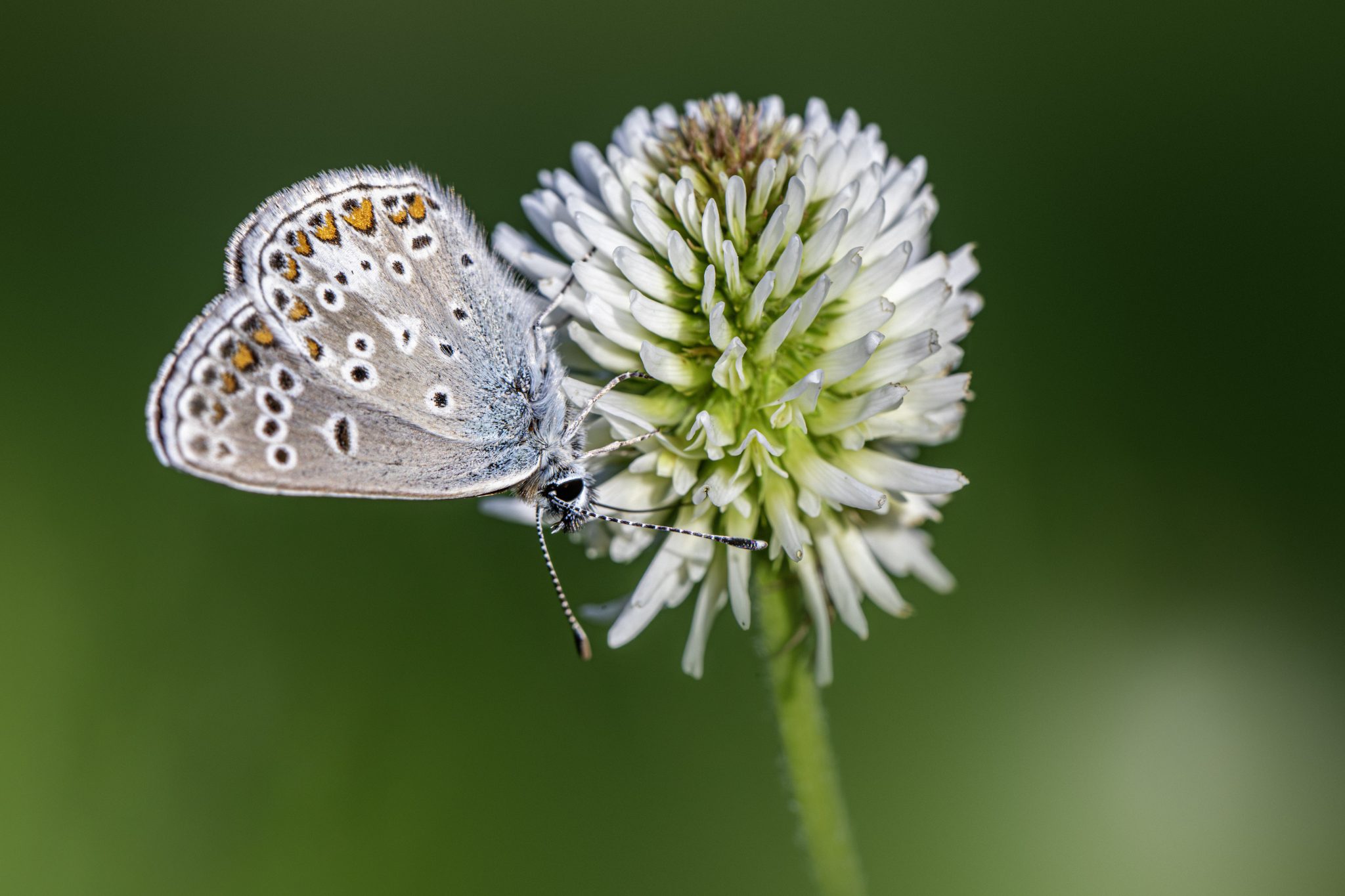
The Northern brown argus (Aricia artaxerxes) is a captivating “glacial relict”—a species that became stranded in northern and mountainous regions of Europe as the ice sheets retreated 12,000 years ago. It is a specialist of the highest order, tethered to a single plant and specific microclimates, making it a critical indicator of habitat health.
1. Physical Profile: The “Scotch White-spot”
This butterfly is a small, velvety-brown member of the “Blues” family (Lycaenidae), despite being almost entirely chocolate-brown.
- Sexual Dimorphism:
- Males: Dark chocolate upperside with a few small orange “lunules” (crescents) on the hindwing.
- Females: Usually more orange lunules that extend onto the forewings, giving them a “brighter” border.
- The “Artaxerxes” Marker:
- Scotland (A. a. artaxerxes): Most individuals possess a brilliant white spot in the center of the forewing upperside. On the underside, the white spots are often missing their black “pupils” (centers).
- Northern England (A. a. salmacis): Known as the “Durham Argus,” this subspecies lacks the white spot (it is black) and looks much more like its southern cousin, the Brown argus.
- Size: Small and delicate, with a wingspan of 25–31 mm.
2. Taxonomy & The “Northern Shift”
For centuries, it was considered a subspecies of the Brown argus (Aricia agestis). Modern genetics and behavioral studies have confirmed they are separate species, though they share a complex relationship:
- Separation by Strategy: The Brown argus is bivoltine (two generations per year), while the Northern brown argus is strictly univoltine (one generation, peaking in June/July).
- Climate Conflict: As the climate warms, the southern Brown argus is moving north. In northern England, the two species are now meeting and hybridizing, creating “muddy” populations that challenge even the most experienced lepidopterists.
3. Lifecycle: The Rock-rose Specialist
The Northern brown argus is a “monophagous” specialist—its caterpillars eat only Common Rock-rose (Helianthemum nummularium).
- The Egg: Females are incredibly picky. They lay a single white egg on the upperside of a Rock-rose leaf, usually choosing plants in sheltered, south-facing spots with high nitrogen levels.
- The Caterpillar: The larvae are pale green with a pinkish stripe, perfectly camouflaged. They feed on the underside of the leaf, leaving the top cuticle intact (creating “window” damage).
- Ant Association: Like many Blues, the larvae possess “honey glands” that secrete a sugary fluid to attract ants. In return for this snack, the ants protect the caterpillar from predators like wasps and spiders.
- Hibernation: They spend the winter as small larvae at the base of the food plant, re-emerging in the spring to finish feeding before pupating in May.
4. Habitat & Distribution
They are sedentary butterflies; a colony may live on a single hillside for decades and never travel more than a few hundred meters.
- Preferred Biotopes: Limestone pavements, coastal sand dunes, and steep, south-facing volcanic slopes. They require “base-rich” soils where Rock-rose thrives.
- Range:
- UK: Scotland (especially the Borders and Highlands) and Northern England (Cumbria, Durham, Yorkshire).
- Europe: Found in Scandinavia and as a “montane” species in the Alps, Pyrenees, and Balkans.
5. Conservation Status: 2024–2026 Outlook
As of the latest reports (including the 2025 Scottish Surveys), the Northern brown argus is in a precarious position.
| Status | Threat Level | Primary Drivers |
| UK Status | Vulnerable | A 39% decline in distribution since 2010. |
| Europe | Stable/Near Threatened | Vulnerable in lowland sites but stable in high mountains. |
| Main Threats | Habitat Loss | Overgrazing (removes the flowers) or Undergrazing (scrub smothers the Rock-rose). |
Critical Trend: In 2024, conservationists noted that “inappropriate woodland creation” (planting trees on open grasslands) has become a top threat. While planting trees is generally good for the planet, doing so on rare Rock-rose meadows can wipe out a 10,000-year-old butterfly colony in a single season.
Quick Identification: Northern vs. Southern
| Feature | Northern Brown Argus | Brown Argus (Southern) |
| Broods | One (June–July) | Two (May & August) |
| Forewing Spot | White (in Scotland) | Black |
| Underside | Uniform grey/white | Brownish/Warmer |
| Shape | Slightly “pointier” wings | More rounded wings |
Views: 185
Subscribe to the newsletter: