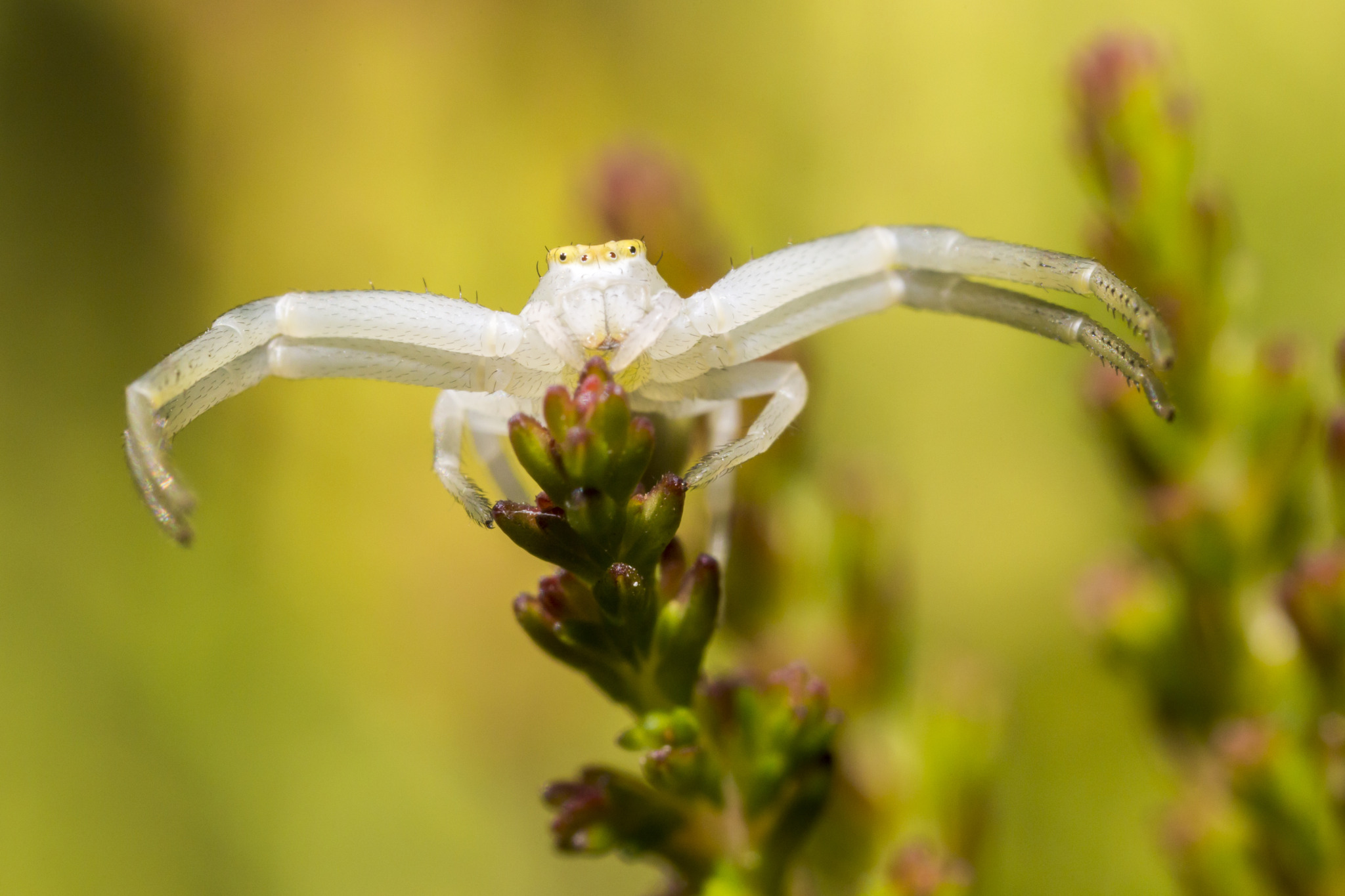

The Invisible Ambush: The Goldenrod Crab Spider (Misumena vatia)
The Chameleon of the Meadow
Unlike most spiders that rely on speed or webs, the female Goldenrod Crab Spider uses reversible color change. This is not a fast process like a chameleon’s; it is a metabolic feat that takes time.
- From White to Yellow: The spider produces liquid yellow pigments (ommochromes) and moves them into its outer skin layer. This shift usually takes between 10 to 25 days.
- From Yellow to White: This is generally faster (often 5 to 10 days), as the spider simply excretes or reabsorbs the yellow pigment, allowing the white guanine crystals beneath to show through.
A Master of Patience
These spiders don’t waste energy building webs. Instead, they position themselves in the heart of a flower, holding their long front legs out in a wide “V”—a posture known as laterigrade, which gives them their “crab” name.
When a pollinator—often a bee or butterfly much larger than the spider—lands for a drink of nectar, the spider strikes with lightning speed. It injects a potent venom that goes to work instantly, allowing this 10mm predator to take down massive prey.
Did You Know? Recent research suggests that while they look camouflaged to humans, they might actually stand out in the Ultraviolet (UV) spectrum. To a bee, the spider might look like a “bullseye” or a nectar guide, actually luring the prey closer rather than hiding from it.
📸 Photographer’s Perspective: Macro on the Bloom
The Goldenrod Crab Spider is a dream subject for macro enthusiasts because it is relatively static, but capturing a “professional” shot requires attention to detail.
- The “Hero” Angle: Instead of shooting from above, get level with the flower’s surface. A head-on shot of the spider with its “arms” wide open creates a much more dramatic, predatory feel.
- Diffuse Your Light: If you are shooting in bright sunlight (where these spiders love to be), the white or yellow bodies can easily “blow out,” losing all texture. Use a small diffuser or a piece of white silk to soften the light.
- Focus on the Eyes: These spiders have eight small eyes arranged in two rows. Even at high magnification, ensure the front-most eyes are tack-sharp.
- Action Shots: If you find one with prey, don’t move! They are surprisingly sensitive to vibrations. Use a tripod and a remote shutter if possible to capture the fine details of the struggle without introducing camera shake.
Quick Facts Table
| Feature | Detail |
| Family | Thomisidae (Crab Spiders) |
| Body Length | Females: 8–10 mm |
| Diet | Bees, flies, butterflies, and moths |
| Hunting Style | Sit-and-wait ambush (No web) |
| Distribution | Holarctic (North America, Europe, Asia) |
| Special Ability | Active camouflage (Reversible color change) |
Views: 1325
Subscribe to the newsletter: