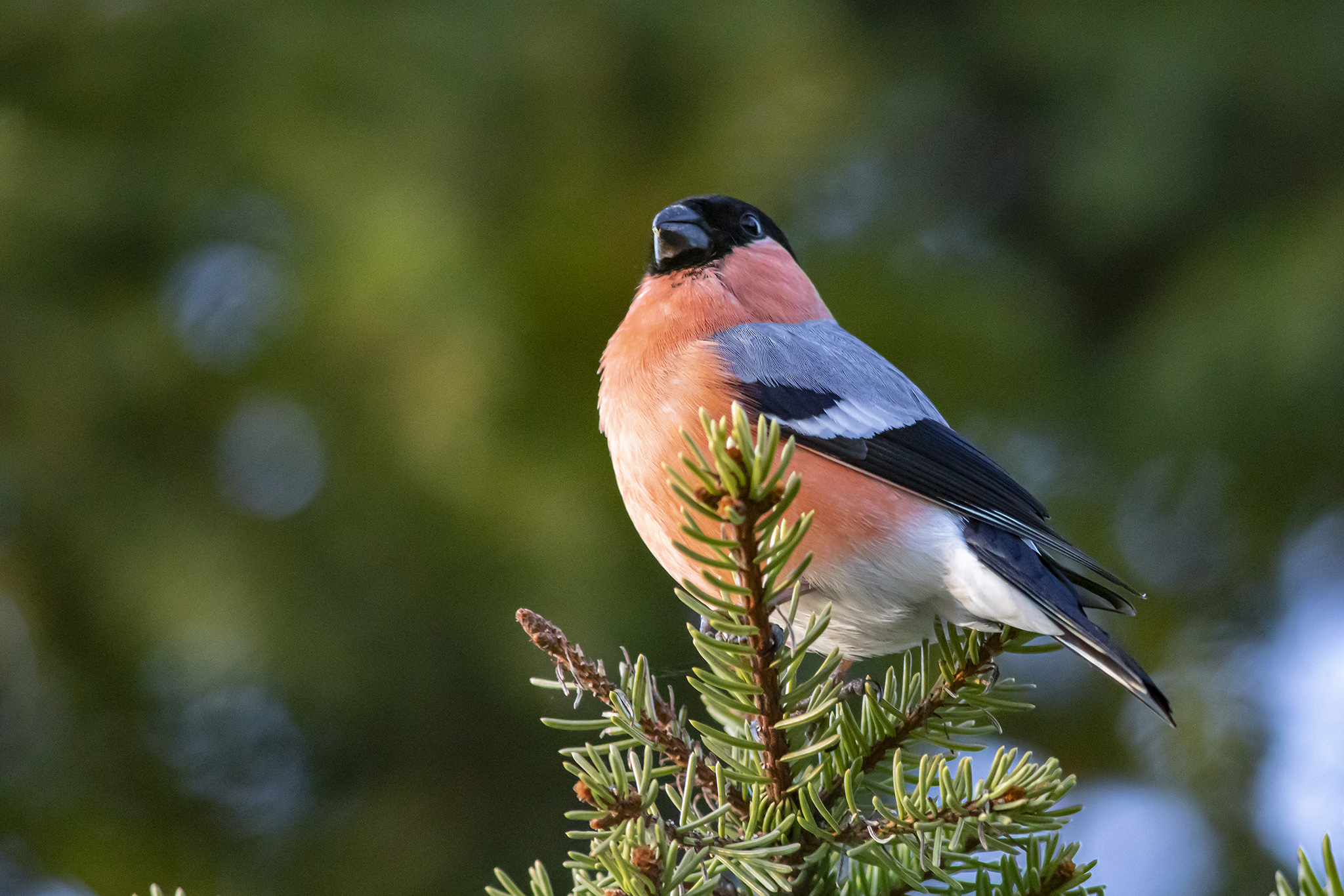

The Crimson Spectacle: Meeting the Eurasian Bullfinch (Pyrrhula pyrrhula)
If there is one bird that can turn a drab winter garden into a scene from a Christmas card, it is the Eurasian Bullfinch (Pyrrhula pyrrhula). With its bulky silhouette and the male’s neon-pink breast, this bird is a masterpiece of avian design—though its shy nature means you often have to look twice to find it.
A Study in Contrast: Rose vs. Buff
The Bullfinch is famous for its extreme sexual dimorphism. Both sexes share a distinctive jet-black “cap” that extends around the bill and eyes, making them look like they are wearing a tiny executioner’s mask.
- The Male: A showstopper. His underparts are a deep, saturated rose-red that seems to glow even on the grayest days.
- The Female: Far more subtle, she wears an elegant palette of buff-pink and soft grays. Her camouflage is perfect for disappearing into the shadows of a thick hedgerow.
- The White Rump: Both birds share a brilliant white rump patch. It is often hidden while they are perched, but when they take flight, it acts like a “follow-me” signal for other members of the flock.
The “Bud-Eating” Outlaw
The Bullfinch’s strong, stubby beak isn’t just for seeds. It is a specialized tool for bud-stripping. In the spring, they have a particular fondness for the developing buds of fruit trees—especially pear and plum. Historically, this made them a nemesis of orchard owners, leading to their reputation as “pests.” However, today they are more commonly celebrated as a sign of a healthy, diverse woodland.
The Secretive Piper
Unlike the boisterous song of a Chaffinch, the Bullfinch is a quiet soul. Its call is a melancholic, flute-like “peu-peu” whistle. It is one of the most distinctive sounds in the forest, yet it is so soft that you can be standing just a few meters away from a pair and not even realize they are there until they move.
📸 Photographer’s Perspective: Capturing the Glow
Photographing Bullfinches requires a mix of stealth and technical precision. They are notoriously “skittish” and will vanish at the first sign of a lens barrel moving.
- Winter is Your Friend: In the summer, they retreat into deep, dark foliage to nest. Winter is the best time for photography, as they often move to garden feeders or feed on colorful berries (like Guelder Rose or Rowan).
- Mind the Exposure: The male’s red breast is a “red channel” killer for digital sensors. In bright light, the red can easily overexpose and lose its fine feather detail. Use a slight negative exposure compensation (-0.3 to -0.7) to keep the reds rich and textured.
- The Over-the-Shoulder Shot: Because of their white rump and black cap, a “back-view” or “three-quarters” portrait can be even more effective than a profile shot. It showcases the contrast between the gray back, the black wings, and the white rump.
- Quiet Shutter: If you are close, use your camera’s silent/electronic shutter mode. The sound of a mechanical shutter can be enough to send a Bullfinch flying before the second frame.
Quick Facts Table
| Feature | Detail |
| Scientific Name | Pyrrhula pyrrhula |
| Weight | 21–27 grams |
| Favorite Winter Food | Ash keys, berries, and sunflower seeds |
| Key ID | Black cap and thick “bull-like” neck |
| Nesting | Neat cup-shaped nests in dense shrubs |
| Conservation | Stable, though secretive |
Views: 182
Subscribe to the newsletter: