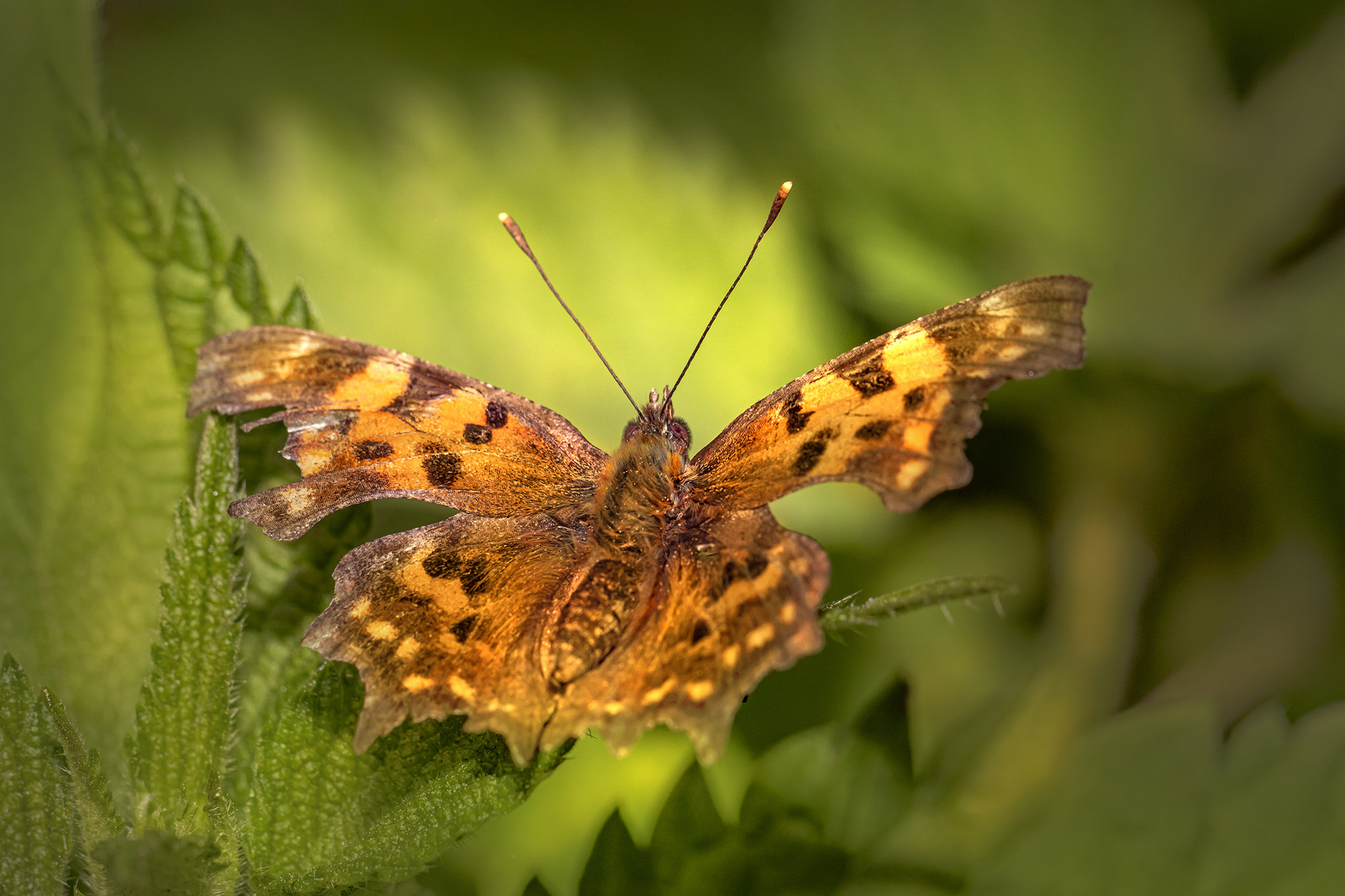

The Comma butterfly (Polygonia c-album) is a favorite for macro photographers, not just for its fiery orange wings, but for its incredible ability to “disappear” in plain sight.
Here is a deep dive into the unique biology and photography potential of this jagged-winged wonder, based on the stunning captures seen at karits.eu.
1. The “Withered Leaf” Masterclass
The Comma’s most famous feature is its jagged, scalloped wing edges. Unlike most butterflies with smooth, rounded wings, the Comma’s silhouette is irregular and “broken.”
- The Disappearing Act: When it closes its wings, the mottled brown and grey underside mimics a dead, dried-out leaf perfectly. The irregular edges break up its outline, making it nearly invisible to predators (and photographers!) against bark or leaf litter.
- The “C” Signature: On the underside of each hindwing is a tiny, bright white “comma” or “C” shape. This is the source of both its common name and its scientific name, c-album (Latin for “white C”).
2. Seasonal Shape-Shifting
The Comma exhibits a fascinating biological trait called seasonal polyphenism. Depending on the amount of daylight they receive as caterpillars, they emerge as one of two distinct forms:
- Form hutchinsoni: The “summer” form. They have a lighter, brighter orange upperside and are more active, breeding immediately to produce a second generation.
- The Typical Form: The “hibernator.” These are darker and more heavily camouflaged. They emerge in late summer and spend the winter hibernating as adults, often tucked away in hollow trees or wood piles.
3. A Conservation Success Story
In the early 20th century, the Comma was on the brink of extinction in many parts of Northern Europe, restricted to small pockets of habitat. However, it has staged a spectacular comeback. By switching its primary host plant from hops to the ubiquitous stinging nettle, it has expanded its range hundreds of miles northward—a rare “climate change winner” in the insect world.
📸 Photographer’s Perspective: How to Shoot the Comma
Capturing a Comma requires a mix of patience and technical precision.
- Exploit Their Territory: Male Commas are notoriously territorial. They often choose a “throne”—a specific sunlit leaf—and return to it repeatedly after chasing off intruders. If you find a Comma that flies away, don’t move. Wait 2–3 minutes, and there is a high chance it will land exactly where it was, allowing you to pre-focus your lens.
- The Profile Shot: To highlight the “comma” mark, you need a side-on profile shot with the wings closed. Use a small aperture (around $f/8$ to $f/11$) to ensure the entire jagged edge and the white mark are sharp.
- Backlighting for Color: The orange-brown upperside looks best in the “Golden Hour.” Backlighting the wings can make the orange glow like stained glass, emphasizing the dark spots and the unique wing shape.
- Caterpillar Hunting: Look for their larvae on nettles. They are easy to spot because they mimic bird droppings—white and brown with spiny hairs. This “unappetizing” look is a brilliant defense mechanism.
Quick Facts Table
| Feature | Detail |
| Scientific Name | Polygonia c-album |
| Family | Nymphalidae (Brush-footed butterflies) |
| Wingspan | 45–60 mm |
| Larval Food | Stinging Nettle (Urtica dioica), Hops, Elm, Willow |
| Overwintering | Hibernates as an adult butterfly |
| Signature Mark | Small white “C” on the hindwing underside |
Explore more high-resolution Comma butterfly imagery and download CC0 stock photos at karits.eu.
Views: 178
Subscribe to the newsletter: