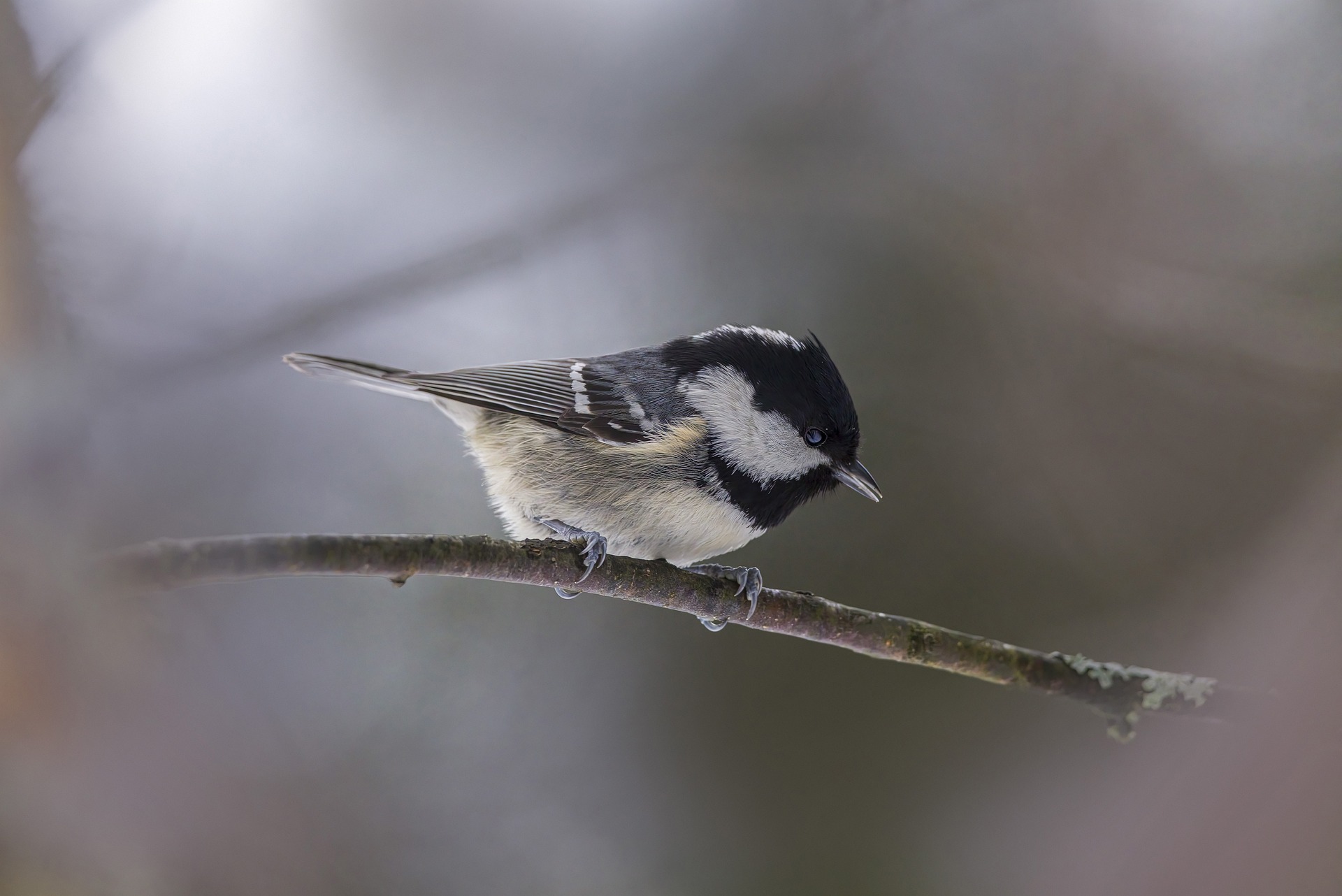
The Coal tit (Periparus ater) is the smallest of our native tits and a master of high-speed survival. While its larger cousins, the Great tit and Blue tit, often dominate garden feeders with their bright colors and bold personalities, the Coal tit relies on agility, secrecy, and a remarkable memory to thrive.
Based on the detailed wildlife photography and observations from karits.eu, here is an exploration of this energetic little bird.
1. The Conifer Specialist
Unlike other tits that prefer broadleaf woodlands, the Coal tit has a deep evolutionary bond with coniferous forests (pines, firs, and spruces).
- The Perfect Tool: Its bill is noticeably thinner and more needle-like than that of a Blue tit. This allows it to reach deep between tight pine needles or into the crevices of cones to extract small seeds and spiders that other birds simply cannot reach.
- Agility: Because it is so lightweight, it can feed on the very tips of the thinnest, most flexible branches, hanging upside down with acrobatic ease.
2. The Master of the Cache
If you watch a Coal tit at a feeder, you will notice it rarely stays to eat. Instead, it performs what birders call “commando raids.” * Scatter Hoarding: It will grab a sunflower seed and immediately fly into a nearby tree to hide it. This is called caching.
- Memory Games: A single Coal tit can hide thousands of seeds in a single season, tucked into moss, behind bark, or even in holes in the ground. Their spatial memory is extraordinary, allowing them to relocate these tiny “emergency pantries” months later during the harshest winter freezes.
- Survival Strategy: By hiding food, they avoid being bullied away from the feeder by larger, more aggressive birds.
3. Identification: The “White Nape” Secret
From a distance, the Coal tit can be confused with the Marsh tit or Willow tit because of its black cap and white cheeks. However, there is one foolproof way to identify it:
- The White Patch: The Coal tit has a very distinct, vertical white stripe or patch on the back of its neck (the nape). Neither the Marsh nor the Willow tit has this “headlight” feature.
- Wing Bars: It also sports two rows of white dots on its wings (wing bars), which are absent in its look-alikes.
📸 Photographer’s Perspective: Catching the Speedster
Capturing a Coal tit is a true test of your camera’s autofocus speed and your own patience.
- High Shutter Speed is Mandatory: These birds are almost never still. To freeze their frantic movement, you will need a shutter speed of at least 1/1600s or higher, especially if you want to catch them in flight between the feeder and their cache.
- Winter is Best: In winter, Coal tits join “roving flocks” with other tits and treecreepers. They become much less shy and more focused on food, allowing you to get closer.
- Pre-focus on the “Landing Zone”: Since they are creatures of habit, they often use the same branch as a “staging area” before flying to a feeder. Instead of chasing them with your lens, pre-focus on that branch and wait for the bird to come to you.
- Low-Angle Nesting: Interestingly, Coal tits often nest very low down—sometimes even in old mouse holes in the ground or tree roots. If you find a nest site, a tripod and a remote shutter release are your best friends to avoid disturbing them.
Quick Facts Table
| Feature | Detail |
| Scientific Name | Periparus ater |
| Weight | 8–10 grams (lighter than a AAA battery!) |
| Habitat | Primarily Coniferous forest, also gardens |
| Diet | Conifer seeds, insects, spiders, and sunflower seeds |
| Conservation | Protected (Estonian Category III; IUCN Least Concern) |
| Nesting | Holes in trees, stumps, or ground-level crevices |
See more intimate portraits of the Coal tit and other woodland birds at karits.eu.
Views: 164
Subscribe to the newsletter: