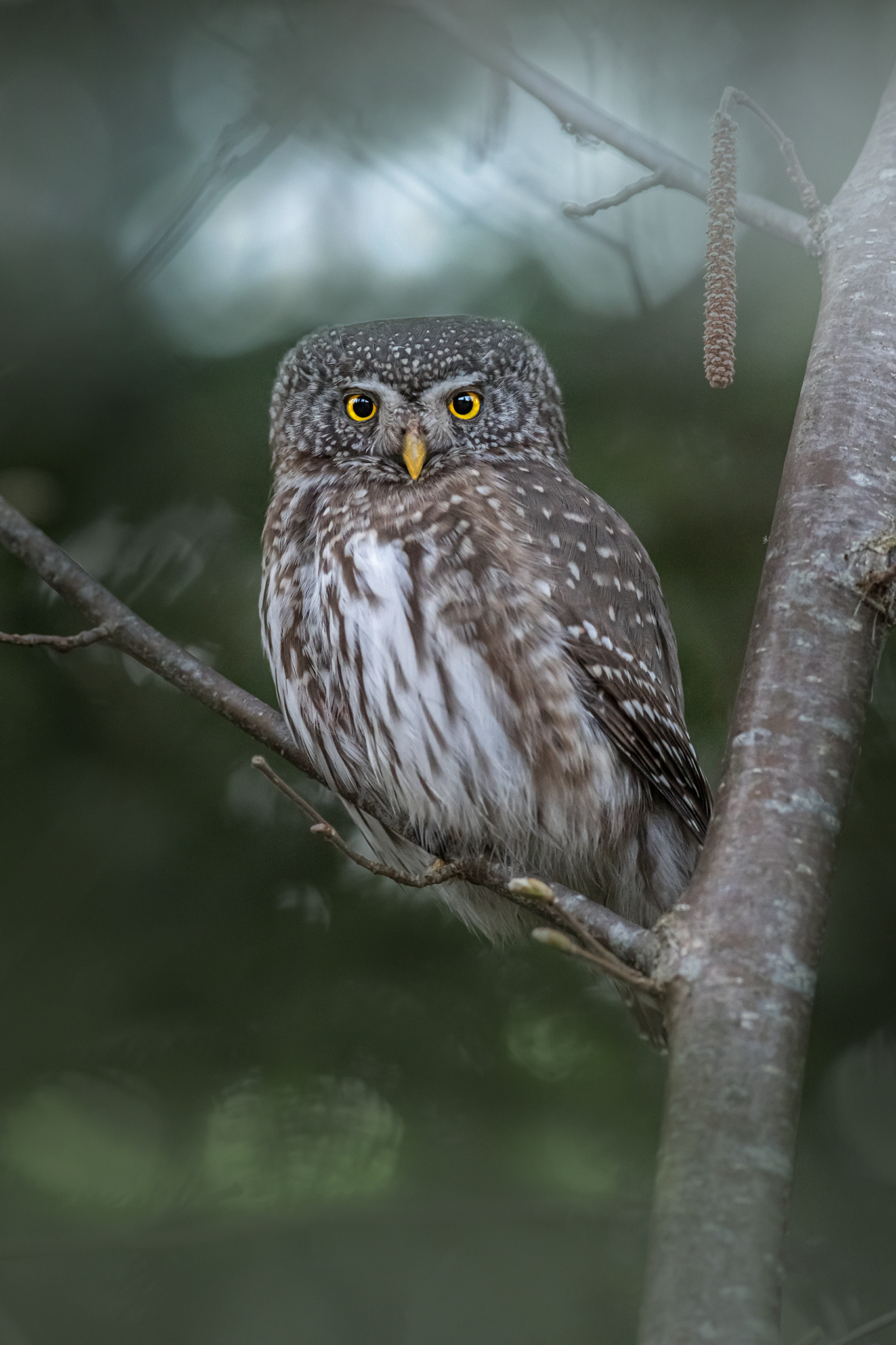

The Eurasian Pygmy Owl (Glaucidium passerinum)—known in Estonia as the Värbkakk—is a living contradiction. It is the smallest owl in Europe, barely the size of a starling, yet it possesses the heart and hunting prowess of a raptor twice its size. In the dense coniferous forests featured in karits.eu, it is the undisputed “pocket-rocket” of the canopy.
1. The “False Face” on the Back
One of the most fascinating evolutionary tricks of the Pygmy owl is the occipital face.
- The Illusion: On the back of its head, it has two dark patches of feathers outlined in white that look exactly like a pair of large, staring eyes.
- The Purpose: This “second face” is designed to fool predators (like hawks) and “mobbing” songbirds into thinking the owl is watching them, even when its back is turned. It prevents sneak attacks and keeps the owl safe while it’s focused on its own prey.
2. A Diurnal Terror
Unlike the classic “owl” stereotype, the Pygmy owl is not strictly nocturnal.
- Sunlight Hunter: It is most active during dawn and dusk (crepuscular) but frequently hunts during broad daylight.
- The Prey Larder: During the autumn and winter, these owls become hoarders. They kill more than they can eat and store the extra “snacks”—small birds and voles—inside old woodpecker holes or nest boxes. In the freezing Estonian winter, they use their body heat to “defrost” this frozen food before eating it.
3. Small Bird, Big Attitude
Despite weighing only about 60–80 grams (about the same as two large eggs), the Värbkakk is a ferocious predator. It is capable of taking down birds nearly its own size, such as thrushes or great spotted woodpeckers. Its flight is silent and undulating, more similar to a finch than the typical flat-winged glide of a larger owl.
📸 Photographer’s Perspective: Finding the Miniature Ghost
Capturing the Pygmy owl is widely considered one of the hardest “ticks” for a wildlife photographer due to its size and camouflage.
- Listen for the “Mob”: You will often find the owl by listening to other birds. If you hear a frantic group of tits, finches, and nuthatches screaming in a particular tree, there is a high chance a Pygmy owl is sitting in the middle of them, looking bored.
- The Eye of the Needle: Because they are so small, they love to sit on the very tips of spruce trees or hide deep in the “shadow zones” near the trunk. You’ll need a long lens (600mm+) and a high shutter speed to catch them, as their movements are lightning-fast.
- Low Light Performance: Since they are active at twilight, you will often be shooting at high ISOs. Focus on the bright yellow iris; that piercing gaze is the “soul” of any Pygmy owl portrait.
- Mimicry: Many photographers use “pishing” or whistle calls to attract them. However, be ethical—only use these sparingly, as distracting an owl during its short hunting window can cost it a meal it needs for survival.
Quick Facts Table
| Feature | Detail |
| Scientific Name | Glaucidium passerinum |
| Estonian Name | Värbkakk |
| Size | 15–19 cm (Smaller than a thrush) |
| Weight | 60–80 grams |
| Habitat | Old-growth coniferous and mixed forests |
| Voice | A monotonous, high-pitched “tueet… tueet… tueet” |
See more intimate, high-resolution portraits of the Värbkakk and download CC0-licensed images at karits.eu.
Views: 165
Subscribe to the newsletter: