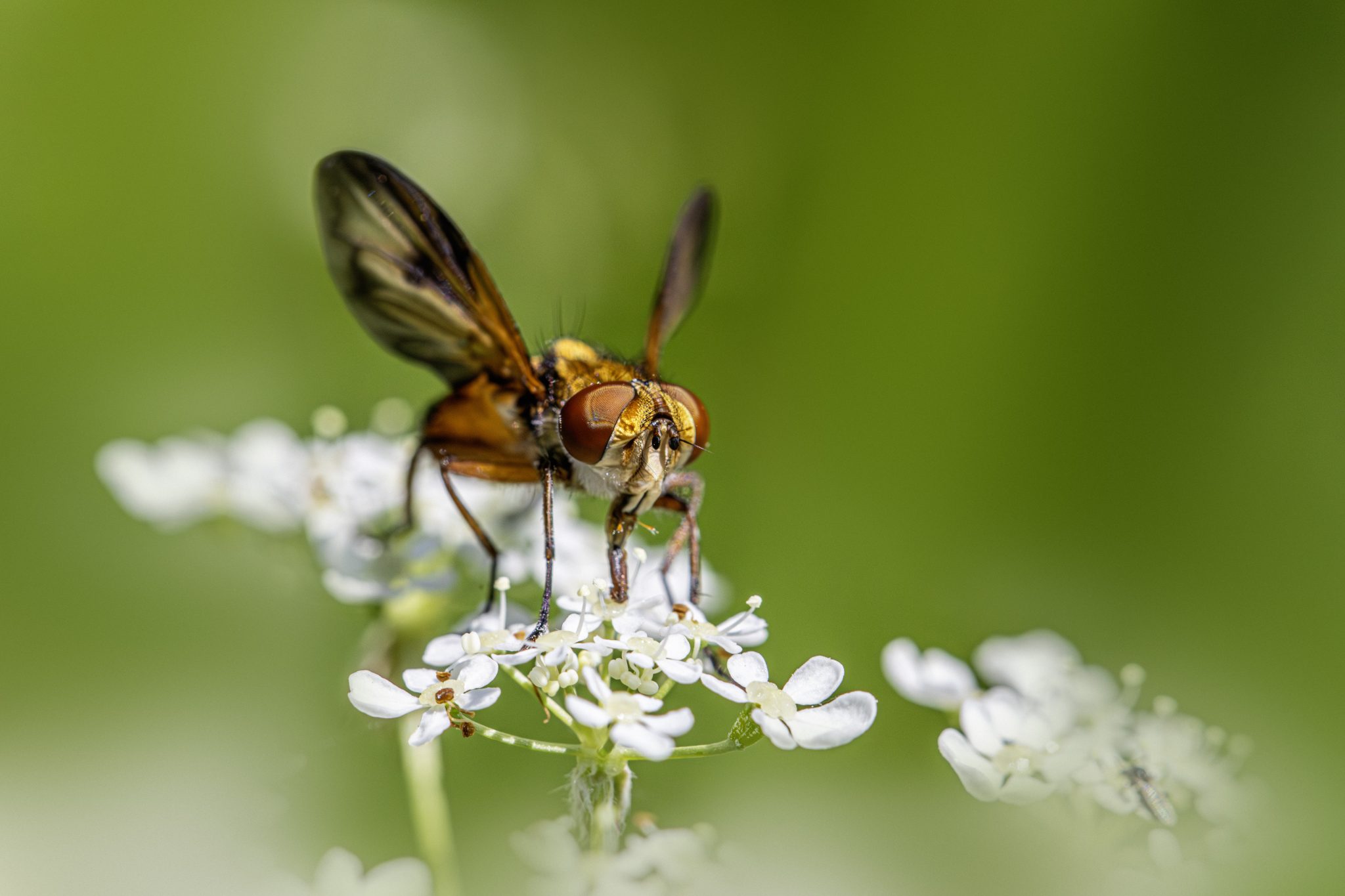
If you’ve ever looked at a fly through a macro lens and thought it looked like it was covered in stiff, black needles, you’ve likely found a Tachinid fly (Family: Tachinidae). In Estonia, they are known as Süsikärblased—a name that hints at their dark, often bristly appearance.
While they may look like common houseflies on a bad hair day, they are actually one of the most important “biological weapons” in the natural world.
1. The “Needle-Clad” Look
Tachinids are defined by their bristles (macrosetae). Unlike the soft hairs on a bee, these are thick, stiff, and usually located prominently on the tip of the abdomen.
- The “Spiky” Butt: These bristles are a key identification feature. If the fly looks like it could double as a pincushion, it’s almost certainly a Tachinid.
- The Postscutellum: For the serious entomologist, the definitive trait is a prominent “bulge” (the postscutellum) located beneath the scutellum (the little plate on the back between the wings).
- The Face: Many species have very large, “inflated” looking faces and aristate antennae.
2. The Ultimate Parasitoids
All Tachinid flies are parasitoids, meaning their larvae develop inside another insect, eventually killing it. They are the “Xenomorphs” of the garden.
- The Target: Their favorite victims are the caterpillars of butterflies and moths, but they also target beetles, grasshoppers, and even stink bugs.
- Diverse Tactics:
- The “Egg-on-Skin”: Some lay a sticky white egg directly on the host’s head or back. When it hatches, the larva bores inside.
- The “Stealth Mine”: Some lay tiny eggs on leaves. When a caterpillar eats the leaf, it accidentally ingests its own demise.
- The “Stinger”: Some species have a sharp ovipositor to inject larvae directly into the host.
3. Nature’s Pest Control
Farmers and gardeners love Tachinid flies. Because they specialize in killing crop-eating caterpillars and beetles, they are considered one of the most effective forms of natural pest control. Without them, our meadows and forests would likely be stripped bare by unchecked larval populations.
📸 Photographer’s Perspective: Managing the “Spike”
Tachinids are fantastic macro subjects because they are often quite large and exhibit interesting textures.
- Detailing the Bristles: To capture the individual bristles without them turning into a blurry mess, you need a deep depth of field. Try shooting at $f/8$ or $f/11$. If the fly is still, focus stacking is the best way to keep the bristles sharp from head to tail.
- Wait for the Nectar: While their larvae are “meat-eaters,” the adults are peaceful nectar-sippers. Look for them on flat-topped flowers like Yarrow or Hogweed (Apiaceae family). They often become very still while feeding, allowing you to set up a tripod.
- Look for the “Identity Crisis”: Some Tachinids (like the Gymnosoma genus) have evolved to look exactly like Ladybugs or Stink bugs to avoid being eaten by birds. Capturing these mimics is a highlight for any wildlife gallery.
- The “White Dot” Shot: If you find a caterpillar (like a Peacock butterfly larva) with a tiny white dot on its “neck,” you’ve captured the beginning of the Tachinid lifecycle.
Quick Identification Table
| Feature | Tachinid Fly (Tachinidae) | House Fly (Musca domestica) |
| Bristles | Very thick, stiff, and prominent | Short, soft, and sparse |
| Abdomen | Often broad and spiny | Smooth and tapered |
| Diet (Adult) | Nectar and Pollen | Decaying matter and sugar |
| Larval Goal | Eating a living host from the inside | Eating decaying organic matter |
Explore more “bristly” beauties and the latest 2026 macro entries from the Estonian forests at karits.eu.
Views: 303
Subscribe to the newsletter: